Filmmaking Essentials: From Script to Screen
Camera Beyond Basics
Sculpting Light and Time
You already know the exposure triangle: aperture, shutter speed, and ISO. Now, let's move beyond just getting a correct exposure and start making artistic choices. One of the most cinematic ways to think about exposure is by using shutter angle instead of shutter speed.
Imagine a spinning, half-circle disc in front of your camera's sensor. When the open part of the disc is over the sensor, light gets in. When the solid part is over it, light is blocked. The size of that opening, measured in degrees, is the A standard 180-degree shutter angle means the shutter is open for half of the time for each frame. At 24 frames per second (fps), a 180-degree shutter angle is equivalent to a 1/48 shutter speed. This creates a natural-looking motion blur that audiences are used to seeing in films.
Changing the shutter angle creates different effects. A smaller angle, like 90 degrees (1/96s at 24fps), produces a sharper, more staccato motion, often used in action sequences. A larger angle, like 360 degrees, creates a dreamy, blurry look. While shutter speed and shutter angle describe the same physical process, thinking in angles helps maintain a consistent aesthetic for motion blur across different frame rates.
ISO also becomes a creative tool. Instead of just cranking it up in low light, consider its effect on texture. While modern cameras handle high ISOs well, pushing the sensitivity can introduce digital noise, or grain. Sometimes, this is undesirable. But in other cases, a little bit of fine-grained noise can add a gritty, organic texture to a sterile digital image, mimicking the look of film stock.
The Rhythm of the Cut
The frame rate is the heartbeat of your film. It dictates the rhythm and feel of the motion on screen. While you can shoot at any rate your camera allows, a few standards have powerful aesthetic implications.
-
24fps: The undisputed king of cinema. This rate creates the slightly dreamy motion blur we associate with movies. It feels less real than what our eyes see, which helps create a sense of escapism.
-
30fps: The standard for live television, news, and sports. It captures smoother motion than 24fps, which gives it a more immediate, “live” feeling. This is why soap operas, for example, look distinctly different from blockbuster films.
-
60fps and higher: These high frame rates (HFR) are your gateway to slow motion. When you shoot at 60fps but play it back at 24fps, the action unfolds at 40% speed. This can emphasize a dramatic moment, reveal a subtle detail, or simply create a feeling of beauty and grace.
Time-lapse is the opposite of slow motion. By capturing one frame every few seconds or minutes, you can compress a long process, like a sunset or a building construction, into a short, dynamic clip. The key is to decide on the interval between shots based on how much you want to speed up the action.
Codecs and Containers
Every video you shoot is compressed into a specific format, or codec. A codec is a protocol for compressing and decompressing data. Think of it like packing a suitcase. You can either just throw everything in (low compression) or carefully fold and roll every item to save space (high compression). The choice of codec is a critical trade-off between file size, image quality, and flexibility in post-production.
| Codec | Best For | Key Trade-off |
|---|---|---|
| H.264/H.265 | Delivery, web streaming | Small file size, but less flexible for color grading. |
| ProRes | Editing and post-production | Large files, but retains high image quality through edits. |
| RAW | High-end production, VFX | Maximum quality and flexibility, but massive file sizes. |
For most projects, a good workflow is to shoot in a high-quality codec like ProRes or a camera's internal equivalent. This gives your colorist the most data to work with. After the edit and color grade are complete, you can export the final film in a more compressed codec like H.264 for easy distribution online.
Moving with Purpose
Static shots have their place, but camera movement is what gives a film its energy and perspective. The key is to make sure every move is motivated by the story.
A dolly or slider creates smooth, controlled linear movements. A slow push-in can build tension or focus attention on a detail. A slide from side-to-side can reveal new information or follow a character.
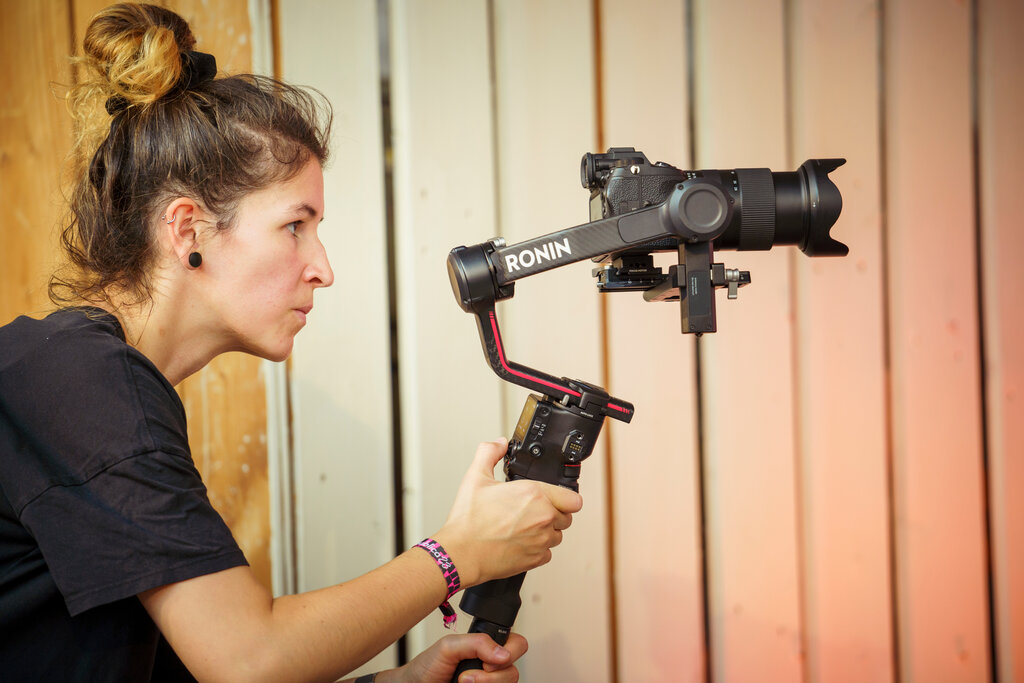
A gimbal or Steadicam allows for complex, stabilized movements that feel like you're floating through the scene. These tools are perfect for long tracking shots that follow characters through a space.
Cranes and jibs move the camera vertically. A crane shot can establish a location by starting on a detail and pulling up to a wide view, or create a sense of grandeur and scale.
Finally, don't underestimate handheld movement. While it can look amateurish if done poorly, an intentionally shaky, handheld shot can create a sense of immediacy, realism, and frantic energy. It puts the audience directly into the character's point-of-view.
Good camera movement is invisible. It serves the story without drawing attention to itself.
Creating Depth
A shallow depth of field, where your subject is in sharp focus and the background is a soft blur, is a hallmark of the cinematic look. It isolates your subject and directs the viewer's eye. You know that a wide aperture (a low f-stop number) is the main ingredient, but two other factors play a huge role: focal length and
Longer focal lengths (telephoto lenses) compress the space between your subject and the background, which enhances the background blur. A shot at 100mm with an aperture of f/2.8 will have a much shallower depth of field than a shot at 35mm with the same aperture, even if the subject is framed identically.
Combining these three elements, a large sensor, a long focal length, and a wide aperture, is the recipe for creating a beautifully cinematic separation between your subject and their world.
If you are shooting at 24fps and want to achieve the standard cinematic motion blur using a 180-degree shutter angle, what is the equivalent shutter speed?
You want to create a beautifully cinematic shallow depth of field, making your subject pop from a blurry background. Which of these factors does NOT directly contribute to achieving that look?
By mastering these intermediate techniques, you move from simply capturing an image to actively shaping it. You are no longer just an operator, but a cinematographer.