Feynman's Atoms in Motion
Introduction to Atoms
The World in a Grain of Sand
Physicist Richard Feynman once posed a question: If a catastrophe destroyed all scientific knowledge, what single sentence could we pass on to future generations? His answer was the atomic hypothesis. The idea that all things are made of atoms—little particles that move around in perpetual motion, attracting each other when they are a little distance apart, but repelling upon being squeezed into one another. This one idea contains the essence of our physical world.
But this powerful concept wasn't born overnight. It began over two thousand years ago in ancient Greece with a philosopher named Democritus. He wondered what would happen if you kept cutting a piece of matter in half. Eventually, he reasoned, you'd reach a point where you couldn't cut it anymore. He called this final, uncuttable piece atomos, which means "indivisible." For centuries, this remained just an intriguing philosophical idea.
From Idea to Theory
It wasn't until the early 1800s that the atom moved from philosophy to science. An English schoolteacher named John Dalton proposed a new atomic theory based on experimental observations. He suggested that all elements were made of unique, indivisible atoms, and that chemical reactions were simply rearrangements of these atoms.
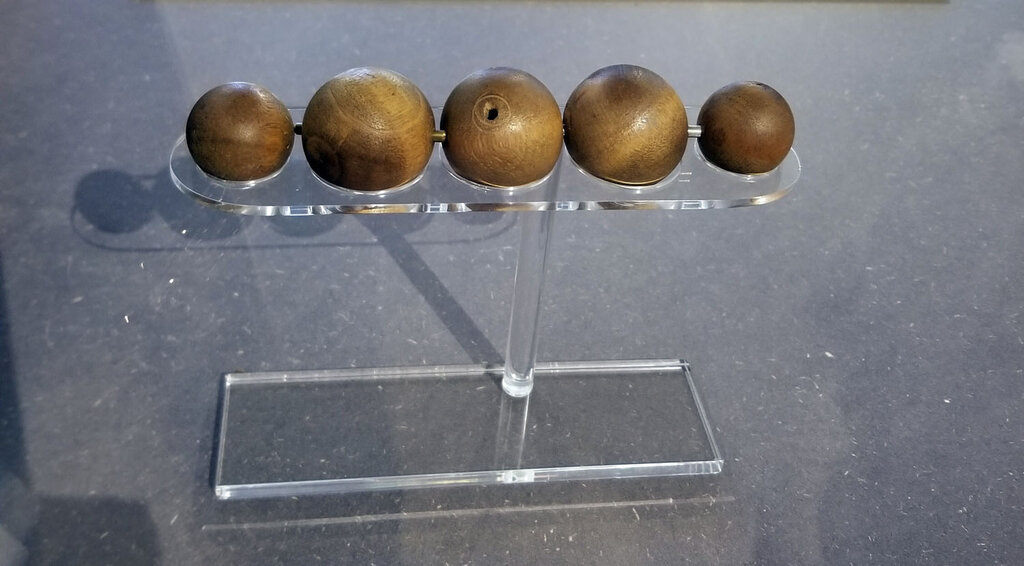
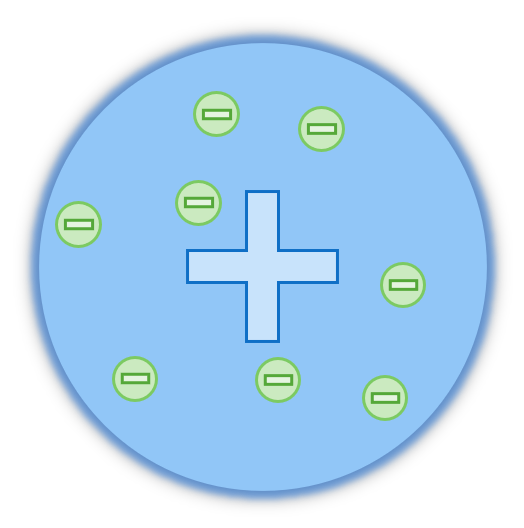
Dalton's model was a huge step forward, but it wasn't the full picture. In 1897, physicist J.J. Thomson discovered the electron, a tiny, negatively charged particle. Since atoms are electrically neutral, he reasoned there must also be a positive charge. This led to the "plum pudding" model, where negative electrons were scattered within a sphere of positive charge, like plums in a pudding.
This model was soon overturned. Ernest Rutherford, a former student of Thomson's, conducted a famous experiment. He fired tiny, positively charged alpha particles at a very thin sheet of gold foil. Most particles passed right through, but to his astonishment, some bounced back. Rutherford concluded that the atom must be mostly empty space, with its positive charge and most of its mass concentrated in a tiny, dense center: the nucleus. The electrons, he proposed, orbited this nucleus like planets around the sun.
Inside the Atom
Rutherford's discovery opened the door to the modern view of the atom. We now know the nucleus itself is made of two types of particles.
proton
noun
A subatomic particle with a positive electric charge, found within the nucleus.
neutron
noun
A subatomic particle with no electric charge (it's neutral), found within the nucleus.
Whizzing around the nucleus in a cloud of probability are the electrons, the negatively charged particles discovered by Thomson. They are incredibly small and light compared to protons and neutrons. The attraction between the positive protons in the nucleus and the negative electrons keeps the atom together.
But if atoms are too small to see, how do we know they exist? The evidence is indirect but overwhelming. One of the first clues was Brownian motion, the random, jittery movement of particles (like pollen in water) observed under a microscope. In 1905, Albert Einstein explained that this jittering was caused by the invisible water molecules constantly bumping into the larger pollen grains. This was powerful evidence for the existence of atoms in perpetual motion.
Today, we have technology like the scanning tunneling microscope (STM), which can create images of surfaces at the atomic level. While not a direct photograph, these images map out the locations of individual atoms, turning Democritus's ancient idea into a visible reality.
Let's check your understanding of these foundational concepts.
According to Richard Feynman, what single, most important scientific idea should be passed on to future generations in case of a catastrophe?
Which physicist's gold foil experiment led to the conclusion that an atom is mostly empty space with a tiny, dense, positively-charged nucleus?
This is just the beginning of the atomic story. From this simple model—a dense nucleus surrounded by electrons—stems all of chemistry and much of modern physics.