Feynman Path Integrals Explained
Introduction to Quantum Mechanics
A Different Kind of Reality
In our everyday world, objects are predictable. A thrown baseball follows a clear path. We can know its position and its speed at any given moment. But when we zoom way down to the level of atoms and electrons, these familiar rules fall apart. Welcome to the world of quantum mechanics, where particles can be in multiple places at once and some things are fundamentally unknowable.
Wave or Particle?
One of the first strange ideas to grapple with is that tiny things like electrons don't behave like tiny baseballs. Sometimes they act like particles, and other times they act like waves.
Imagine firing electrons one by one at a screen with two narrow slits in it. If electrons were just tiny particles, you'd expect to see two distinct bands on a detector wall behind the slits, right where they passed through. But that's not what happens. Instead, they create an interference pattern, a series of alternating bright and dark bands. This is classic wave behavior, as if each electron passed through both slits simultaneously and interfered with itself.
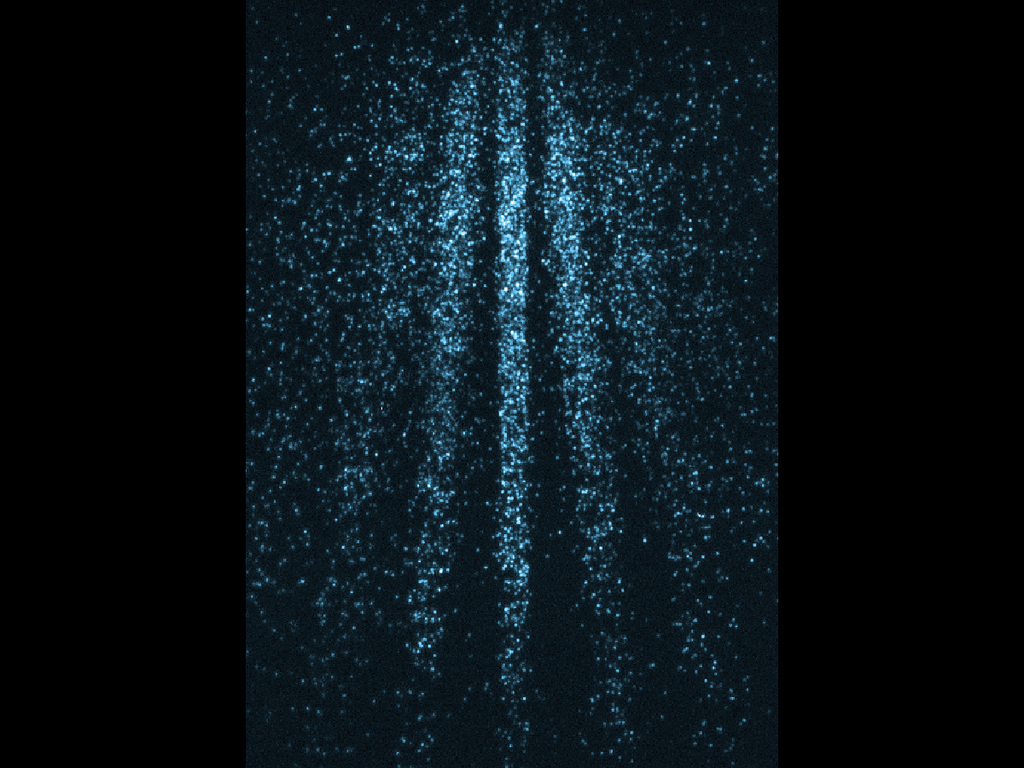
Here's the truly bizarre part. If you place a detector at the slits to see which one the electron goes through, the interference pattern vanishes. The very act of observing forces the electron to behave like a particle, and we go back to seeing just two bands on the detector. This strange phenomenon is known as wave-particle duality. Quantum objects aren't strictly one or the other; they are both, and what we see depends on how we look.
States and Probabilities
To describe this dual nature, physicists use a mathematical tool called the wavefunction. A particle's wavefunction, often represented by the Greek letter psi (), contains all the information about its quantum state. It's not a physical wave like an ocean wave, but a wave of probability.
Before a measurement, a particle exists in a superposition of all its possible states at once. It might have a certain probability of being here, and another probability of being over there. The wavefunction describes this landscape of possibilities. When we measure the particle's position, this cloud of possibilities “collapses,” and the particle appears in one definite location. The probability of it appearing in any given spot is determined by the squared magnitude of the wavefunction at that spot.
wavefunction
noun
A mathematical description of the quantum state of a system, representing the probability amplitude of a particle's position, momentum, and other properties.
So, how does this wavefunction change over time? In the 1920s, physicist Erwin Schrödinger developed an equation that does just that. The Schrödinger equation is the quantum equivalent of Newton's second law of motion (). While Newton's law predicts the exact path of a baseball, the Schrödinger equation predicts the future evolution of a particle's wavefunction, and therefore its future probabilities.
This is the time-dependent Schrödinger equation in one dimension. It tells us how the wavefunction changes with time for a particle of mass in a potential .
The Uncertainty Principle
The wave-like nature of particles leads to another core concept: the Heisenberg Uncertainty Principle. It states that there's a fundamental limit to how precisely we can know certain pairs of properties at the same time. The most famous pair is position and momentum.
The more precisely you measure a particle's position, the less precisely you can know its momentum, and vice versa. It's not a limitation of our instruments; it's a built-in feature of the universe. A particle with a very specific position is described by a sharply peaked wavefunction, which is mathematically composed of a wide range of momentums. A particle with a very specific momentum has a wavefunction that is a smooth, spread-out wave, meaning its position is highly uncertain.
This formula says the uncertainty in position () multiplied by the uncertainty in momentum () must be greater than or equal to a tiny constant. If you make one uncertainty smaller, the other must get larger to keep the product above this minimum value.
These principles—wave-particle duality, the probabilistic nature of the wavefunction, and the uncertainty principle—form the bedrock of quantum mechanics. They paint a picture of a universe that is far stranger and less deterministic than it appears on the surface.
Ready to test your understanding of these bizarre new rules?
In the double-slit experiment, what happens if you place a detector at the slits to observe which slit an electron passes through?
What does a particle's wavefunction (Ψ) represent in quantum mechanics?
While these ideas might seem counterintuitive, they are the foundation for understanding everything from how the sun shines to how computers work. They reveal a reality governed by probability and observation.