Fermat's Last Theorem Unveiled
Introduction to Number Theory
The Building Blocks of Numbers
Number theory is the study of integers, the whole numbers we use every day. At its heart, it's about understanding the relationships between them. The most basic of these building blocks are the prime numbers.
prime number
noun
A whole number greater than 1 that cannot be formed by multiplying two smaller whole numbers.
Think of primes as the atoms of the number world. Just as all matter is made of elements from the periodic table, all integers greater than 1 are either prime numbers themselves or can be built by multiplying prime numbers together. The numbers 2, 3, 5, 7, 11, and 13 are the first few primes.
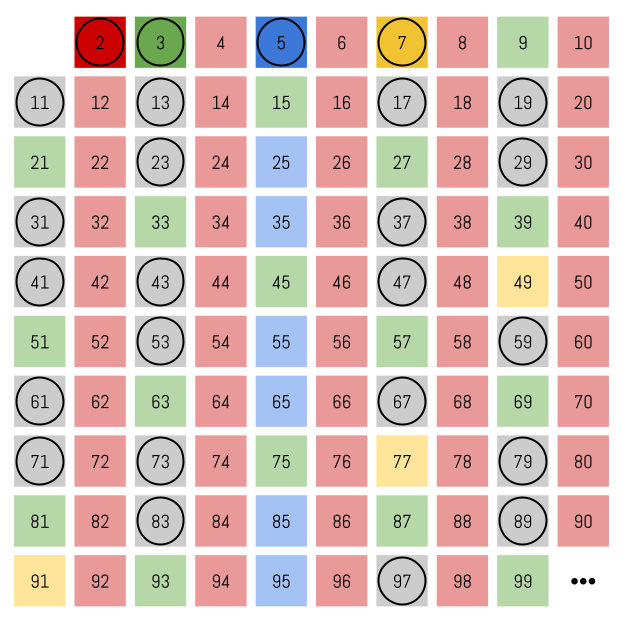
Numbers that aren't prime, like 4, 6, 8, and 9, are called composite numbers. Every composite number can be broken down into a unique product of primes. This is a cornerstone idea called the Fundamental Theorem of Arithmetic. It means that no matter how you break down a number, you'll always end up with the same set of prime factors.
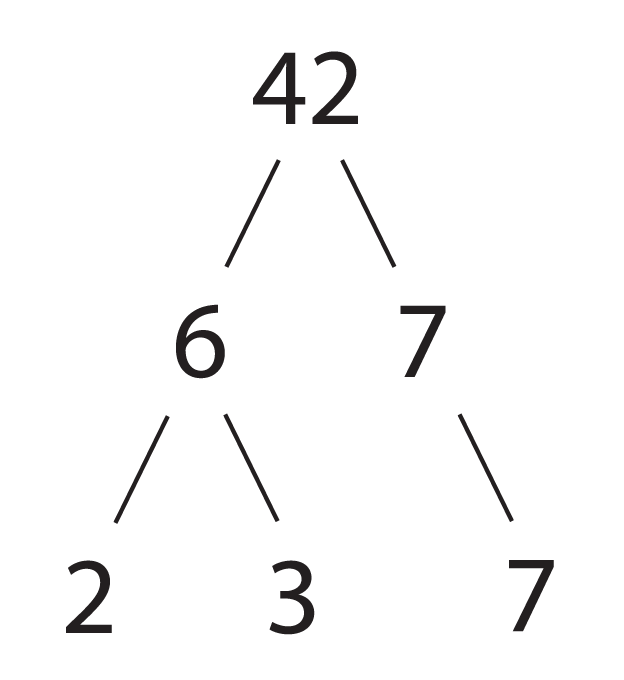
For example, let's take the number 42. We can see it's 6 times 7. The number 7 is prime, but 6 is not. We can break 6 down into 2 times 3. Both 2 and 3 are prime. So, the prime factorization of 42 is . There is no other combination of prime numbers that will multiply to 42.
Finding Common Ground
Once we understand how numbers are built from primes, we can start looking at how they relate to each other. One key relationship is divisibility. If you can divide one integer by another without a remainder, we say the first is divisible by the second. For example, 18 is divisible by 6, but not by 5.
This leads us to the idea of a greatest common divisor, or GCD. The GCD of two numbers is the largest number that divides both of them evenly.
Take 12 and 18. The numbers that divide 12 are 1, 2, 3, 4, 6, and 12. The numbers that divide 18 are 1, 2, 3, 6, 9, and 18. The common divisors are 1, 2, 3, and 6. The greatest of these is 6, so the GCD of 12 and 18 is 6.
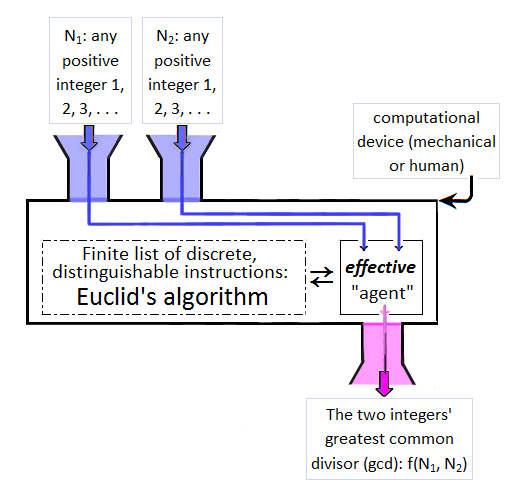
Listing all the factors works for small numbers, but it's not practical for large ones. A much more powerful method is the Euclidean Algorithm. It's a step-by-step process that quickly finds the GCD of any two integers.
Here's how it works for GCD(48, 18):
- Divide 48 by 18: . The remainder is 12.
- Now, divide the previous divisor (18) by the remainder (12): . The new remainder is 6.
- Repeat the process: . The remainder is now 0, so we stop.
The last non-zero remainder is our answer. The GCD of 48 and 18 is 6.
Clock Arithmetic
Imagine a clock. The hours go from 1 to 12, and then they start over. If it's 9 o'clock now, what time will it be in 5 hours? You'd add $9 + 5 = 14$. But there's no 14 on a clock. It would be 2 o'clock. This is the essence of modular arithmetic.
Modular arithmetic deals with remainders. In our clock example, we are working "modulo 12". When we divide 14 by 12, we get a remainder of 2. In mathematical terms, we write this as:
The symbol means "is congruent to". This expression says that 14 and 2 have the same remainder when divided by 12. This concept is incredibly useful in number theory. It simplifies complex problems by allowing us to work with a finite set of numbers (0, 1, 2, ..., 11 in our clock example) instead of all integers.
For example, is an even or odd number? We could multiply it out, or we could use modular arithmetic. An even number is any number congruent to 0 (mod 2), and an odd number is congruent to 1 (mod 2).
(since it's odd) (since it's even)
So, . The product is even.
Integer Puzzles
Now let's combine these ideas to look at a special type of equation. A Diophantine equation is a polynomial equation where we are only interested in integer solutions. They are named after the ancient Greek mathematician Diophantus.
The simplest type is a linear Diophantine equation, which looks like this:
Here, , , and are given integers, and we need to find integer values for and that make the equation true.
For example, consider the equation . We're looking for whole number pairs that work. One solution is , because . Another is , because .
An interesting fact connects these equations to our earlier topic: an equation only has integer solutions if is divisible by the greatest common divisor of and . For our example, GCD(6, 10) = 2. Since 22 is divisible by 2, we know solutions exist.
Diophantine equations can be much more complex, involving higher powers like . Finding integer solutions to these equations is a central challenge in number theory and has fascinated mathematicians for centuries.
Which principle states that any integer greater than 1 is either a prime number itself or can be represented as a unique product of prime numbers?
What is the correct prime factorization of the number 98?
These concepts are the foundation upon which much of number theory is built. Understanding them is the first step toward exploring some of the deepest and most beautiful results in mathematics.