Feline Biological Wonders
Crepuscular Rhythms
Twilight Hunters
Many cat owners notice a pattern. Just as the sun rises or sets, their calm companion transforms into a blur of activity. This isn't a coincidence; it's a deeply ingrained biological rhythm. Cats are crepuscular, a term for animals that are most active during the twilight hours of dawn and dusk.
Crepuscular
adjective
Relating to or resembling twilight; used to describe animals that are primarily active during dawn and dusk.
This behaviour is an evolutionary holdover from their wild ancestors. For a small predator, the low light of dawn and dusk provides the perfect cover. It's bright enough to spot prey, but dark enough to remain hidden from larger predators and unsuspecting victims. Their vision is superbly adapted for these conditions, allowing them to detect the slightest movement in the dim light.

Synchronised with Prey
A predator's success depends on timing. The evolutionary advantage of being crepuscular is directly linked to the activity patterns of their primary food sources. Small mammals like mice and voles, along with many species of birds, are also most active during these twilight periods.
By aligning their hunting schedule with their prey's busiest hours, cats maximise their chances of securing a meal. Their internal body clock, or circadian rhythm, is fine-tuned to trigger alertness and a drive to hunt precisely when the opportunity is greatest. This biological synchronisation is a key survival strategy passed down through generations.
Napping for a Purpose
To fuel these intense bursts of twilight activity, cats have mastered the art of energy conservation. Unlike humans, who typically have one long period of sleep (monophasic sleep), cats are polyphasic sleepers. This means they sleep in multiple short bouts throughout the day and night.
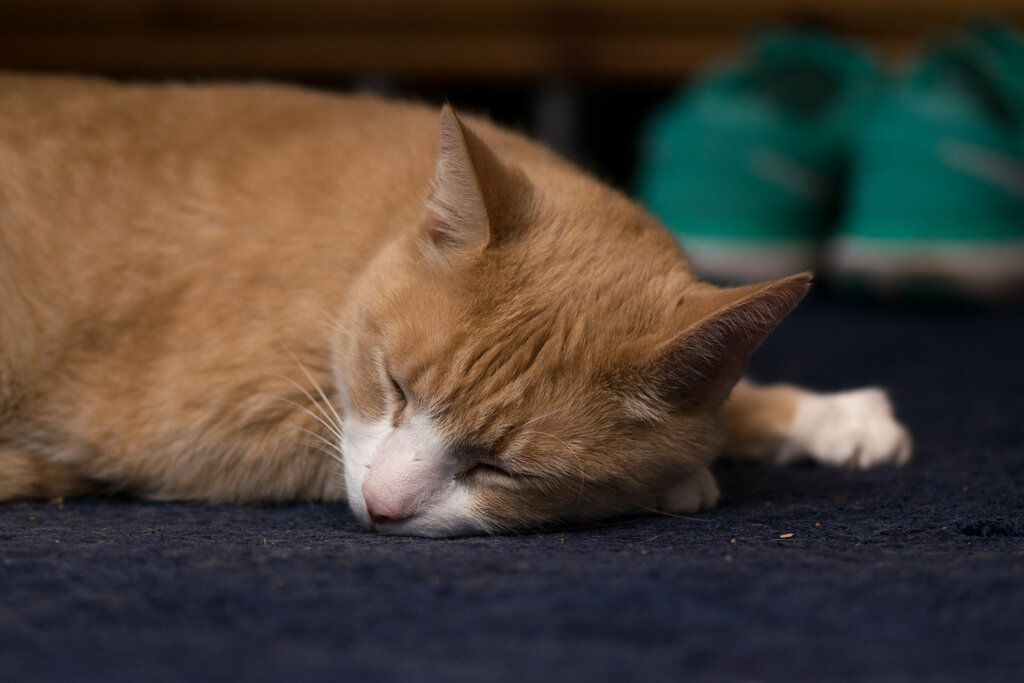
These frequent naps allow a cat to rest and conserve energy without ever being fully 'offline' for too long. They can quickly rouse themselves if a threat or an opportunity appears. This pattern ensures they are always rested and ready for the crucial hunting windows at dawn and dusk. The long hours they spend dozing are not laziness, but a calculated biological strategy for predatory success.
Adult cats can sleep for 12 to 16 hours a day, strategically distributing their rest to peak for crepuscular activity.
The Midnight Crazies
In a domestic environment, these ingrained rhythms persist. The sudden, frantic bursts of energy your cat displays—often called the 'zoomies' or 'midnight crazies'—are a direct manifestation of their crepuscular clock kicking in. Their body is telling them it's prime time to hunt, even if the only thing to stalk is a toy mouse or your feet under a blanket.
This behaviour is perfectly normal. It's a sign that your cat's natural instincts are alive and well. Understanding this allows you to work with their internal clock, not against it. Engaging your cat in a vigorous play session with a wand toy in the early evening can help simulate a hunt. Following this with their evening meal satisfies the natural 'hunt, catch, kill, eat' sequence, often leading to a calmer cat for the rest of the night.
Now, let's test what you've learned about your cat's inner clock.
What does the term 'crepuscular' mean?
What is the main evolutionary reason for cats being most active at twilight?
Understanding these natural rhythms helps us better appreciate the complex, instinct-driven world of our feline companions.