Federated Learning Explained
Introduction to Federated Learning
Learning Without Sharing
Machine learning models get better with more data. But what if that data is private, sensitive, or scattered across millions of devices? Think about medical records in different hospitals, financial data in separate banks, or your personal text messages on your phone. Sharing this raw data to a central server for training creates huge privacy risks.
Federated learning offers a clever solution. It's a way to train a shared model across many different locations without the data ever leaving its source. The learning comes to the data, not the other way around.
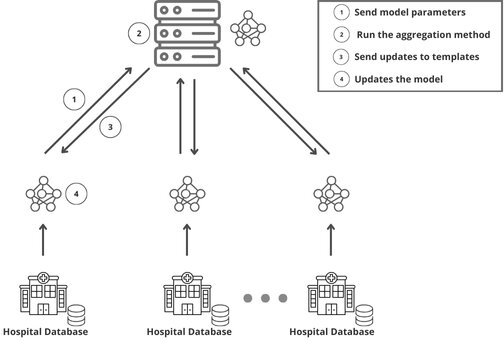
Imagine several hospitals want to build an AI model to detect a rare disease. Each hospital has patient data, but they can't legally or ethically share it. With federated learning, they can collaborate. A central server sends a copy of the initial model to each hospital. Each hospital then trains the model on its own private data. Instead of sending the data back, they only send the improvements they made to the model—things like updated weights and parameters. The central server aggregates these improvements to create a better, more robust global model, which it then sends back to the hospitals for another round of training.
The raw data never leaves the local device or server. Only the mathematical learnings are shared.
Key Components
The process relies on a few core parts working together:
- Clients: These are the decentralized devices or servers where the data lives. They could be hospitals, banks, or individual smartphones. Clients do the local training.
- Server: A central server coordinates the process. It's responsible for distributing the global model, collecting the updates from clients, and aggregating them to improve the model.
- Communication Protocol: This is the set of rules for how the server and clients exchange information. The process is typically iterative, happening in rounds until the model's performance is good enough.
This cycle of distributing, training, and aggregating allows the global model to learn from the collective knowledge of all clients without accessing their private data.
Applications and Hurdles
The privacy-preserving nature of federated learning makes it ideal for many industries.
| Domain | Example Application | Why It's a Good Fit |
|---|---|---|
| Healthcare | Predicting disease outbreaks | Enables collaboration between hospitals without sharing sensitive patient records. |
| Finance | Detecting credit card fraud | Banks can pool insights on fraudulent patterns without exposing customer transaction data. |
| IoT / Mobile | Improving keyboard predictions | Your phone can learn your typing style without sending your personal messages to a server. |
Despite its benefits, federated learning isn't without challenges.
One major issue is data heterogeneity. The data on each client can be very different. For example, users in one region might use different slang than users in another, making it hard to build a single predictive text model that works well for everyone. The data might also vary in size and quality.
Another challenge is communication efficiency. Sending model updates back and forth, especially with thousands or millions of clients on slow or unreliable networks, can be slow and expensive. Researchers are constantly working on ways to compress these updates and reduce the number of communication rounds needed.
To address these issues, many retailers are turning to federated learning approaches, which allow model training across decentralized data sources without sharing raw customer data.
Time for a quick check on what we've covered.
What is the fundamental principle of federated learning?
In a federated learning setup, what do the clients (e.g., individual hospitals or smartphones) send back to the central server?
Federated learning represents a significant shift in how we approach machine learning in a world that values data privacy. By bringing the model to the data, it allows for powerful collaboration without compromise.