FAA Instrument Flight Rules
Instrument Flight Basics
Flying Without Windows
Imagine driving your car with the windows completely blacked out. Scary, right? How would you stay on the road, avoid other cars, or know your speed? In aviation, pilots do something similar all the time. It's called instrument flight.
When clouds, fog, or darkness obscure the view outside, pilots can't rely on the horizon to keep the plane level or the ground to navigate. Instead, they fly under Instrument Flight Rules (IFR), a set of regulations that allows them to operate an aircraft solely by referencing the instruments in the cockpit.
Pilots are trained to rely on their instruments rather than visual cues during low visibility, a practice known as “flying by instruments” or IFR (Instrument Flight Rules).
This is a fundamental shift in flying. Instead of looking out, the pilot's entire world shrinks to the panel of gauges and screens in front of them. Mastering this skill requires discipline, precision, and an unwavering trust in the technology.
The Six-Pack
At the heart of instrument flying are the primary flight instruments. In many aircraft, these are laid out in a standard configuration known as the "six-pack." Each instrument provides a critical piece of information about the aircraft's performance and orientation.
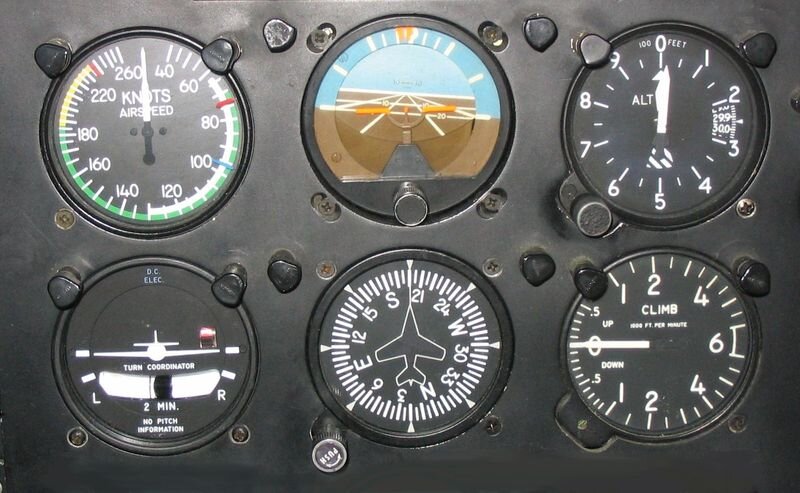
Think of these instruments as your new senses. They tell you what the aircraft is doing, independent of what you might see or feel.
| Instrument | Question it Answers |
|---|---|
| Attitude Indicator | Is the plane's nose pointing up or down? Are the wings level? |
| Airspeed Indicator | How fast are we moving through the air? |
| Altimeter | What is our altitude above sea level? |
| Turn Coordinator | Are we turning? Is the turn coordinated (not slipping or skidding)? |
| Heading Indicator | In which compass direction are we flying? |
| Vertical Speed Indicator | Are we climbing or descending, and how quickly? |
Together, these six instruments paint a complete picture of the aircraft's state. The pilot's job is to interpret this information and make control inputs to keep the aircraft on its desired path.
The Instrument Scan
A pilot can't just stare at one instrument. Flying on instruments requires a continuous, methodical scan of the entire panel. This technique, called the instrument scan, ensures the pilot maintains a constant awareness of the aircraft's status.
Most scan patterns are centered on the Attitude Indicator. It's the primary instrument because it gives an immediate, direct picture of the aircraft's pitch (nose up/down) and bank (wings level/tilted). From the Attitude Indicator, the pilot's eyes move to other instruments to confirm specific details and then return to the center. For example, they might glance from the Attitude Indicator to the Altimeter to check for a change in altitude, then back to the Attitude Indicator.
The goal isn't to fixate but to create a flowing, rhythmic process of observation and interpretation. This allows for early detection of any deviation from the intended flight path.
Your Body Can Lie
One of the hardest parts of instrument training is learning to ignore your own body. Our sense of balance comes from our inner ear, which works great on the ground. But in an aircraft, the forces of turning, accelerating, and climbing can send misleading signals to the brain.
Without visual cues from the horizon, a pilot can quickly experience spatial disorientation. This is a dangerous condition where you feel like you're turning when you're flying straight, or think you're climbing when you're actually descending.
disorientation
noun
A state of mental confusion about time, place, or identity.
For example, a slow, steady turn can go completely unnoticed by the inner ear. When the pilot levels the wings, their body might scream that the plane is now banking in the opposite direction. This false sensation is known as "the leans."
If the pilot trusts their feeling instead of the Attitude Indicator, they might try to "correct" for it by re-entering the original turn, potentially putting the aircraft in a dangerous spiral.
The golden rule of instrument flight is simple: Trust the instruments. Always. Your instruments tell the truth, even when your body is telling a very convincing lie.
By learning to perform basic maneuvers—straight-and-level flight, climbs, descents, and turns—with sole reference to the six-pack, a pilot builds the foundation for safe flight in any weather. Each maneuver is a combination of a target attitude, airspeed, and power setting, all confirmed by a disciplined instrument scan.
Ready to test your knowledge on these foundational concepts?
What is the primary purpose of flying under Instrument Flight Rules (IFR)?
In the context of an instrument scan, which instrument is typically the central focus from which a pilot branches out to view other gauges?
Instrument flying is a demanding but essential skill. It replaces the natural view of the world with a logical system of instruments, requiring a pilot to fundamentally rewire their brain to ignore physical sensations and trust the data presented to them.