F1 Engineering Demystified
Hybrid Power Architecture
The Hybrid Heart
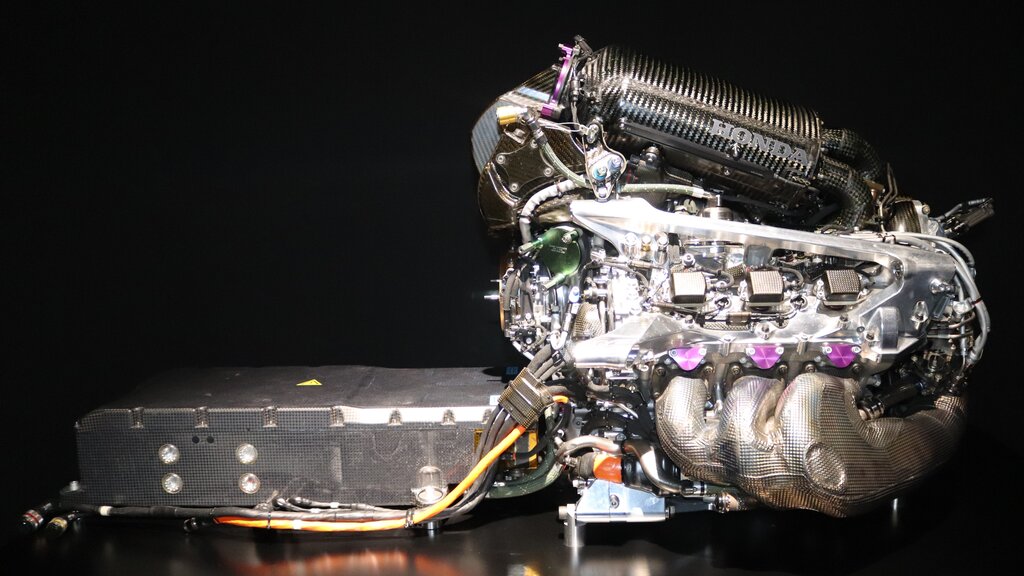
A Formula 1 Power Unit (PU) isn't just an engine; it's a symphony of interconnected systems. At its core is the 1.6-litre V6 internal combustion engine (ICE), but its immense power comes from the integration with two critical motor-generator units: the MGU-K and the (Motor Generator Unit – Heat). These components, along with the Energy Store (ES), create a hybrid system that is astonishingly efficient.
The magic begins with the relationship between the ICE, the turbocharger, and the MGU-H. Traditionally, a turbocharger suffers from 'turbo lag'—a delay in power delivery as the exhaust gases build up enough pressure to spin the turbine. The MGU-H eliminates this. Acting as a motor, it can spin the turbo's compressor instantly, providing immediate boost.
When the driver lifts their foot off the throttle, the MGU-H reverses its role. Instead of consuming power, it acts as a generator, harnessing the energy from the hot exhaust gases still spinning the turbine. This captured electrical energy is then sent to the Energy Store. This process of using exhaust energy for more than just spinning the turbo is a form of turbo-compounding, making the PU incredibly efficient.
While the MGU-H handles heat energy, its partner, the MGU-K (Motor Generator Unit – Kinetic), manages kinetic energy. Connected to the engine's crankshaft, it performs two crucial functions.
- Harvesting: Under braking, the MGU-K acts as a generator, converting the car's kinetic energy into electricity instead of letting it dissipate as heat. This is regenerative braking.
- Deployment: Under acceleration, it acts as a motor, delivering a controlled burst of electrical power directly to the drivetrain for a significant performance boost.
This synergy is a constant balancing act governed by strict rules. Drivers can harvest an unlimited amount of energy from the MGU-H, but the MGU-K is limited to harvesting 2 megajoules (MJ) of energy per lap. For deployment, the MGU-K can deliver a maximum of 4 MJ per lap to the wheels. Since they can only harvest 2 MJ, where does the extra energy come from? From the MGU-H's unlimited harvesting potential.
Energy Management Strategy
Managing the battery's (SoC) is one of the most complex strategic elements in modern F1. A driver's engine mode settings directly control the flow of energy—whether to prioritize harvesting energy to recharge the battery or deploy it for maximum attack or defence.
In qualifying, the strategy is simple: deploy the full 4 MJ in the most optimal way to achieve the fastest single lap time. This usually means using the power on corner exits and down the longest straights. The battery will be nearly depleted by the end of the lap, but that doesn't matter for a one-off effort.
Race strategy is far more nuanced. A driver can't deploy 4 MJ every single lap, as they would quickly run out of stored energy. They must spend parts of the race in harvesting-focused modes to recharge the Energy Store, often by lifting off the throttle slightly earlier into braking zones to give the MGU-K more time to regenerate energy. This energy is then saved for critical moments, like overtaking or defending a position.
If a driver uses all their available electrical deployment before the end of a long straight, they experience a phenomenon known as 'clipping'. The car suddenly stops accelerating as the 160 horsepower boost from the MGU-K cuts out, leaving only the ICE to provide power. The car's speed trace on a graph will visibly flatten, or 'clip', at the top. This makes a driver a sitting duck for attack. Preventing clipping is a key part of energy management, requiring the driver to deploy their electrical energy intelligently throughout the lap.
What is the primary role of the Motor Generator Unit – Heat (MGU-H) in a Formula 1 power unit?
A Formula 1 car can deploy up to 4 megajoules (MJ) of energy per lap from the MGU-K, but it can only harvest 2 MJ per lap via the same system. Where does the additional energy come from?
This intricate dance between generating and deploying energy is what defines the pinnacle of motorsport engineering. It's a high-speed, high-stakes game of efficiency and power.