Exploring Word Classes
Introduction to Parts of Speech
The Building Blocks of Language
Think of building a sentence like cooking a meal. You need different ingredients, and each one has a specific role. Carrots do one thing, salt does another. You can't just throw them together randomly and expect a good result.
Words work the same way. Every word in a sentence has a job to do, and we group them into categories based on those jobs. These categories are called the parts of speech. They are the fundamental building blocks of language, helping us understand how to put words together to make sense.
To put sentences together properly, you must understand what the parts of speech are and how they function in sentences.
Learning these categories isn't about memorizing boring rules. It's about gaining the skills to express yourself clearly and powerfully. When you understand the role each word plays, you can construct sentences that are not only grammatically correct but also effective and engaging.
An Overview of the Eight Parts
In English grammar, we typically talk about eight main parts of speech. Each one contributes to the sentence in a unique way. Let's do a quick roll call to meet the team. We won't dive deep into each one right now, but just get a feel for their main purpose.
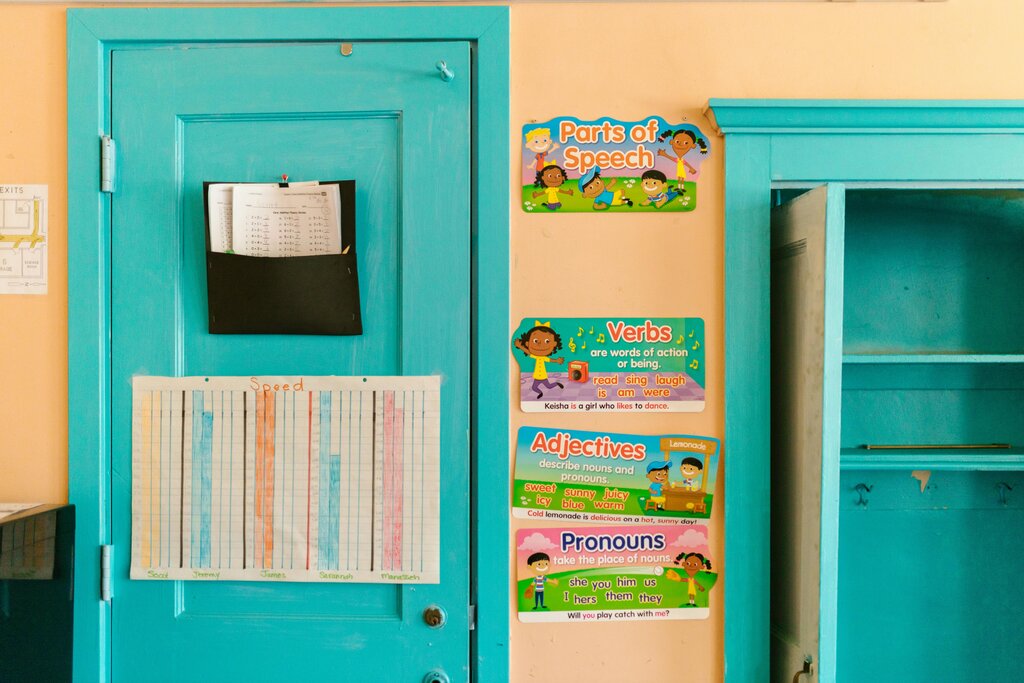
Here are the eight primary categories:
| Part of Speech | Main Job | Simple Example |
|---|---|---|
| Noun | Names a person, place, thing, or idea | The dog barked. |
| Pronoun | Replaces a noun | He is happy. |
| Verb | Shows action or a state of being | They run fast. |
| Adjective | Describes a noun or pronoun | A red car. |
| Adverb | Describes a verb, adjective, or adverb | She sings loudly. |
| Preposition | Shows the relationship between words | The cat is on the mat. |
| Conjunction | Connects words, phrases, or clauses | I like tea and coffee. |
| Interjection | Expresses strong emotion | Wow, that's amazing! |
Seeing them laid out like this helps clarify their distinct roles. A noun gives you something to talk about, a verb gives it an action, and an adjective might give it some color. Each part adds another layer of detail and meaning.
Why This Matters
Understanding the parts of speech is the first step toward mastering grammar. It’s like learning the names of the different pieces on a chessboard. Once you know what a knight or a rook can do, you can start thinking about strategy. Similarly, once you can identify nouns, verbs, and adjectives, you can begin to analyze sentences, spot errors, and build more sophisticated ones yourself.
This foundation makes it easier to learn more complex rules later on, like subject-verb agreement or correct punctuation usage. It gives you a vocabulary to talk about language, which is essential for improving your writing and communication skills.
Think of it this way: you can't build a sturdy house without knowing the difference between a brick, a beam, and a window. Words are the materials, and parts of speech tell you what kind of material you're working with.
Let's test your understanding of these basic building blocks.
According to the text, what is the primary benefit of learning the parts of speech?
Which part of speech is primarily used to name a person, place, thing, or idea?