Exploring Torics
Introduction to Algebraic Curves
Equations as Shapes
At its heart, algebraic geometry is about the connection between algebra and geometry. It's a way of turning equations into pictures and pictures back into equations. The most basic of these pictures are algebraic curves.
An algebraic curve is the set of all points on a plane that satisfy a polynomial equation .
A polynomial in two variables, and , is just a sum of terms where each term is a constant multiplied by and raised to some non-negative integer powers. For example, is a polynomial. Setting it to zero gives us the equation for a familiar shape.
All the points that make this equation true trace out a circle with a radius of 1 centered at the origin. That circle is an algebraic curve. The curve is a one-dimensional object living in a two-dimensional space (the plane).
From Lines to Loops
You've been working with algebraic curves for years, probably without calling them that. The simplest ones are lines.
A line is an algebraic curve of degree one, because the highest power of any variable in its equation is 1.
Circles, ellipses, parabolas, and hyperbolas are also algebraic curves. They are all defined by polynomial equations where the highest power is 2. For this reason, they are called curves of degree two, or conic sections.
| Curve Type | Example Equation | Degree |
|---|---|---|
| Parabola | 2 | |
| Ellipse | 2 | |
| Hyperbola | 2 |
But algebraic curves can get much more interesting. As we increase the degree of the polynomial, the shapes can become more complex. Consider this equation, which defines a curve called the Folium of Descartes:
This is a curve of degree three. It has a distinctive loop in one quadrant and two arms that stretch out towards infinity. It's a great example of how a simple-looking polynomial can generate a beautiful and non-obvious shape.
A Curve's Character
The degree of the polynomial is one of the most basic properties of an algebraic curve. It tells you a lot about the curve's potential complexity. A line (degree 1) is simple. A conic section (degree 2) is a bit more complex. A cubic curve (degree 3) like the Folium of Descartes can have loops and self-intersections.
Another key property is whether a curve has any sharp points or places where it crosses itself. These are called singularities. The loop of the Folium of Descartes crosses itself at the origin, . This self-intersection is a type of singularity.
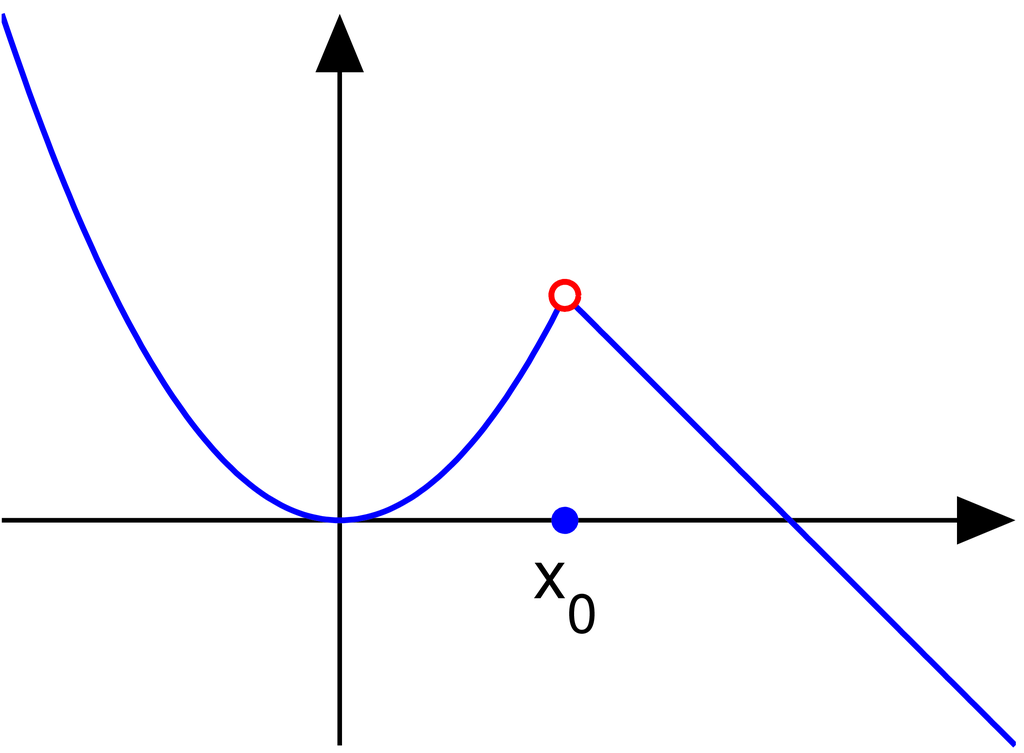
A curve without any singularities is called a smooth curve. Circles and parabolas are smooth. Smooth curves are often easier to work with, but singularities are interesting in their own right. They are special points where the geometry gets a little more complicated, and studying them reveals deeper properties of the curve.
These basic concepts—defining a curve with a polynomial, classifying it by its degree, and identifying special points like singularities—are the first steps into the rich world of algebraic geometry.
What is the fundamental connection explored in algebraic geometry?
A circle, defined by the equation , is an algebraic curve of what degree?