Exploring the World of Mathematics
Arithmetic Fundamentals
The Building Blocks of Numbers
Everything in math starts with numbers. But what is a number, really? It's a symbol representing a quantity. We use a system called base-10, which means we have ten digits: 0, 1, 2, 3, 4, 5, 6, 7, 8, and 9. The magic happens when we combine them.
The position, or place value, of a digit in a number tells you its value. Think about the number 472. It’s not just a 4, a 7, and a 2 sitting next to each other. The 2 is in the ones place, the 7 is in the tens place, and the 4 is in the hundreds place.
This concept is the foundation for everything else. Understanding that the '4' represents 400, not just 4, is key to performing any kind of calculation.
Basic Operations
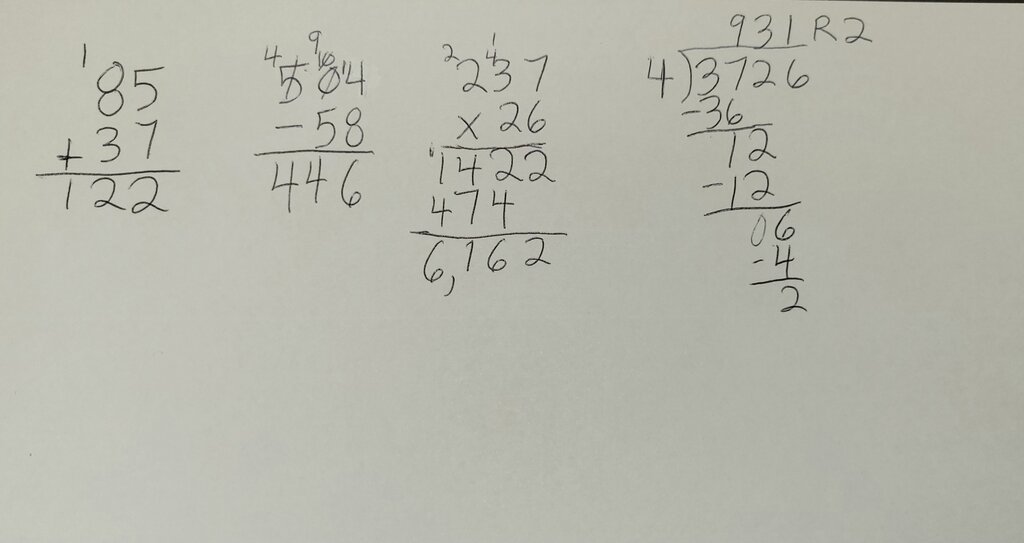
With numbers understood, we can start combining them. The four basic operations of arithmetic are addition, subtraction, multiplication, and division. They form two pairs of opposites.
Addition (+) is about combining quantities. If you have 3 apples and get 2 more, you add them together to find the total.
$3 + 2 = 5$
Subtraction (-) is the opposite. It's about taking away. If you start with 5 apples and eat 2, you subtract to see what's left.
$5 - 2 = 3$
Notice how addition and subtraction are inverse operations. You can use one to check the other.
Addition puts things together. Subtraction takes them apart.
Multiplication (×) is essentially repeated addition. Instead of writing , we can just write . It's a shortcut for adding the same number multiple times.
Division (÷) is the opposite of multiplication. It’s about splitting a quantity into equal groups. If you have 12 apples and want to share them among 4 friends, you divide.
Each friend gets 3 apples. Just like with subtraction, you can use multiplication to check your division. If each of the 4 friends has 3 apples, you have apples in total.
Rules of the Road
Operations follow certain rules, or properties, that make calculations predictable and easier. They work like traffic laws for numbers.
The Commutative Property means you can swap the order of numbers in addition and multiplication without changing the result.
This doesn't work for subtraction or division. $5-2$ is not the same as $2-5$.
The Associative Property means you can regroup numbers in a long addition or multiplication problem. It doesn't matter which pair you calculate first.
The Distributive Property is a bit different. It links multiplication and addition. It tells us that multiplying a number by a group of numbers added together is the same as doing each multiplication separately.
This property is incredibly useful for breaking down complex problems into simpler ones.
Math concepts build on each other, so if students don’t grasp the basics, they’ll struggle with more complex ideas later.
Beyond Whole Numbers
Not everything can be counted with whole numbers like 1, 2, or 3. Sometimes we need to represent parts of a whole. This is where fractions and decimals come in.
A fraction shows a part of a whole. It has two parts: the numerator (top number) tells you how many parts you have, and the denominator (bottom number) tells you how many parts the whole is divided into. The fraction $3/4$ means a whole was divided into 4 equal parts, and we have 3 of them.
A decimal is another way to write a fraction. Decimals are based on the number 10, just like our place value system. The decimal point separates the whole numbers on the left from the fractional parts on the right.
The number 0.75 is the decimal equivalent of . The '7' is in the tenths place () and the '5' is in the hundredths place (). Together, they represent seventy-five hundredths, which is the same as three quarters.
| Fraction | Decimal | Meaning |
|---|---|---|
| 0.5 | One half | |
| 0.25 | One quarter | |
| 0.75 | Three quarters | |
| 0.1 | One tenth |
Learning to switch between fractions and decimals is a powerful skill for solving problems. Some problems are easier to solve with fractions, while others are simpler with decimals.
Now let's check your understanding of these core arithmetic concepts.
In the number 917, what value does the digit '1' represent?
Which of the following equations is an example of the Distributive Property?
Mastering these basics opens the door to the rest of mathematics. Every complex equation or advanced concept is built upon these simple ideas of counting, combining, and splitting numbers.