Exploring the World of Linguistic Phrases
Introduction to Phrases
The Building Blocks of Sentences
Sentences are made of more than just a string of words. Words team up to form groups, and these groups are called phrases. A phrase is a small cluster of words that acts as a single unit of meaning within a sentence.
Think of it this way: a word is like a single Lego brick. A phrase is like a few bricks clicked together to make a small component, like a window or a wheel. A full sentence is the entire Lego creation.
A phrase is a group of words that function as a unit.
Phrases don't have a subject doing a verb, which is what separates them from a full sentence. For example, "the happy dog" is a phrase, but "the happy dog barks" is a complete sentence.
Why Phrases Matter
Phrases add detail and richness to our language. Without them, our sentences would be very simple and lack descriptive power. Compare these two sentences:
The cat sat.
The fluffy orange cat sat on the warm, sunny windowsill.
The second sentence is much more vivid because it uses phrases to give us more information. "The fluffy orange cat" tells us which cat, and "on the warm, sunny windowsill" tells us where it sat. These word groups work together to paint a clearer picture.
Linguists visualize phrases and their role in sentence structure using diagrams. These diagrams show how individual words group together into phrases, which then form the sentence. Here is a very simple example for the phrase "a box".
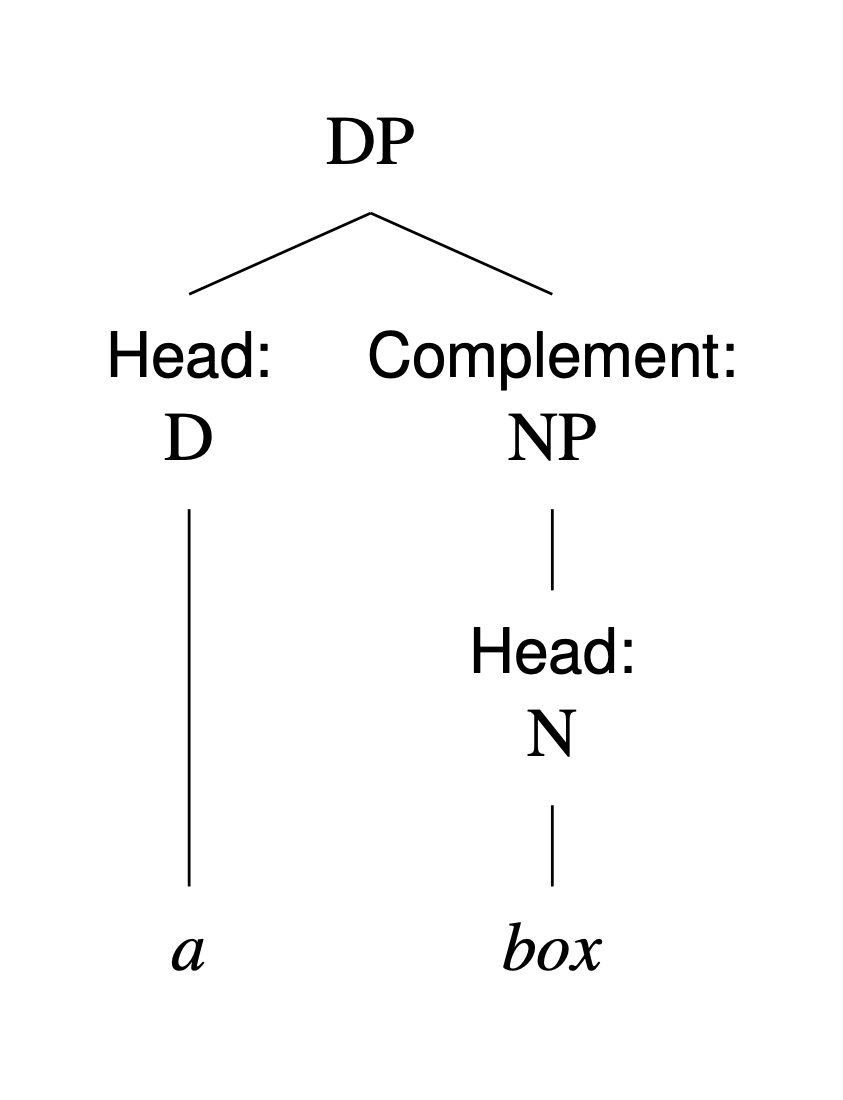
In this diagram, "a" and "box" combine to form a Noun Phrase (NP). This NP can then be used as a single unit in a larger sentence, like "I opened a box."
Spotting Phrases
Let's look at some simple phrases. You don't need to know their technical names yet, just get a feel for how they work as units.
| Phrase Example | How It Functions in a Sentence |
|---|---|
| the tall tree | Acts like a single noun (e.g., "We saw the tall tree.") |
| very quickly | Acts like a single adverb (e.g., "She ran very quickly.") |
| under the bridge | Provides location (e.g., "He hid under the bridge.") |
| is sleeping | Acts like a single verb (e.g., "The baby is sleeping.") |
Notice how each group of words could be replaced by a single word (like "it" or "soundly" or "there") without breaking the sentence's basic structure. That's the key idea: a phrase functions as a single part of speech.
What is the key difference between a phrase and a complete sentence?
Which of the following is a phrase, NOT a complete sentence?
Understanding phrases is the first step toward analyzing how sentences are built. They are the essential link between individual words and complete thoughts.