Exploring the Wonders of the Human Body
Introduction to Human Anatomy and Physiology
Structure and Function
Human anatomy and physiology are two sides of the same coin. They are intertwined fields that help us understand the incredible complexity of the human body.
Think of it like studying a car. Anatomy is concerned with the structure of the car: the engine, the wheels, the seats, the steering wheel. It's about what the parts are and where they are located.
Physiology, on the other hand, is about function. It asks how the engine burns fuel to create power, how the wheels turn, and how the steering wheel guides the vehicle. It’s the study of how all those individual parts work together to get you from point A to point B.
Anatomy
noun
The scientific study of the body's structures and the physical relationships between them.
You can't truly understand one without the other. The structure of a body part is perfectly suited for its function. The hollow chambers of the heart are designed to pump blood, and the thin walls of the lungs are designed for gas exchange. We will explore this relationship between structure and function again and again.
Physiology
noun
The scientific study of the chemistry and physics of the body's structures and how they work together to support the functions of life.
From Atoms to You
The human body is a marvel of organization, built from the ground up in a series of increasingly complex levels. It's like constructing a building, where you start with simple bricks and end up with a skyscraper.
The simplest level is the chemical level, which includes atoms and molecules. These are the fundamental building blocks of everything, including you. Atoms like oxygen, carbon, and hydrogen bond together to form molecules like water () and proteins.
These molecules combine to form cells, the basic units of life. Cells then group together to form tissues, which are collections of similar cells that work together to perform a specific function. For instance, muscle tissue is made of muscle cells that contract.
When two or more different types of tissues combine, they form an organ, like the heart, liver, or stomach. Each organ has a distinct function. Organs that cooperate for a common purpose make up an organ system. The digestive system, for example, includes the stomach, intestines, and liver, all working to break down food.
Finally, all the organ systems together make up the complete organism—a living human being.
Keeping Everything in Balance
Your body is constantly working to maintain a stable internal environment, a state known as homeostasis. Think of it like the thermostat in your house. You set it to a comfortable temperature, and the system works to keep it there. If it gets too cold, the heat kicks on. If it gets too hot, the air conditioning starts.
Your body does the same for things like temperature, blood sugar, and blood pressure. This regulation is achieved through feedback mechanisms, or feedback loops.
Homeostasis
noun
The state of steady internal, physical, and chemical conditions maintained by living systems. This is the condition of optimal functioning for the organism.
Most feedback loops in the body are negative feedback loops. These work to counteract a change and bring the body back to its set point. When your body temperature rises, your brain signals your sweat glands to produce sweat, which cools you down. When your temperature drops, you shiver to generate heat. In both cases, the response opposes the initial stimulus.
Less common are positive feedback loops. Instead of counteracting a change, they amplify it. A classic example is childbirth. The pressure of the baby's head on the cervix stimulates the release of the hormone oxytocin, which causes stronger uterine contractions. These contractions push the baby's head harder against the cervix, leading to more oxytocin release and even stronger contractions. This cycle continues and intensifies until the baby is born.
The Body's GPS
To study the body, we need a common language to describe where things are. Imagine trying to give directions in a city where no one agrees on what “north” or “south” means. Anatomical terminology provides a universal map and set of directions for the human body.
Everything starts from a standard reference point called the anatomical position. This is a person standing upright, with feet parallel and flat on the floor, head level and looking forward, and arms at the side with palms facing forward.
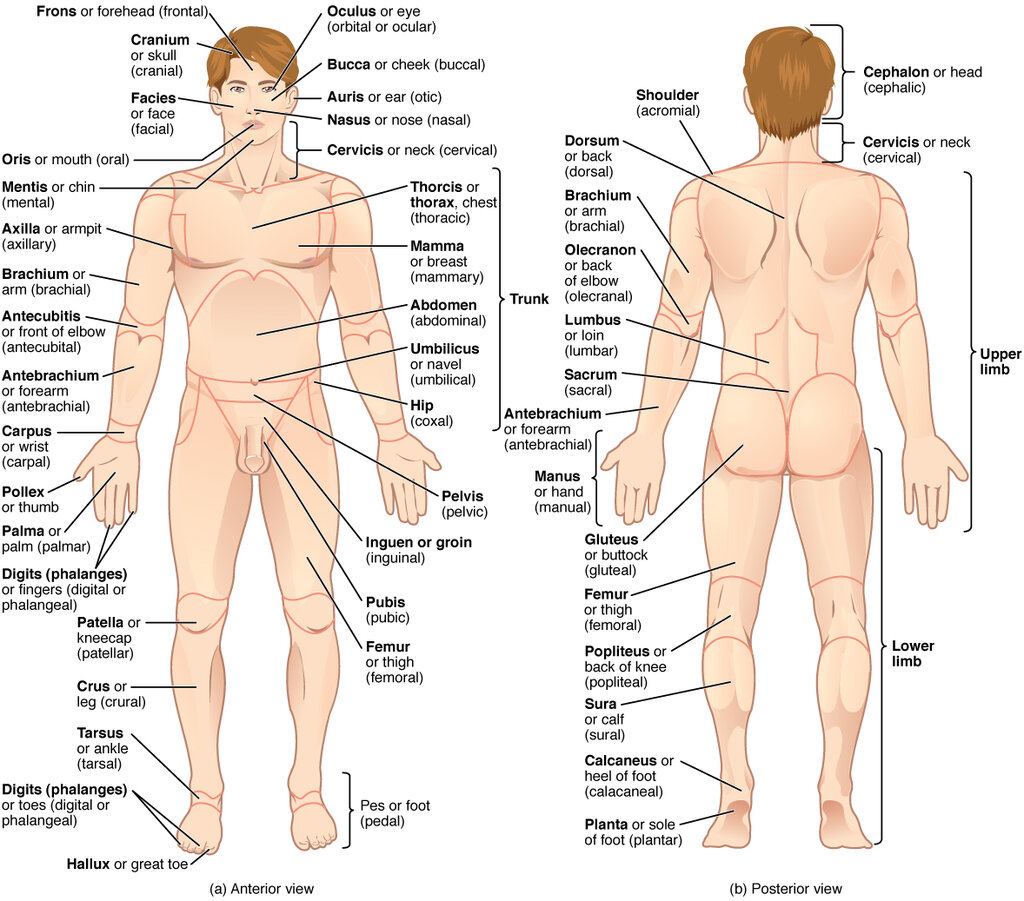
From this position, we can use directional terms to describe the location of one body part in relation to another. These terms always apply as if the body is in the anatomical position, regardless of its actual orientation.
| Term | Definition | Example |
|---|---|---|
| Superior (Cranial) | Above; toward the head | The nose is superior to the mouth. |
| Inferior (Caudal) | Below; toward the feet | The stomach is inferior to the heart. |
| Anterior (Ventral) | In front of; toward the front | The sternum is anterior to the spine. |
| Posterior (Dorsal) | Behind; toward the back | The heart is posterior to the sternum. |
| Medial | Toward the midline of the body | The big toe is on the medial side of the foot. |
| Lateral | Away from the midline | The ears are lateral to the nose. |
| Proximal | Closer to the point of attachment | The elbow is proximal to the wrist. |
| Distal | Farther from the point of attachment | The fingers are distal to the elbow. |
| Superficial | Closer to the body surface | The skin is superficial to the muscles. |
| Deep | Farther from the body surface | The bones are deep to the muscles. |
We also use imaginary flat surfaces, or planes, to slice through the body and view its internal structures. The three most common planes are perpendicular to each other.
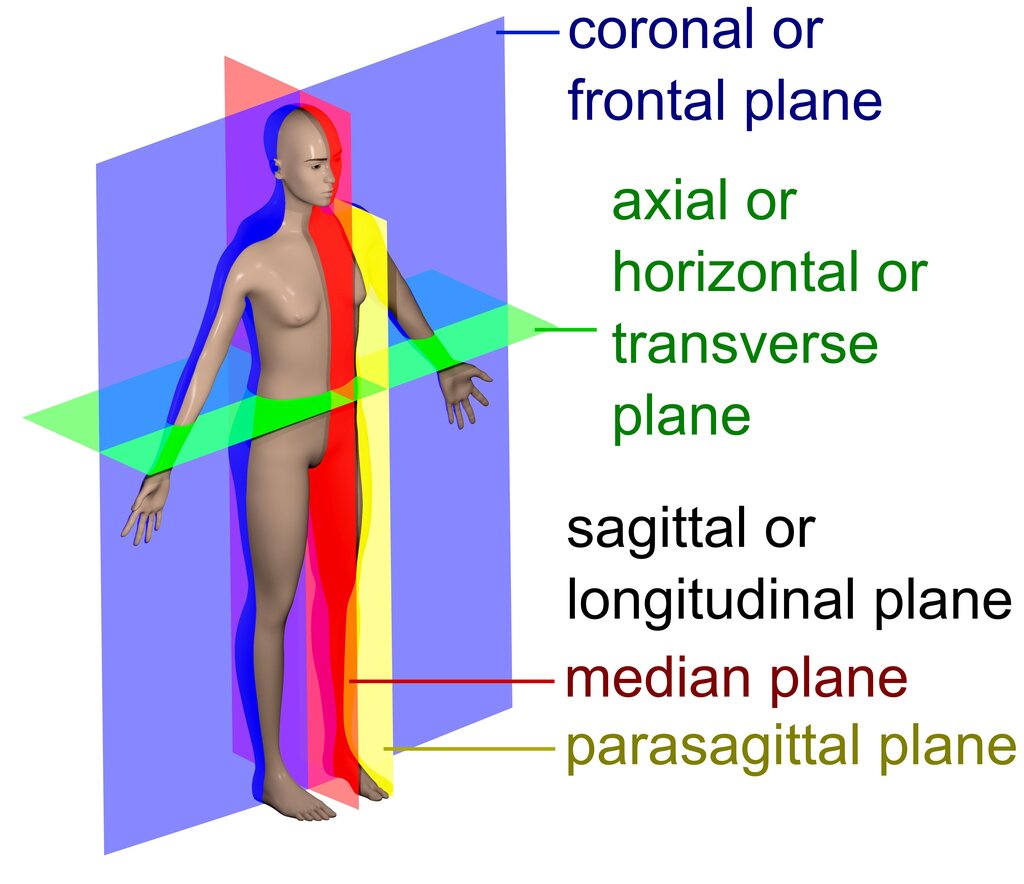
The sagittal plane divides the body into left and right portions. If it passes directly through the midline, it's a midsagittal plane.
The frontal (or coronal) plane divides the body into anterior (front) and posterior (back) portions.
The transverse (or horizontal) plane divides the body into superior (upper) and inferior (lower) portions. This is the plane that creates cross-sections.
Finally, the body's organs are housed in internal compartments called body cavities. These cavities protect the organs and allow them to change shape and size. The two main cavities are the dorsal (posterior) cavity and the ventral (anterior) cavity.
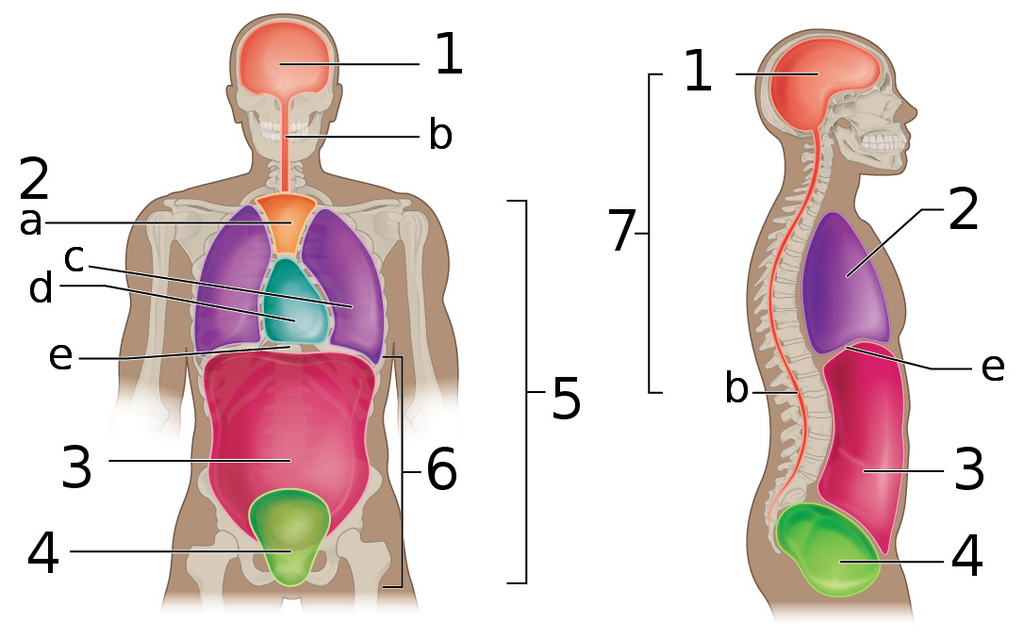
The dorsal cavity is located on the posterior side and includes the cranial cavity (which houses the brain) and the vertebral cavity (which contains the spinal cord).
The ventral cavity is larger and located on the anterior side. It is subdivided by the diaphragm into the superior thoracic cavity and the inferior abdominopelvic cavity. The thoracic cavity contains the heart and lungs, while the abdominopelvic cavity contains the digestive, urinary, and reproductive organs.
Ready to check your understanding? Let's see what you've learned about the fundamentals of anatomy and physiology.
Which of the following scenarios best represents a physiological study?
Which sequence correctly lists the levels of structural organization in the human body from simplest to most complex?
This framework of organization, balance, and terminology provides the foundation for exploring all the intricate systems that make the human body work.