Exploring the Sky Above Us
Atmospheric Composition
The Air We Breathe
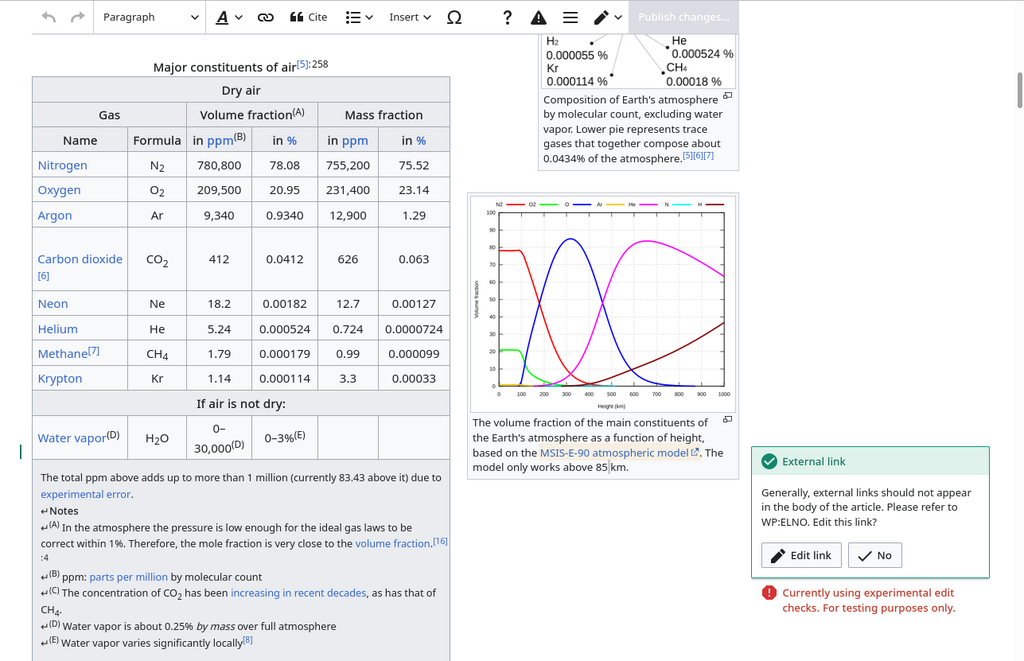
Earth's atmosphere is a vast, invisible ocean of gases that surrounds our planet. While it might seem like empty space, it's actually a complex mixture of different gases and particles. The two most abundant gases are nitrogen () and oxygen (). Together, they make up about 99% of the air.
Roughly 78% of the atmosphere is nitrogen, and about 21% is oxygen. The last 1% is a mix of other gases.
Nitrogen is mostly inert, meaning it doesn't easily react with other elements. This stability makes it a great filler gas, forming the bulk of our atmosphere. Oxygen, on the other hand, is highly reactive and essential for life as we know it. It’s the gas we breathe to power our bodies and the fuel for combustion, from a campfire to a car engine.
The Other One Percent
That tiny remaining one percent might not sound like much, but it contains several important "trace gases." The most plentiful of these is argon (), an inert noble gas. But others, even in much smaller amounts, have a huge impact on our planet.
Carbon dioxide () is a key example. It makes up just about 0.04% of the atmosphere, but it’s a powerful greenhouse gas. It traps heat from the sun, helping to keep Earth warm enough for life to thrive. Other significant trace gases include neon, helium, methane, and krypton. Here’s a quick breakdown of the main components:
| Gas | Chemical Formula | Percentage by Volume |
|---|---|---|
| Nitrogen | ~78.08% | |
| Oxygen | ~20.95% | |
| Argon | ~0.93% | |
| Carbon Dioxide | ~0.04% | |
| Others | - | <0.01% |
More Than Just Gas
The atmosphere isn't just a mix of gases. It also carries a huge number of tiny solid or liquid particles called aerosols or particulates. These can be natural or human-made.
Aerosol
noun
A suspension of fine solid particles or liquid droplets in air or another gas.
Natural sources include dust blown from deserts, salt crystals sprayed from the ocean, pollen from plants, and ash from volcanic eruptions. Human activities also contribute significantly, releasing soot from burning fossil fuels and other pollutants from industrial processes.
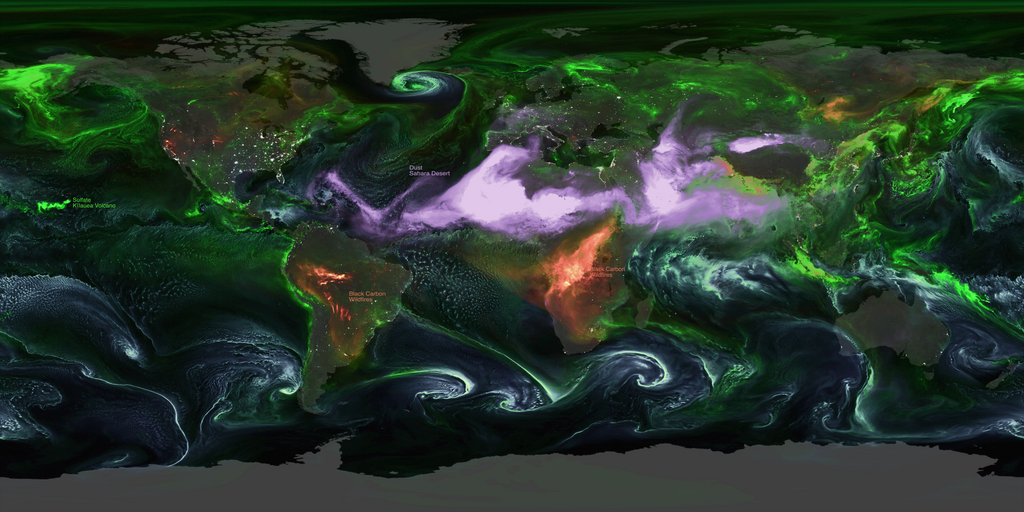
These particles have several important effects. They can scatter sunlight, which is why the sky looks hazy on polluted days. They are also crucial for cloud formation. Water vapor needs a surface to condense upon to form a droplet, and aerosols provide those surfaces. Without dust, salt, and other particulates, it would be much harder for clouds—and rain—to form.
What are the two most abundant gases in Earth's atmosphere, making up approximately 99% of the air?
Despite making up a very small fraction of the atmosphere (around 0.04%), carbon dioxide () has a significant impact on the planet. What is its primary role?
Understanding this complex mix of gases and particles is the first step to understanding how our atmosphere works, from the air we breathe to the climate we live in.