Exploring the Qu Path Framework
Introduction to Complex Systems
The Sum of the Parts
Some things are more than the sum of their parts. A single ant is a simple creature, following basic rules. But a colony of ants can build complex nests and find the shortest path to food, all without a leader giving orders. A single neuron in your brain can't think, but billions of them working together create consciousness.
These are examples of complex systems. They are systems made up of many individual components that interact with each other. This web of interactions creates behaviors that are difficult to predict just by looking at the individual parts. Earth's climate, living organisms, and human cities are all complex systems.
The key is the interaction. In a complex system, the connections between the parts are just as important as the parts themselves.
Because everything is interconnected, modeling these systems is incredibly challenging. You can't just isolate one piece and study it, because its behavior depends on what everything else is doing. A small change in one area can ripple through the system and cause large, unexpected effects somewhere else.
Key Properties
Complex systems share a few common characteristics. Understanding them helps us make sense of the world.
Nonlinearity: In many simple systems, the output is proportional to the input. Push twice as hard, and it moves twice as far. In complex systems, this isn't the case. A tiny nudge could trigger an avalanche, while a huge effort might do nothing at all. The relationship between cause and effect is not a straight line.
Think of the stock market. A small piece of news can sometimes lead to a massive market crash (a nonlinear response), while major economic reports might barely cause a ripple.
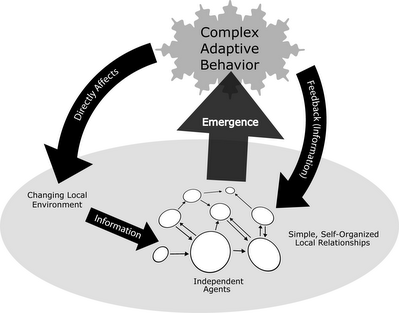
Emergence: This is the idea we started with. Emergence is when a system shows properties that its individual parts do not have. Flocks of birds, traffic jams, and market trends are all emergent behaviors. No single bird, car, or trader decides the overall pattern; it emerges from the simple interactions of many individuals.
The world is full of such emergent phenomena: large-scale patterns and organization arising from innumerable interactions between component parts.
Spontaneous Order: This is closely related to emergence. It's the tendency of complex systems to organize themselves without any central planner or external control. A perfect example is a free market economy. No single person decides what the price of bread should be, yet prices and supplies adjust automatically based on the collective actions of millions of buyers and sellers. This order arises from the bottom up, not the top down.
Adaptation: Complex systems are not static. They change and learn from experience. They adapt. Species evolve through natural selection to better fit their environment. Your immune system adapts to recognize and fight new viruses. Businesses adapt their strategies in response to market changes.
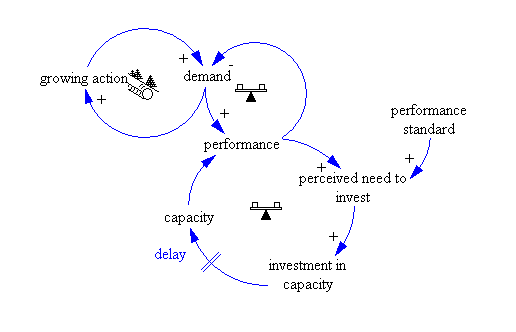
Feedback Loops: These are the engines of change and stability in complex systems. A feedback loop is when the output of an action influences the next action.
-
Negative feedback loops are stabilizing. They work to keep a system in a certain state. A thermostat is a classic example: when the room gets too hot, the thermostat turns the heat off. When it gets too cold, it turns it on. The system self-regulates.
-
Positive feedback loops are amplifying. They push a system further and further in one direction. A microphone squeal is a positive feedback loop: a sound goes into the mic, gets amplified by the speaker, goes back into the mic, and gets amplified even more, creating a piercing noise. These loops often drive rapid change.
Time to check your understanding of these core concepts.
Which of the following best describes a complex system?
A single bird follows simple rules, but a flock can create intricate, coordinated patterns in the sky. This collective behavior is an example of:
By recognizing these properties, you can start to see the world not as a collection of separate objects, but as a web of interconnected, dynamic systems.