Exploring the Human Body
Introduction to Human Body Systems
From Cells to Systems
Your body is a masterpiece of organization, built from the ground up. The smallest living units are cells. Think of them as individual workers. When similar cells group together to perform a specific job, they form a tissue. A collection of different tissues working together creates an organ, like the heart or the stomach. Organs, in turn, don't work alone. They team up to form organ systems, each responsible for a major function in the body. Finally, all these systems work in harmony to create a complete organism—you.
Keeping Everything in Balance
Despite what’s happening outside your body—whether it’s freezing cold or scorching hot—your internal environment stays remarkably stable. Your body temperature hovers around 98.6°F (37°C), and your blood sugar remains within a narrow range. This ability to maintain a steady internal state is called homeostasis.
Think of homeostasis as your body's internal thermostat. If you get too hot, your body triggers sweating to cool you down. If you get too cold, you shiver to generate heat. The goal is always to return to the set point, keeping everything running smoothly.
homeostasis
noun
The tendency of a system, especially the physiological system of higher animals, to maintain internal stability, owing to the coordinated response of its parts to any situation or stimulus that would tend to disturb its normal condition or function.
A Tour of the Systems
The human body is composed of 11 major organ systems that work together to maintain homeostasis and perform all the functions of life. Each system has a unique set of tasks, but they are all deeply interconnected.
An organ system is a group of organs that work together to perform major functions or meet physiological needs of the body.
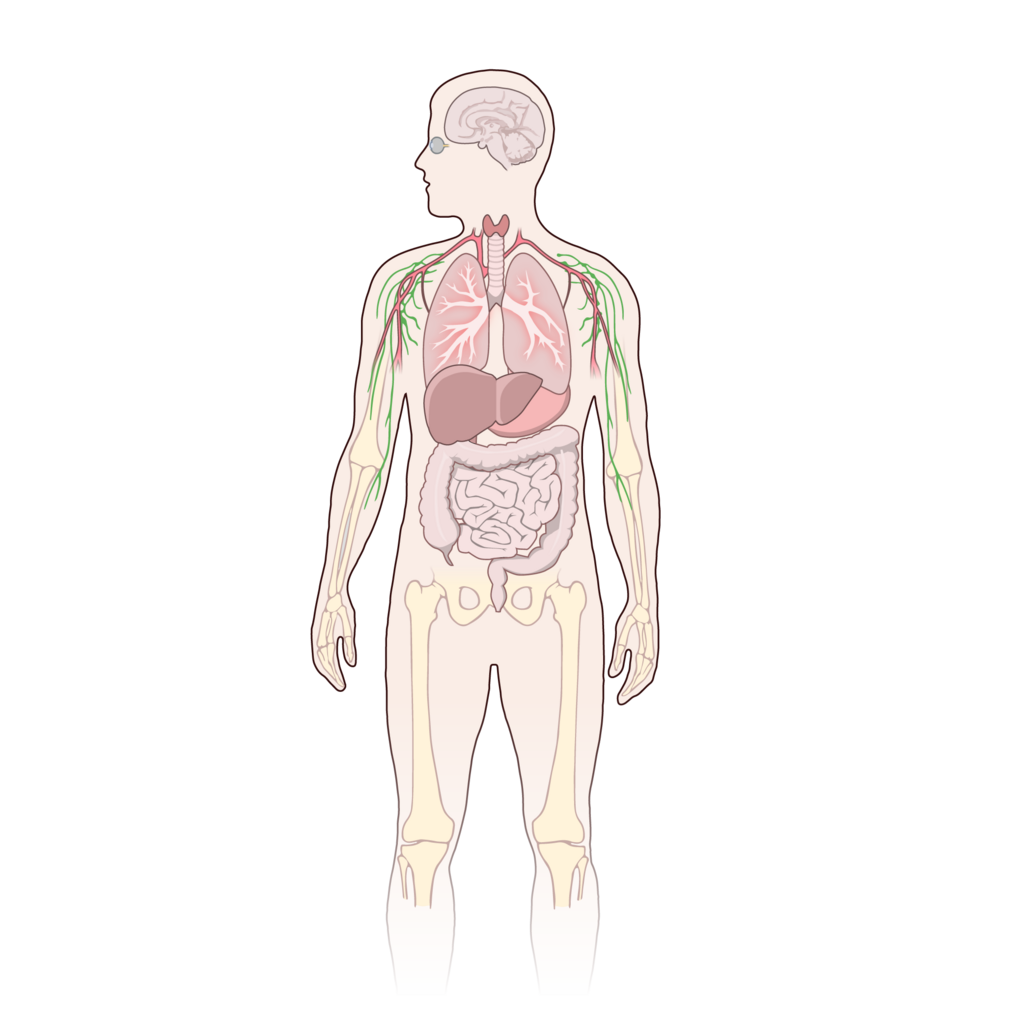
Here is a quick look at the 11 systems and what they do.
| System | Major Structures | Primary Function |
|---|---|---|
| Integumentary | Skin, hair, nails | Protects against external environment, regulates temperature. |
| Skeletal | Bones, cartilage, ligaments | Provides support, protects organs, allows movement, produces blood cells. |
| Muscular | Skeletal, smooth, and cardiac muscles | Enables movement, maintains posture, generates heat. |
| Nervous | Brain, spinal cord, nerves | Transmits nerve impulses to coordinate and regulate body activities. |
| Endocrine | Glands (e.g., pituitary, thyroid) | Secretes hormones to regulate growth, reproduction, and metabolism. |
| Cardiovascular | Heart, blood vessels, blood | Transports oxygen, nutrients, and hormones; removes waste. |
| Lymphatic | Lymph nodes, spleen, lymph vessels | Returns fluid to blood, defends against pathogens. |
| Respiratory | Lungs, trachea, bronchi | Brings oxygen into the body and removes carbon dioxide. |
| Digestive | Stomach, intestines, liver, pancreas | Breaks down food, absorbs nutrients, eliminates waste. |
| Urinary | Kidneys, bladder, ureters | Eliminates waste from the blood, regulates water and salt balance. |
| Reproductive | Ovaries, testes, uterus | Produces offspring. |
No system works in isolation. When you run, your muscular system needs more oxygen. Your respiratory system responds by breathing faster, while your cardiovascular system pumps blood more quickly to deliver that oxygen. It’s a beautifully coordinated dance that keeps you alive and moving.
Now let's check your understanding of these foundational concepts.
What is the correct order of organizational levels in the human body, from simplest to most complex?
The body's ability to maintain a stable internal environment, despite changes in external conditions, is known as: