Exploring the English Language
Origins of English
The Ancestor of English
The story of English doesn't start in England. It begins thousands of years earlier, with a language we've never actually heard. Scholars call it Proto-Indo-European, or PIE. It was spoken around 6,000 years ago, likely in the steppes north of the Black and Caspian Seas.
Everyone agrees on one key point: the Indo-European languages descend from a common ancestor, a mother tongue called Proto-Indo-European, or PIE.
We have no written records of PIE. It’s a reconstructed language, pieced together by linguists who noticed striking similarities between languages as different as Sanskrit, Latin, and Irish. They worked backward, like detectives, figuring out what a common parent word must have looked like. For example, the words for "three" in many languages—treis (Greek), tres (Latin), drei (German), and tri (Russian)—all point to a PIE root, tréyes.
Over millennia, groups of PIE speakers migrated across Europe and Asia. As they settled in different places and lost contact with each other, their shared language began to drift apart. It branched off into new families, just like a family tree.
The Germanic Branch
One of these branches was Proto-Germanic. This is the ancestor of modern German, Dutch, Swedish, and, of course, English. The people who spoke this language lived in northern Europe around 500 BC. Their version of PIE had undergone significant sound changes, setting it apart from other branches like Italic (which led to Latin and French) or Hellenic (which led to Greek).
This Germanic language family itself split into three main sub-groups:
- East Germanic: Spoken by peoples like the Goths. These languages are now extinct.
- North Germanic: Evolved into the modern Scandinavian languages: Danish, Swedish, Norwegian, Icelandic, and Faroese.
- West Germanic: The ancestor of German, Dutch, Frisian, and English.
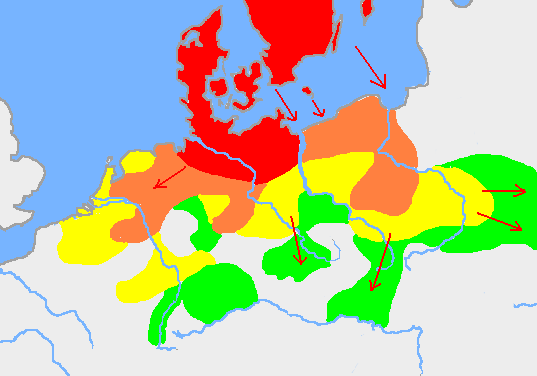
English belongs squarely in the West Germanic group. Its closest linguistic relatives are Frisian, a language spoken in parts of the Netherlands and Germany, and Low German.
Arrival in Britain
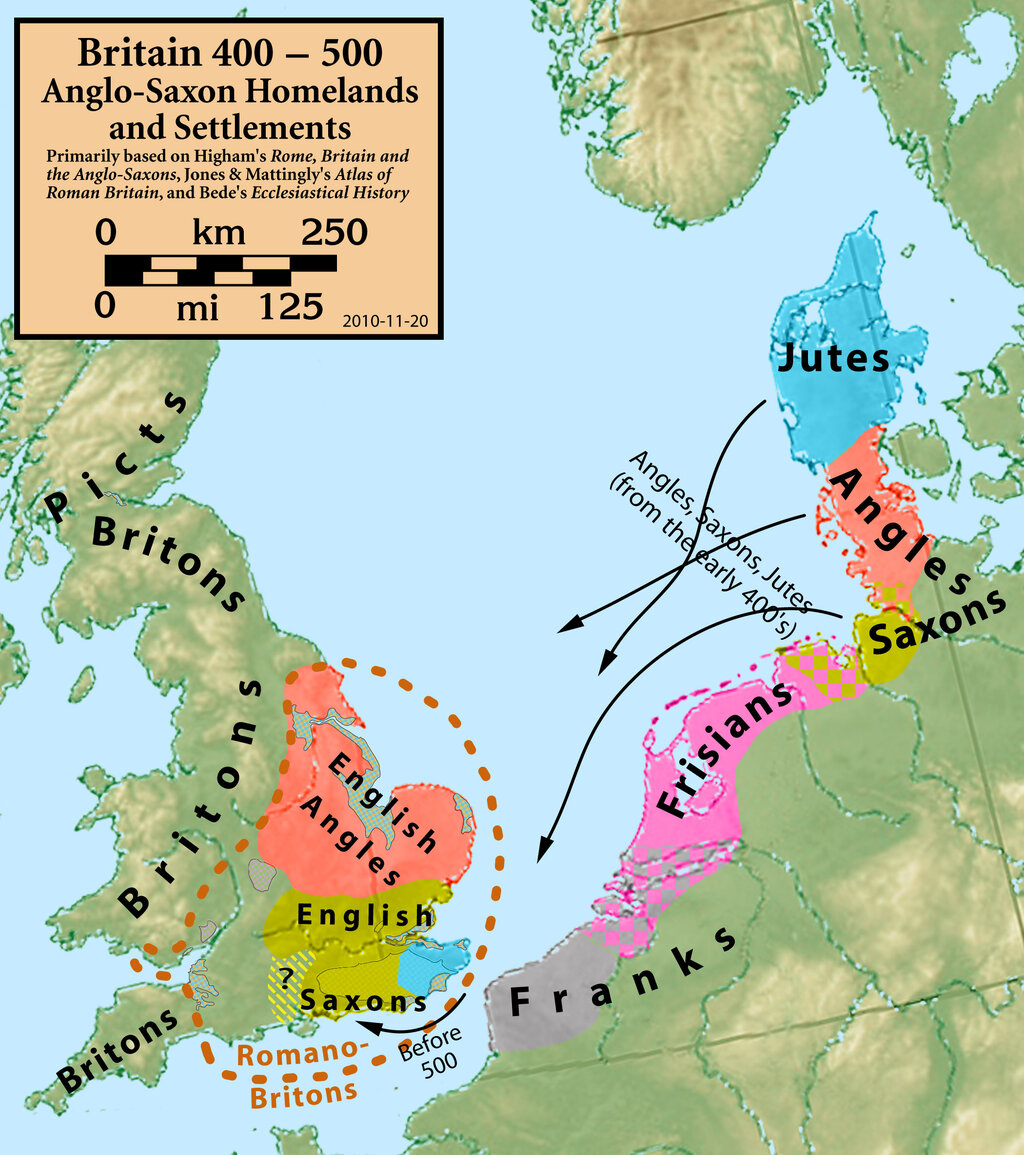
For centuries, Britain was home to Celtic-speaking peoples known as the Britons. But the collapse of the Roman Empire in the 5th century AD left the island vulnerable. Three powerful Germanic tribes—the Angles, the Saxons, and the Jutes—saw an opportunity. They crossed the North Sea from what is now Denmark and northern Germany, looking for new lands to settle.
Old English developed out of the combined dialects of Germanic tribes called the Angles, Saxons, and Jutes, who invaded Britain in the 5th century.
These invaders pushed the native Britons to the west and north, into modern-day Wales, Cornwall, and Scotland. Their own Germanic dialects began to dominate the land. Over time, these dialects started to mix and merge, forming a new language. We call this language Anglo-Saxon, or more commonly, Old English.
The country became known as Englaland (the land of the Angles), and their language was called Englisc. This is the direct ancestor of modern English.
What Was Old English Like?
Old English would be almost unrecognizable to a modern English speaker. The vocabulary was almost entirely Germanic. Simple, everyday words we still use today come from Old English: mann (man), wīf (wife, woman), cild (child), hūs (house), etan (eat), and drincan (drink).
The grammar was much more complex. Modern English relies on word order to make sense. "The man sees the dog" means something very different from "The dog sees the man." Old English didn't work that way. It used a system of inflections, or word endings, to show the function of a word in a sentence. Nouns had different endings depending on whether they were the subject, object, or possessor. This system, similar to modern German or Latin, gave the language a much freer word order.
inflection
noun
A change in the form of a word (typically the ending) to express a grammatical function or attribute such as tense, mood, person, number, case, and gender.
Here’s the first line of the epic poem Beowulf, written in Old English:
Listen! We of the Spear-Danes in days of yore, of those clan-kings, heard of their glory.
It looks and sounds foreign, but it's the foundation upon which all later forms of English were built. The core of our language, from its basic vocabulary to its fundamental structure, was set in place by these Germanic settlers over 1,500 years ago.
Let's review what you've learned.
What is the name of the reconstructed ancient language from which English, along with many other European and Asian languages, is believed to have descended?
English belongs to which specific sub-group of the Germanic language family?
That's how a forgotten language from the Eurasian steppes gave rise to a Germanic dialect that, after a journey across the sea, became the earliest form of English.