Exploring the Cosmos
Understanding Space
What Is Space?
Space is the nearly empty expanse that exists between celestial bodies. It’s the boundless, three-dimensional area where all events and objects have their position and direction. When we look up at the night sky, we are looking across immense distances of space to see stars and planets.
Think of it as the ultimate container. Everything in the universe, from the smallest atom to the largest galaxy, is located in space.
But space isn't just an empty void. It has properties. It can bend, ripple, and expand. While it might seem like nothing, it's the stage on which the entire cosmic story unfolds.
An Ocean of Everything
The universe is unimaginably vast. It contains all of space and everything in it, including all matter and energy. When astronomers point powerful telescopes at what seems to be a tiny, dark patch of sky, they don't find emptiness. They find an incredible number of galaxies.
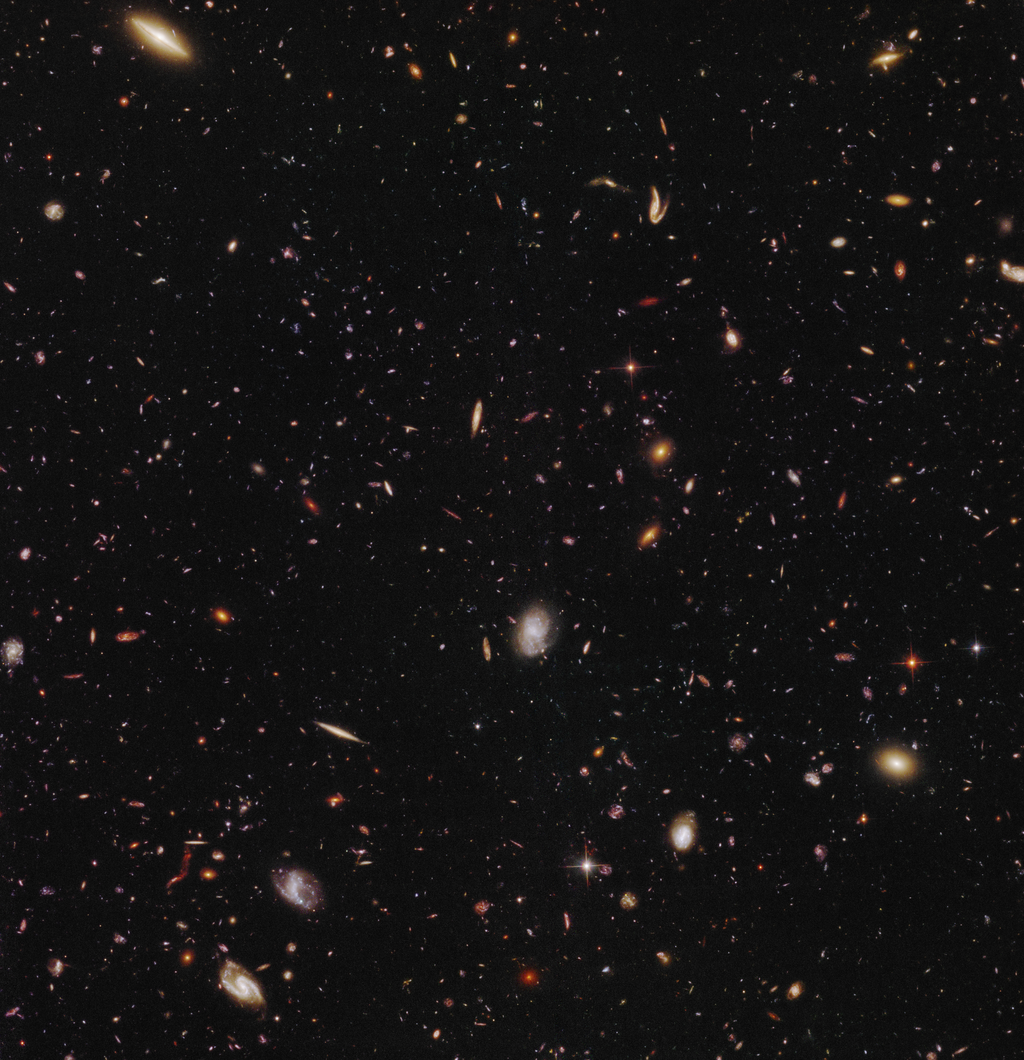
Each of those galaxies contains billions of stars, and there are estimated to be hundreds of billions of galaxies in the observable universe. The distances between them are so great that light, the fastest thing we know, takes millions or even billions of years to travel from one galaxy to another.
This sheer scale is difficult to grasp. But looking at an image filled with galaxies helps give a sense of the scope. The universe isn't just big; it's filled with countless worlds and structures separated by profound distances.
The Cosmic Web
On the largest scales, the universe has a distinct structure. Matter isn't spread out evenly like butter on toast. Instead, gravity has pulled galaxies together into massive groups and long, thread-like chains called filaments. This creates a vast, interconnected structure that looks a bit like a sponge or a spider's web.
This structure is known as the cosmic web. The bright filaments are where galaxies are found, clustered together in groups and superclusters.
Between these glowing filaments are enormous, nearly empty regions called cosmic voids. These voids contain very few galaxies and are composed mostly of dark energy and dark matter. They are the great deserts of the cosmos, making up the vast majority of the universe's volume.
So, while space appears empty to our eyes, it has a grand, underlying architecture. This structure of filaments and voids tells us about the history of the universe and how gravity has shaped everything since the beginning.
Which statement best describes a property of space itself, not just the objects within it?
What is the large-scale structure of the universe often compared to?