Exploring Space Technologies
Orbital Dynamics
The Six Numbers That Define an Orbit
Every object in orbit, from a tiny CubeSat to the International Space Station, follows a path that can be described by six specific parameters. These are the classical orbital elements, and they act like a cosmic address, telling us not just the shape and size of the orbit, but also its orientation in three-dimensional space and the satellite's exact location within it.
| Element | Symbol | What It Defines |
|---|---|---|
| Semi-major Axis | a | The orbit's size (half of its longest diameter) |
| Eccentricity | e | The orbit's shape (0 for a circle, >0 for an ellipse) |
| Inclination | i | The tilt of the orbital plane relative to the Earth's equator |
| Longitude of the Ascending Node | Ω | The swivel of the orbital plane in space |
| Argument of Periapsis | ω | The orientation of the ellipse within its plane |
| True Anomaly | ν or θ | The satellite's current position along the orbit |
Together, these six numbers form a state vector, a snapshot that mission controllers use to predict a satellite's future position. Understanding how to interpret them is the first step in mastering orbital dynamics. For example, a mission requiring frequent passes over the polar regions would need an orbit with a high inclination, close to 90 degrees.
The Unseen Forces
An orbit defined by the classical elements assumes a perfect universe: a spherical Earth and nothing else. The reality is far more complex. Several forces, known as perturbations, constantly nudge spacecraft, altering their paths over time. For missions in Low Earth Orbit (LEO), the most significant of these is atmospheric drag. Even at altitudes of hundreds of kilometres, the wisps of Earth's atmosphere create friction, stealing a tiny amount of energy with every orbit. This causes the spacecraft to slow down, lowering its altitude and leading to eventual orbital decay.
Gravity itself isn't uniform. The Earth is not a perfect sphere; it's an oblate spheroid, slightly flattened at the poles and bulging at the equator. It also has regions of higher density rock. These gravitational anomalies, or mascons, tug on satellites, causing their orbits to precess, or wobble, over time. Mission planners can even use this effect to their advantage, designing sun-synchronous orbits that precess at the same rate the Earth orbits the Sun, allowing the satellite to pass over a given spot at the same local time each day.
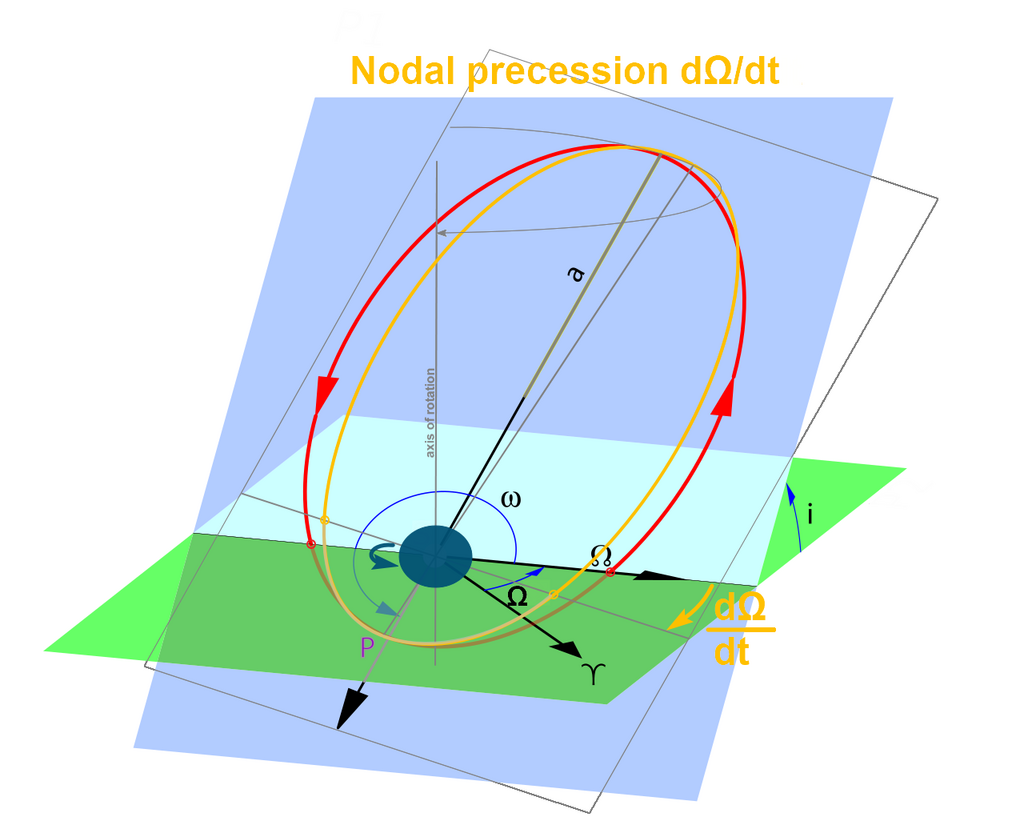
For spacecraft in higher orbits or with large, lightweight structures like solar panels, solar radiation pressure becomes a factor. The constant stream of photons from the Sun exerts a tiny but relentless force. Over months and years, this pressure can significantly alter an orbit. Finally, the gravitational pull from the Moon and Sun, known as third-body perturbations, also plays a role, especially for missions far from Earth.
Changing Course in the Void
Spacecraft rarely stay in a single orbit. To get from a launch trajectory to a final destination, or to rendezvous with another object, they must perform orbital maneuvers. These are essentially controlled engine burns that change the spacecraft's velocity, altering the size, shape, or orientation of its orbit. The amount of velocity change required for a maneuver is called delta-v (), and it's the fundamental currency of mission planning. A spacecraft's budget determines what it can accomplish.
The most fuel-efficient way to move between two circular, coplanar orbits is the Hohmann transfer orbit. It involves two short engine burns. The first burn places the spacecraft into an elliptical transfer orbit that just touches the target orbit at its highest point (apoapsis). When the spacecraft reaches that point, a second burn circularises the orbit.
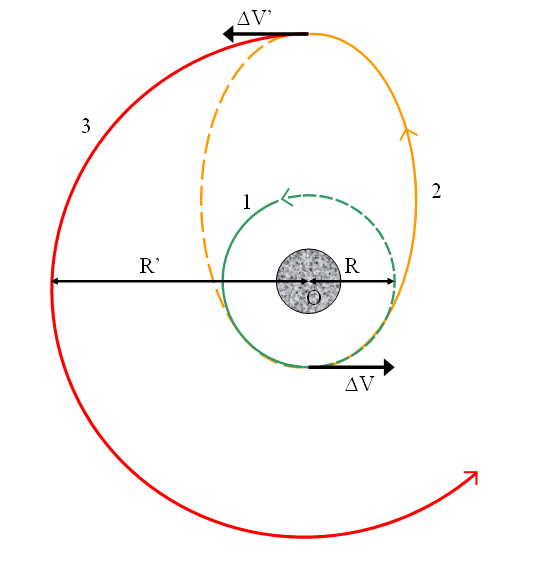
For very large changes in orbital radius, a bi-elliptic transfer can sometimes be more efficient, though it takes longer. This maneuver uses three burns: the first sends the spacecraft into a very large elliptical orbit, the second adjusts the periapsis at the new high point, and the third circularises the orbit at the target altitude.
Changing the tilt of an orbit, known as a plane change, is one of the most expensive maneuvers in terms of . It requires firing the engine perpendicular to the direction of travel, typically at the point where the initial and target orbital planes intersect. The required is proportional to the spacecraft's current velocity, making these maneuvers incredibly costly for satellites moving at high speeds in LEO.
What is the primary purpose of the six classical orbital elements?
A satellite in a very high orbit with large solar panels begins to deviate from its predicted path over a year. Which orbital perturbation is most likely the primary cause?
These principles of perturbations and maneuvers are the building blocks of modern spaceflight, enabling everything from satellite deployment and station-keeping to complex interplanetary journeys.