Exploring Space Technologies
Orbital Mechanics Basics
The Rules of the Road in Space
Getting a spacecraft into orbit is one thing; keeping it there is another. Orbital mechanics is the playbook for how objects move in space. It's not about the brute force of launch, but the elegant, constant dance with gravity. At its heart are concepts you're already familiar with: Newton's Laws of Motion and his law of universal gravitation.
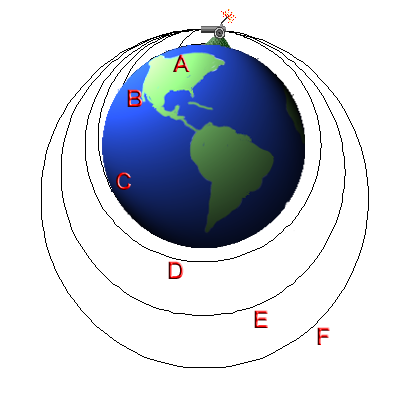
In the vacuum of space, an object in motion truly stays in motion. A satellite doesn't need engines firing constantly to stay in orbit. Instead, it's in a perpetual state of falling towards a celestial body, like Earth. However, it also has so much sideways velocity that it continuously misses. This balance between momentum and gravity is what creates a stable orbit. Every object in the universe pulls on every other object, a force that depends on their masses and the distance between them. This is the gravitational force that holds moons, planets, and even entire galaxies together. It's the invisible tether that keeps our satellites from flying off into deep space.
Describing an Orbit
No two orbits are exactly alike. To describe a satellite's specific path, we use a set of standard measurements called orbital parameters. They are the vital statistics that tell mission controllers precisely where a satellite is and where it's going. Four of the most common parameters are apogee, perigee, inclination, and eccentricity.
| Parameter | Description |
|---|---|
| Apogee | The point in an orbit farthest from the central body (e.g., Earth). |
| Perigee | The point in an orbit closest to the central body. |
| Inclination | The angle of the orbital plane relative to the Earth's equatorial plane. |
| Eccentricity | A measure of how much an orbit deviates from a perfect circle. A value of 0 is a perfect circle, and a value approaching 1 is a very elongated ellipse. |
These parameters aren't just numbers; they define the mission. A high apogee might be great for a telescope that needs to get far from Earth's glare, while a low perigee could be used for atmospheric studies. A high inclination is necessary to observe the polar regions, which would be invisible from an equatorial orbit.
Common Orbital Paths
Orbits are categorized based on their altitude and shape, creating distinct operational zones around Earth. The most common types are Low Earth Orbit (LEO), Medium Earth Orbit (MEO), and Geostationary Orbit (GEO). Each has unique advantages and is chosen to fit a mission's specific needs.
LEO is home to the International Space Station and many imaging satellites. Its proximity allows for high-resolution photos and rapid communication, but satellites move quickly, meaning they aren't always over the same spot. MEO is the domain of navigation systems like GPS. It provides a balance between ground coverage and signal strength. Geostationary Orbit is unique: a satellite in GEO orbits at the same speed that the Earth rotates. From the ground, it appears to hover in a fixed position, making it perfect for communication and weather satellites that need to cover a specific region continuously.
Changing Course
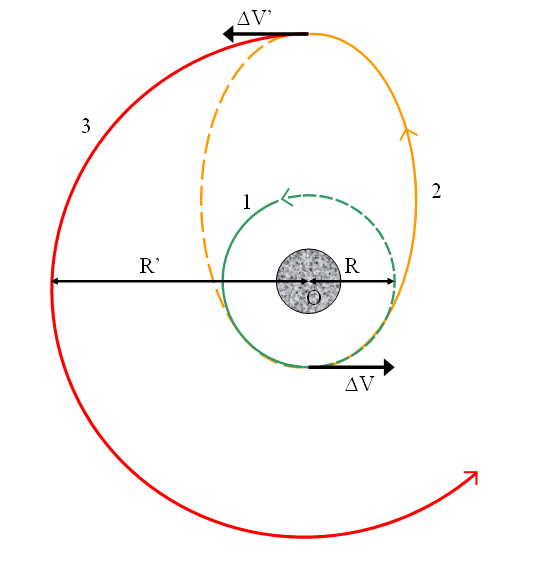
Spacecraft rarely stay in one orbit for their entire mission. They need to perform orbital maneuvers, which are precise, calculated engine burns that change their trajectory. These burns alter the spacecraft's velocity, which in turn reshapes its orbit. A small burn at perigee can raise the apogee, making an orbit more elliptical. Another burn at the new apogee can then circularise the orbit at that higher altitude.
Common maneuvers include station-keeping, which involves small adjustments to counteract forces like atmospheric drag or the gravitational pull of the Sun and Moon that can alter an orbit over time.
One of the most fundamental maneuvers for moving between two circular orbits is the orbit. It's an elliptical orbit that touches both the initial and target orbits. The spacecraft performs one engine burn to enter the transfer ellipse and a second burn upon reaching the target orbit to circularise its path. This method is highly fuel-efficient, making it a cornerstone of mission planning for interplanetary travel and for moving satellites to their final operational altitudes.
Understanding these orbital principles is fundamental to everything we do in space. The choice of orbit and the plan for maneuvering within it directly impact a satellite's capabilities, its lifespan, and the overall cost and complexity of its mission. Every satellite, from a tiny CubeSat to a massive space telescope, operates according to this celestial dance.
What fundamental principle keeps a satellite in a stable orbit around Earth?
A mission requires a satellite to observe the arctic and antarctic regions. Which orbital parameter must be high to achieve this?