Exploring Senhora Lua The Moon's Mystique
Moon Basics
Our Cosmic Neighbor
The Moon is Earth's only natural satellite, a constant presence in our sky that has captivated humanity for millennia. It's more than just a beautiful light; it's a dynamic partner in our planet's cosmic dance, shaping tides and marking time. But how did it get there, and what is it made of?
A Violent Birth
The leading theory for the Moon's origin is as dramatic as a blockbuster movie. It’s called the Giant-Impact Hypothesis. About 4.5 billion years ago, when our solar system was still a chaotic construction zone, a Mars-sized protoplanet named Theia slammed into the young Earth.
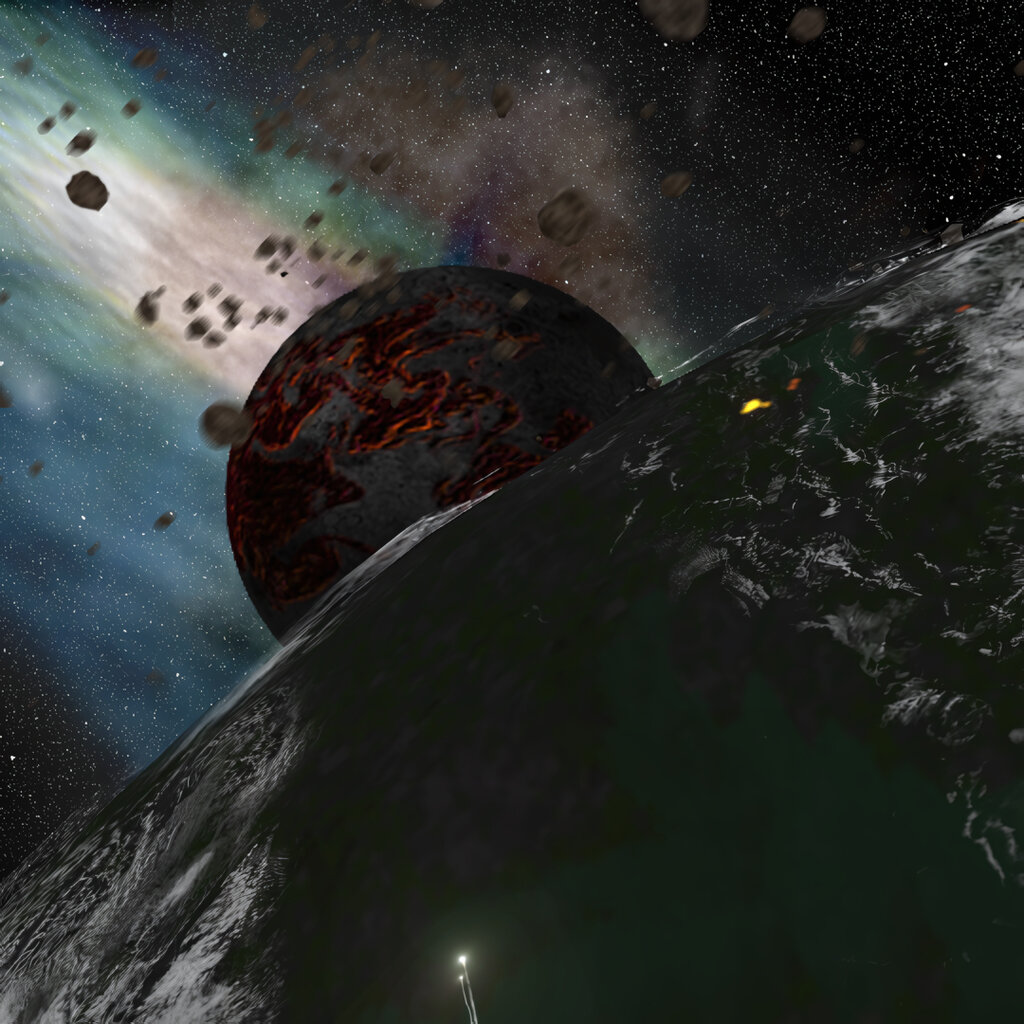
The collision was catastrophic, vaporizing Theia and a large chunk of Earth's mantle. This molten debris was blasted into orbit around Earth. Over time, gravity pulled this swirling ring of rock and dust together, eventually forming the Moon we see today. This violent birth explains why the Moon's composition is so similar to Earth's mantle.
Internally, the Moon has a solid iron-rich inner core and a molten outer core, surrounded by a mantle and a crust. Its surface is a tale of two terrains: the dark, smooth plains called maria and the bright, heavily cratered highlands. The maria are vast plains of cooled lava from ancient volcanic eruptions, while the highlands are the Moon's original, older crust, battered by billions of years of asteroid impacts.
Maria
noun
Large, dark, basaltic plains on Earth's Moon, formed by ancient volcanic eruptions. Early astronomers mistakenly thought they were seas.
Phases and Cycles
The Moon doesn't produce its own light; it reflects sunlight. As the Moon orbits Earth, the amount of its sunlit side we can see changes. These changes are what we call the lunar phases. A common misconception is that the phases are caused by Earth's shadow, but that's incorrect. Earth's shadow is only involved during a lunar eclipse.
The entire cycle, from one New Moon to the next, takes about 29.5 days.
The cycle begins with the New Moon, when the Moon is between Earth and the Sun. We can't see it because the side facing us isn't illuminated. As it moves in its orbit, we see a sliver, the Waxing Crescent. At the First Quarter, half the Moon is lit. It continues to "wax" (grow) into a Waxing Gibbous until it becomes a Full Moon, when Earth is between the Sun and Moon. Then, it begins to "wane" (shrink), moving through Waning Gibbous, Third Quarter, and Waning Crescent, until the cycle starts again.
Tides and Eclipses
The Moon's gravitational pull is the primary force behind Earth's ocean tides. It pulls on the water on the side of Earth closest to it, creating a bulge, or high tide. There’s also a high tide on the opposite side of Earth. This is because the Moon pulls the Earth itself slightly away from the water on the far side.
Between these two high tides are low tides. As the Earth rotates through these tidal bulges each day, coastal areas experience two high tides and two low tides.
Occasionally, the Sun, Earth, and Moon align perfectly, creating a spectacular event called an eclipse. There are two main types.
A solar eclipse happens during a New Moon when the Moon passes directly between the Sun and Earth, casting a shadow on our planet. For a brief time, the Moon blocks the Sun's light.
A lunar eclipse occurs during a Full Moon when Earth passes directly between the Sun and the Moon. Earth's shadow obscures the Moon, often giving it a reddish hue, which is why it's sometimes called a "blood moon."
Because the Moon's orbit is slightly tilted relative to Earth's orbit around the Sun, we don't get eclipses every month. The perfect alignment needed for an eclipse is relatively rare.
According to the leading scientific theory, how did the Moon form?
What is the primary cause of the Moon's phases?
From its violent formation to its steady influence on our planet, the Moon is a fundamental part of the Earth system. Understanding these basics is the first step to appreciating our closest celestial companion.