Exploring Riccardo
Introduction to Riccardo Giacconi
A New Window on the Universe
The story of X-ray astronomy is inseparable from the story of Riccardo Giacconi. Born in Genoa, Italy, in 1931, his early life was shaped by the turmoil of World War II. He pursued his education with determination, eventually earning a Ph.D. in physics from the University of Milan, where he worked with renowned physicist Giuseppe Occhialini.
After a couple of postdoctoral positions, Giacconi moved to the United States in 1956, seeking greater opportunities in scientific research. He landed at a small research and development company in Massachusetts called American Science and Engineering (AS&E). At the time, looking for X-rays from space was a fringe idea, but it was one that would soon change our entire understanding of the cosmos.
Seeing the Invisible
For thousands of years, our view of the universe was limited to the narrow band of light our eyes can see. Even after the invention of radio telescopes, much of the cosmos remained hidden. High-energy phenomena, like exploding stars and matter swirling into black holes, release immense amounts of energy in the form of X-rays. But there was a major problem: Earth's atmosphere is a protective blanket, absorbing most of these X-rays before they ever reach the ground.
To see the X-ray universe, astronomers had to become astronauts. They needed to get their instruments above the atmosphere.
This was the challenge Giacconi's team at AS&E took on. Funded by the U.S. Air Force, their initial goal was modest: to see if X-rays from the sun might be reflected by the moon. To do this, they developed new, highly sensitive X-ray detectors. The next step was to get them into space. Since satellites were still new and expensive, they relied on a simpler tool: the sounding rocket. These small rockets could fly up above the atmosphere for just a few minutes, giving the instruments a brief but clear window to the cosmos.
A Surprise Discovery
On June 18, 1962, an Aerobee sounding rocket launched from the White Sands Missile Range in New Mexico carrying Giacconi's experiment. The flight lasted only a few minutes, but the data it collected was revolutionary. The team didn't find any X-rays from the moon, but they found something far more important.
Their detectors picked up a powerful source of X-rays coming from the direction of the constellation Scorpius. It was the first time X-rays had ever been detected from an object outside our solar system. This source, named Scorpius X-1, was a complete mystery. It was pouring out a thousand times more energy in X-rays than the sun does in all wavelengths combined. The discovery of Scorpius X-1, along with a diffuse background of X-rays across the sky, marked the official birth of X-ray astronomy.
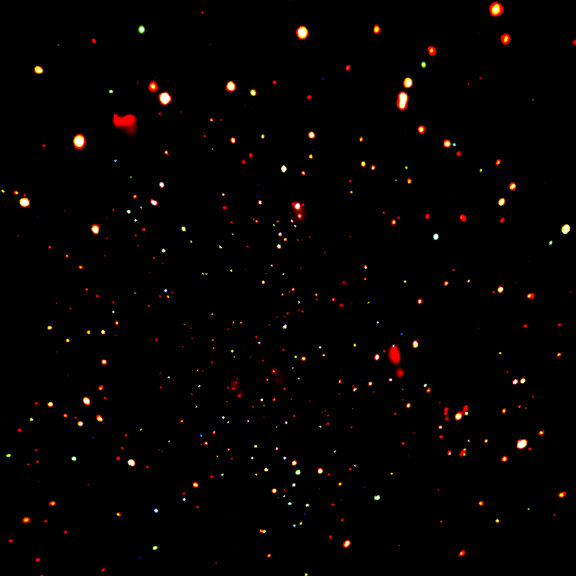
Giacconi's initial experiments were designed to look for one thing but ended up finding something else entirely. This unexpected result opened a brand new field of astrophysics, paving the way for decades of discovery.
Why must X-ray detectors be placed in space to observe cosmic phenomena?
What was the original scientific objective of the 1962 rocket experiment led by Riccardo Giacconi?
This first glimpse showed that the universe was far more violent and energetic than previously imagined.