Exploring Quantum Immortality
Many-Worlds Interpretation
The Problem with Looking
Quantum mechanics tells us that before we measure it, a particle like an electron can exist in a mix of multiple states at once — a state of superposition. It might be spinning both clockwise and counter-clockwise simultaneously. But the moment we look, we only ever see one result. The electron is spinning clockwise. Or it's spinning counter-clockwise. Never both.
This raises a thorny question: what happens to all the other possibilities? The standard answer for decades was that the act of measurement forces the particle to 'choose' a state, causing its wave function — the mathematical description of all its possibilities — to collapse. This idea works, but it troubled many physicists. It suggests a strange division between the quantum world and our classical world, with different rules for each. It also introduces a random, unpredictable jump into an otherwise smooth theory.
A Universe for Every Outcome
In the 1950s, a graduate student named proposed a radical alternative. What if the wave function never collapses? What if every possible outcome of a quantum measurement actually happens?
This is the core of the Many-Worlds Interpretation (MWI). Instead of the universe picking one path, it splits. When you measure the electron's spin, the universe branches into two. In one branch, you see the electron spinning clockwise. In a completely separate, parallel branch, an identical version of you sees it spinning counter-clockwise. Both outcomes are real.
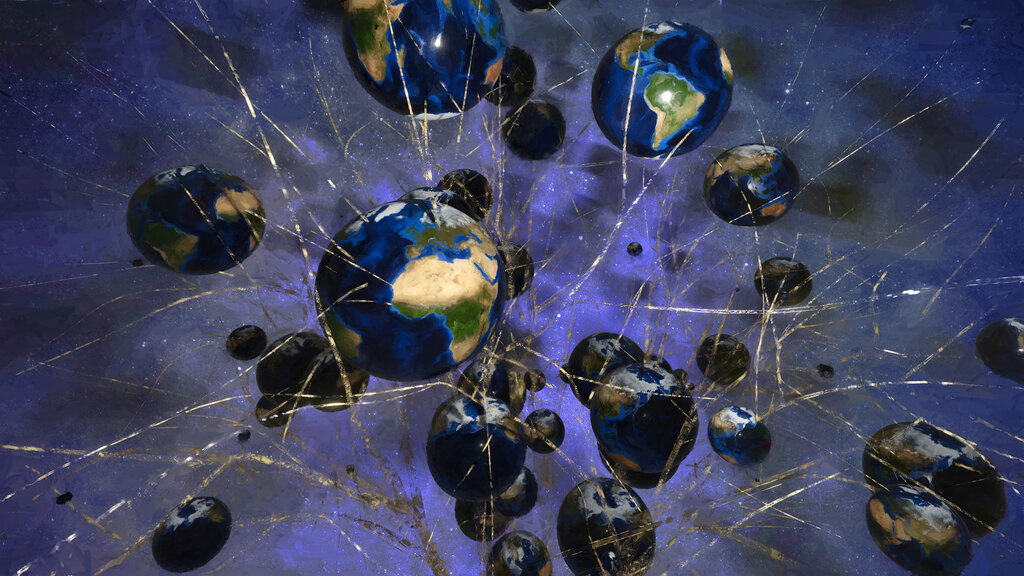
From that point on, these two branches of reality evolve independently. They can't interact or communicate with each other. This splitting isn't a rare event; it happens constantly, every time a quantum interaction resolves itself. There isn't just one other universe — there's an unimaginably vast, ever-growing tree of them.
The Universal Wave Function
In the Many-Worlds view, there is only one wave function, and it describes the entire universe — or more accurately, the multiverse. This universal wave function contains all the information about every particle, in every branch, for all time.
Crucially, this single function evolves smoothly and predictably according to the . There are no sudden collapses or random jumps. The apparent randomness we experience is just an illusion created by our perspective from within a single branch. The theory preserves a deterministic, elegant view of reality, at the cost of accepting an astoundingly large number of unseen worlds.
Relative States and You
So why do we only experience one outcome? Everett's original formulation didn't talk about splitting universes. He talked about "relative states." When you, as an observer, become entangled with the particle you're measuring, the universal wave function doesn't collapse. Instead, it evolves into a superposition of combined observer-particle states.
Let's break that down. Imagine the particle can be spin-up or spin-down. Before you measure it, your state is "ready to measure." After, the universe's state is a superposition of two terms: (You seeing spin-up | particle is spin-up) + (You seeing spin-down | particle is spin-down).
From the perspective of the version of you who saw 'spin-up', the particle is definitively spin-up. This is its state relative to you. Similarly, for the other version of you, the particle is definitively spin-down. Each observer's subjective reality is perfectly consistent within their own branch. The illusion of collapse is created because we can only perceive the contents of our own branch of the multiverse.
The theory is clean and avoids adding new rules to quantum mechanics. Its only requirement is that we take the math of the wave function at face value and follow it to its logical, albeit strange, conclusion. For every possible reality allowed by quantum probability, a world exists.