Exploring Physics Sectors
Classical Mechanics
The Rules of Motion
At its heart, classical mechanics is the study of how things move. It's the physics of the everyday world, from a thrown baseball to a planet orbiting the sun. The foundational rules for this were laid out by Isaac Newton centuries ago, and they begin with a simple idea called inertia.
An object at rest stays at rest, and an object in motion stays in motion with the same speed and in the same direction unless acted upon by an outside force.
This is Newton's First Law. It means objects don't change their motion on their own. A hockey puck gliding across a frictionless sheet of ice will keep going forever in a straight line. To change its motion—to speed it up, slow it down, or change its direction—you need to apply a force. A force is just a push or a pull. Without a force, motion is constant.
Force, Mass, and Acceleration
So, a force changes motion. But by how much? That depends on two things: the size of the force and the mass of the object. Mass is a measure of how much matter an object contains. It's also a measure of inertia—how much an object resists a change in its motion.
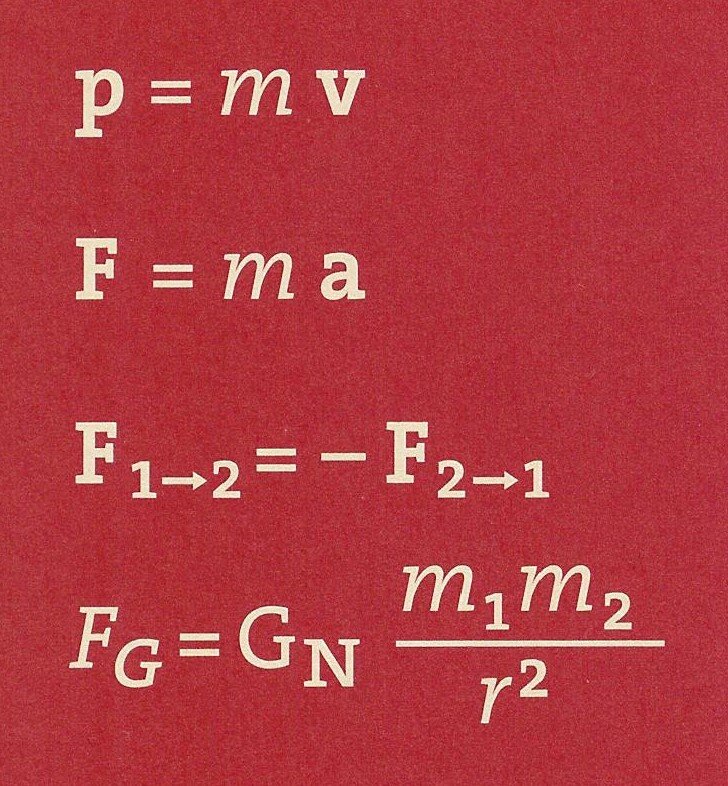
This relationship is captured perfectly in Newton's Second Law, one of the most important equations in all of physics.
Here, is the net force applied to an object, is its mass, and is the acceleration it experiences. Acceleration is the rate of change of velocity. If you push on an object, it accelerates. Push harder (increase the force), and it accelerates more. If the object has more mass, the same force will produce less acceleration. It's harder to get a refrigerator moving than a small cardboard box.
The final piece of Newton's puzzle is his Third Law. It states that for every action, there is an equal and opposite reaction. Forces always come in pairs. When you push on a wall, the wall pushes back on you with the exact same amount of force. A rocket expels hot gas downwards (the action), and the gas pushes the rocket upwards (the reaction).
Energy and Work
Force isn't the only way to think about motion. We can also use the concepts of energy and work. In physics, work has a very specific definition: it's what happens when a force causes an object to move a certain distance. If you push a box across the floor, you are doing work on the box. If you push on a wall and it doesn't move, you've done zero work, no matter how tired you get.
Work is a way to transfer energy. Energy is the capacity to do work. There are many forms of energy, but in mechanics, we often focus on two: kinetic and potential energy.
Kinetic Energy
adjective
The energy an object possesses due to its motion. It's calculated as .
Potential energy is stored energy. A classic example is gravitational potential energy. When you lift a book off the floor and place it on a shelf, you do work against gravity. That work is stored in the book as potential energy. If the book falls, that stored potential energy is converted into kinetic energy as it picks up speed.
Conservation Laws
Some of the most powerful ideas in physics are conservation laws. These laws say that certain quantities in an isolated system—one with no external forces acting on it—remain constant. Two of the most important are the conservation of energy and the conservation of momentum.
The Law of Conservation of Energy states that energy cannot be created or destroyed, only changed from one form to another.
In our falling book example, the total mechanical energy (potential + kinetic) is the same at the top of the shelf as it is just before it hits the ground. As potential energy decreases, kinetic energy increases by the exact same amount.
Another conserved quantity is momentum. Momentum is a measure of an object's motion, combining its mass and velocity (). It's sometimes called "mass in motion." A heavy truck moving slowly can have the same momentum as a light car moving quickly.
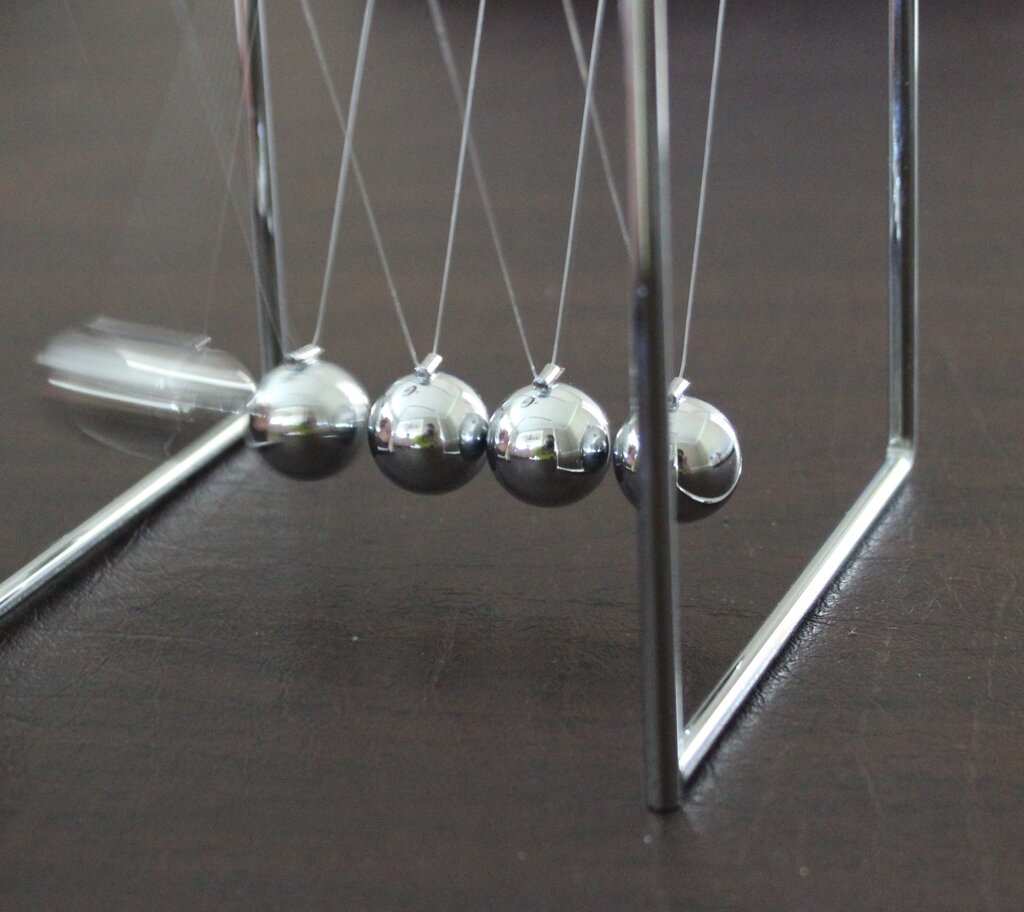
The Law of Conservation of Momentum states that the total momentum of an isolated system remains constant. This is the principle behind collisions. When a cue ball hits a rack of billiard balls, the total momentum of all the balls before the collision is equal to the total momentum of all the balls after. Momentum is transferred between the balls, but the total amount never changes.
These principles—Newton's laws and the conservation of energy and momentum—are the bedrock of classical mechanics. They allow us to predict the motion of almost everything in our macroscopic world.
Time to test your understanding of these core concepts.
According to Newton's First Law of Motion, what will an object do if no net force is acting on it?
If you push a heavy refrigerator and a light cardboard box with the exact same force, which statement is true based on Newton's Second Law ()?