Exploring Musical Modes
Understanding Musical Modes
Beyond Major and Minor
You're probably familiar with major and minor scales. We often describe them with emotions: major sounds happy, and minor sounds sad. But these are just two of seven distinct musical flavors you can get from the exact same set of notes. These flavors are called modes.
Think of the notes of a major scale as seven people standing in a line. If the first person starts the conversation, you get one kind of story (the major scale). But what if the second person starts? Or the third? The characters are the same, but the focus shifts, changing the entire mood of the story. That's the core idea behind modes. They are scales built by starting on different notes of a parent scale, like the C major scale.
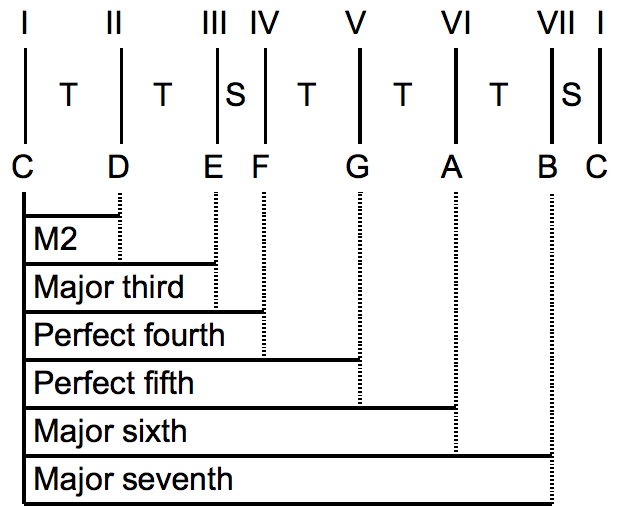
Each mode uses the exact same notes as its parent major scale, but the different starting point reorders the pattern of whole and half steps. This simple shift creates a unique melodic character for each mode.
The Seven Flavors of a Scale
Let's use the C major scale as our parent scale. Its notes are C, D, E, F, G, A, and B. By starting a new scale on each of these notes while keeping the pattern of no sharps or flats, we generate the seven primary modes.
| Mode Name | Starting Note (from C Major) | Scale Notes | Tonal Quality |
|---|---|---|---|
| Ionian | C (1st) | C D E F G A B | Bright, happy (Major scale) |
| Dorian | D (2nd) | D E F G A B C | Minor, but hopeful or jazzy |
| Phrygian | E (3rd) | E F G A B C D | Dark, Spanish, tense |
| Lydian | F (4th) | F G A B C D E | Major, but dreamy or magical |
| Mixolydian | G (5th) | G A B C D E F | Dominant, bluesy, rock |
| Aeolian | A (6th) | A B C D E F G | Sad, somber (Natural Minor) |
| Locrian | B (7th) | B C D E F G A | Dissonant, unstable |
A Closer Listen
Let's explore the unique personality of each mode.
Ionian
noun
The first mode, which is identical to the major scale. It's built on the first degree of the parent scale.
This is the mode you already know. Starting on C in the key of C gives you the familiar C major scale. It's the benchmark for brightness and stability.
Now for the interesting part. Starting on D gives us the D Dorian mode. It's a minor mode because the third note (F) is a minor third above the root (D). However, its sixth note (B) is a major sixth. This raised sixth gives Dorian a brighter, more soulful quality than the standard minor scale.
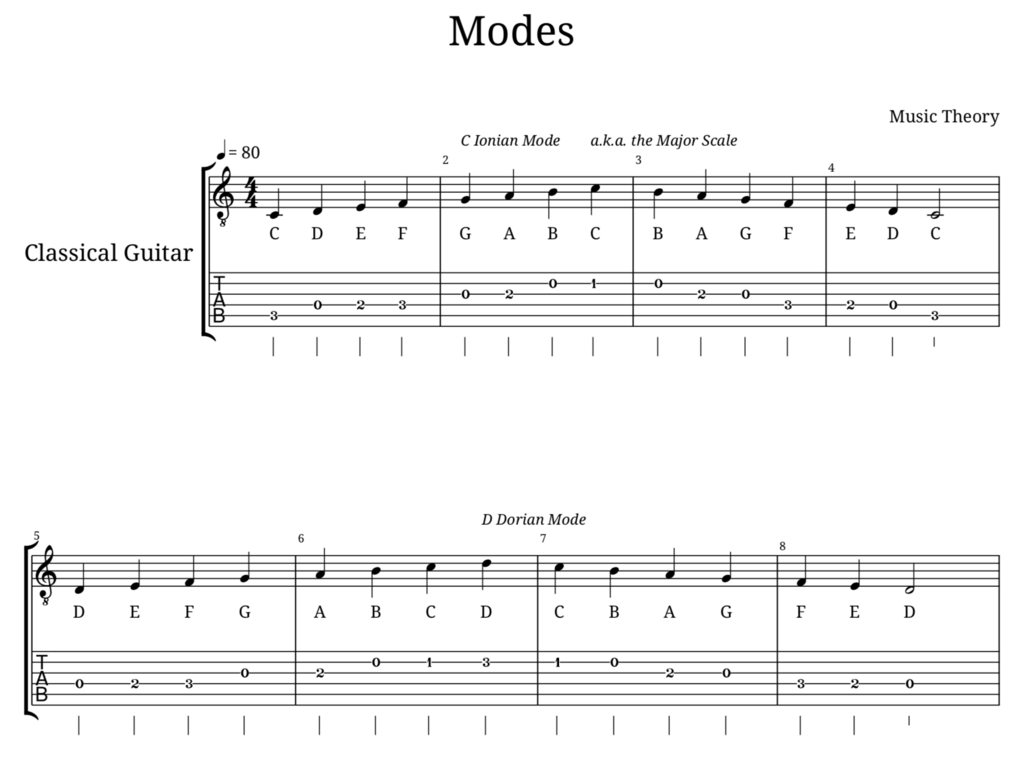
Next is E Phrygian. This is another minor mode, but its defining feature is the lowered second note (F, just a half step above E). This interval creates a tense, exotic sound often associated with Spanish or flamenco music.
Starting on the fourth note, F, we get F Lydian. This is a major mode, but with a twist: a raised fourth note (B). This interval gives Lydian a dreamy, ethereal, and almost magical quality. It feels even brighter than the standard major scale.
The G Mixolydian mode starts on the fifth degree. It's a major mode with a lowered seventh note (F). This gives it a bluesy, rock-and-roll feel. It’s the sound of a dominant seventh chord, full of energy and forward momentum.
Mixolydian is one of the most common modes in popular music, from classic rock to folk.
When we start on the sixth note, A, we get the A Aeolian mode. This is the natural minor scale. If you know your relative major and minor keys (like C major and A minor), you already know Aeolian. It has a classic sad or pensive sound.
Finally, starting on the seventh note, B, gives us B Locrian. This mode has a diminished fifth, making it sound very unstable and dissonant. Because of this quality, it's the least common mode in popular music, often used to create a feeling of suspense or unresolved tension.
Ready to test your knowledge?
What is the fundamental characteristic that distinguishes the seven modes derived from a single major scale?
A musician wants to create a 'dreamy' and 'ethereal' sound that is even brighter than a standard major scale. Which mode, known for its raised fourth scale degree, should they use?