Exploring Minimal Surfaces
Introduction to Minimal Surfaces
The Shape of Soap Films
Have you ever played with a bubble wand? When you dip a wire frame into soap solution, a thin, shimmering film forms, stretching across the boundary. This soap film is nature's architect, automatically finding the shape with the least possible surface area for that specific boundary. This is the core idea behind a minimal surface.
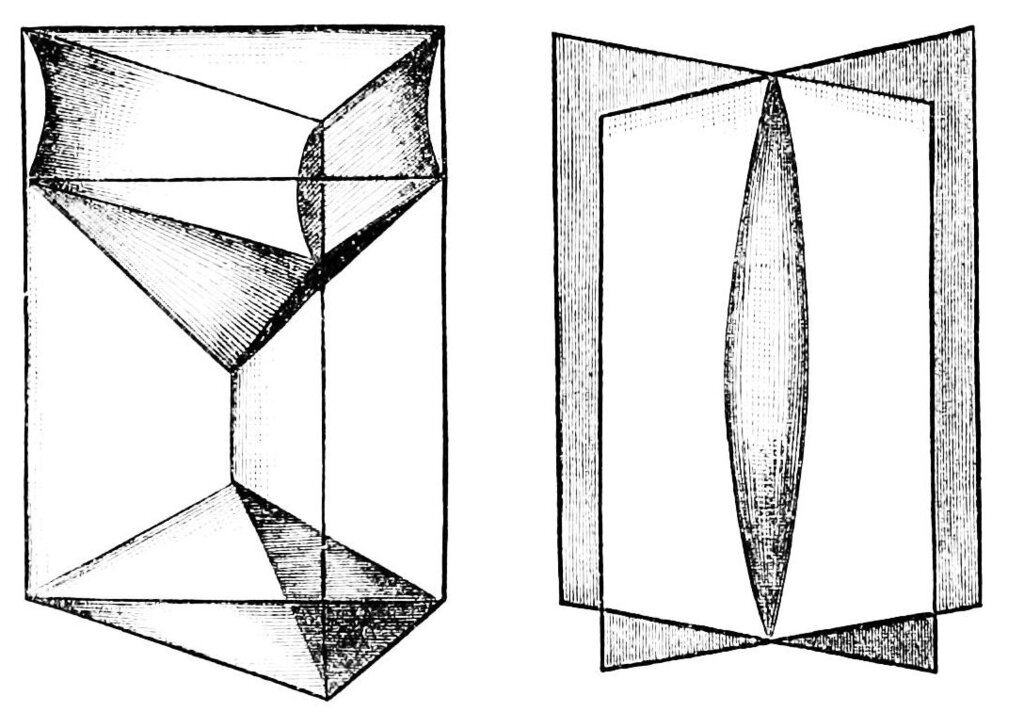
A minimal surface is one that locally minimizes its area. Think of it like a perfectly balanced tent fabric pulled taut. At every single point on the surface, the pull in one direction is perfectly counteracted by the push in another. This balance means the surface is as small as it can be without breaking away from its boundary.
Mathematically, this property of being 'perfectly balanced' at every point is described by saying the surface has zero mean curvature.
mean curvature
noun
A measure of how a surface curves at a particular point. It's calculated by averaging the two principal curvatures, which are the maximum and minimum bending rates in perpendicular directions. For a minimal surface, this average is always zero.
This means that at any point on the surface, any curve bending one way (like a valley) is exactly balanced by a curve bending the opposite way (like a ridge). The result is a surface that isn't bulging out or caving in on average. It’s perfectly saddle-shaped at every point, unless it's completely flat.
Classic Examples
While a flat plane is the simplest minimal surface, things get much more interesting with more complex boundaries. Two of the most famous and earliest discovered examples are the catenoid and the helicoid.
The catenoid is the shape you get if you span a soap film between two parallel circular rings. It's also the surface created by rotating a catenary curve—the shape a hanging chain makes—around an axis.
The helicoid, on the other hand, looks like a spiral staircase or a screw. It's a surface traced by a line rotating around a central axis while also moving along it. Remarkably, aside from a simple plane, the helicoid is the only minimal surface that is also a 'ruled surface'—meaning it can be formed entirely by sweeping a straight line through space.
For a long time, the catenoid and helicoid were thought to be distinct. But in 1856, the mathematician Ossian Bonnet discovered a surprising connection: you can continuously bend and twist a piece of a helicoid to form a catenoid, all without stretching the surface. Throughout this entire transformation, it remains a minimal surface.
From Math to Nature
The study of minimal surfaces began in the 18th century with Joseph-Louis Lagrange, who was exploring problems in the calculus of variations—a field of math focused on finding functions that maximize or minimize certain quantities. Later, the Belgian physicist Joseph Plateau conducted famous experiments with soap films, showing how they physically solve the mathematical problem of finding a minimal surface for a given boundary. These experiments were so influential that the problem of finding a minimal surface is often called Plateau's problem.
The theory was further developed by giants of mathematics like Bernhard Riemann and Hermann Schwarz. They established a deep connection between minimal surfaces and complex analysis, a branch of math dealing with functions of complex numbers. This connection opened the door to discovering and understanding a whole family of new minimal surfaces.
Minimal surfaces are a perfect example of how abstract mathematical ideas can describe the real world. The same principles that govern a soap film also appear in fields like materials science, architecture, and even biology, showing how nature often finds the most efficient and elegant solutions.
What fundamental property does a soap film demonstrate when it forms on a wire frame?
A minimal surface is mathematically defined as a surface with zero ____.