Exploring Kabbalah
Introduction to Kabbalah
The Hidden Tradition
Beyond the laws and stories that form the bedrock of Judaism lies a deeper, mystical stream of thought. This is Kabbalah, the esoteric heart of Jewish wisdom. The word itself comes from the Hebrew root meaning "to receive," highlighting its nature as a tradition passed down from teacher to student.
Kabbalah isn't just about intellectual study. Its purpose is to understand the nature of God, the universe, and our place within it all. It seeks to answer fundamental questions: How did a limitless, infinite creator bring about a finite world? And how can we, as finite beings, connect with that infinite source?
It’s a spiritual path that uses ancient symbols and complex theological ideas to guide the soul toward a direct experience of the divine.
The Limitless Light
At the core of Kabbalistic thought is the concept of God as an unknowable, boundless reality. This ultimate source is called Ein Sof.
Ein Sof
noun
A Hebrew term meaning "without end" or "the Infinite." It refers to the divine essence in its purest, most transcendent state, beyond all human description or comprehension.
Imagine trying to grasp the entire ocean by holding a cup of water. The cup gives you a taste, but it can't contain the ocean's vastness. Similarly, our minds cannot contain the Ein Sof. It is the absolute, undifferentiated unity from which everything emerges. It isn't a being with thoughts or emotions, but the infinite potential for all being.
Mapping the Divine
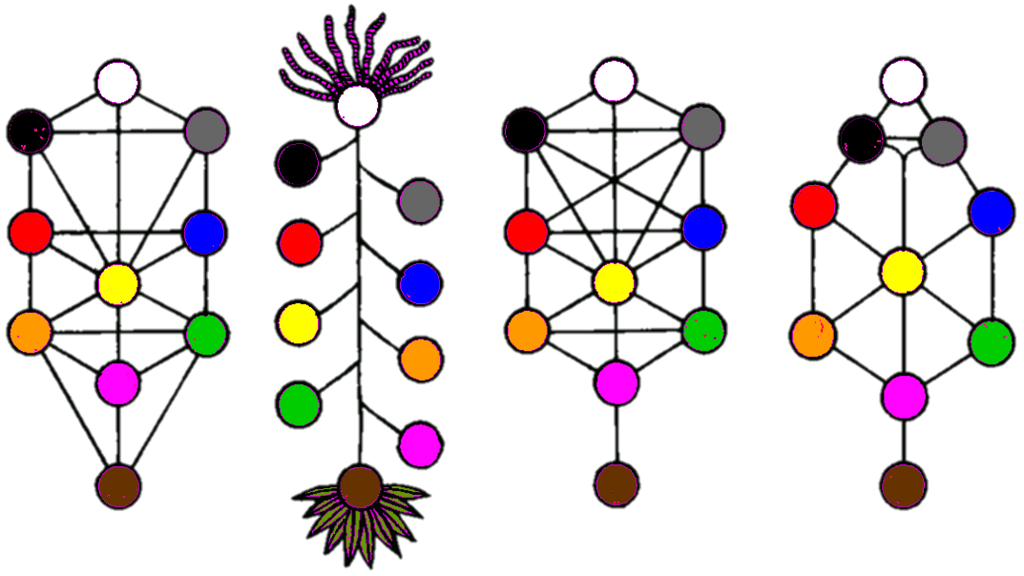
If God is unknowable, how do we experience the divine in our world? Kabbalah explains this through the Sefirot. These are ten divine attributes or emanations that flow from the Ein Sof, creating the universe and everything in it. Think of them as colored lenses through which the pure, white light of the Ein Sof shines, each revealing a different aspect of God's nature.
These ten Sefirot are not separate gods; they are interdependent facets of a single reality. They include concepts like Chokmah (Wisdom), Binah (Understanding), Chesed (Loving-kindness), and Gevurah (Strength or Judgment). Together, they form the blueprint of creation.
The Sefirot are famously arranged in a diagram known as the Tree of Life. This map illustrates how the divine energy flows down from the highest, most spiritual realms into our physical world. It's a model of the cosmos, the human soul, and the spiritual path an individual can walk to reconnect with their divine source.
This structure isn't just cosmic; it's also personal. Kabbalists see the Tree of Life reflected in the human body and psyche, suggesting that by understanding this divine map, we can better understand ourselves.
A Brief History
While Kabbalah became most prominent in the Middle Ages, its roots stretch back to ancient times. Early forms of Jewish mysticism, known as Merkabah mysticism, focused on meditative practices to achieve ecstatic visions of the divine throne, as described by the prophet Ezekiel. These early mystics, or "riders of the chariot," sought to journey through spiritual realms to approach God.
Kabbalah as we know it began to take shape in the 12th and 13th centuries in Provence, France, and Catalonia, Spain. It was during this period that one of its most important texts emerged: the Zohar.
Zohar
noun
The foundational work of Kabbalah, written as a mystical commentary on the Torah. Its Hebrew name means "Splendor" or "Radiance."
Traditionally attributed to the 2nd-century sage Shimon bar Yochai, scholars believe the Zohar was written by the 13th-century Spanish Kabbalist Moses de León. Written in Aramaic, it presents a rich tapestry of mystical allegories, myths, and interpretations of the Torah. Its publication marked a turning point, making Kabbalistic ideas more widely available and establishing the framework for all subsequent Kabbalistic thought.
What is the literal meaning of the Hebrew word 'Kabbalah'?
In Kabbalistic thought, the Ein Sof is best described as:
These foundational concepts—Ein Sof, the Sefirot, and the Tree of Life—provide the basic vocabulary for exploring the profound and intricate world of Jewish mysticism.