Exploring Hypersonic Flow Regimes
Introduction to Hypersonic Flow
Beyond Supersonic
Fluid dynamics changes dramatically with speed. We live our lives in subsonic flow, where the speed of sound is the ultimate speed limit. Break that barrier, and you're in the supersonic realm, a world of shock waves and sonic booms.
But what happens when you go even faster? Much faster?
Welcome to hypersonic flow. This isn't just a speedier version of supersonic. It's a distinct physical regime that begins around Mach 5, or five times the speed of sound. At these incredible velocities, the air itself starts to behave in strange and extreme ways.
Mach Number
noun
A dimensionless quantity representing the ratio of flow velocity past a boundary to the local speed of sound.
While a supersonic jet at Mach 2 creates shock waves, a hypersonic vehicle at Mach 10 creates something far more intense. The shock waves in hypersonic flow are incredibly strong and they hug the vehicle's body much more closely. This thin layer of intensely compressed, superheated air between the shock wave and the vehicle is where the most extreme physics happens.
The Wall of Heat
One of the biggest consequences of this intense compression is aerodynamic heating. At hypersonic speeds, the friction and compression of air molecules generate immense heat on the vehicle's surface. We're not talking about things getting a little warm; temperatures can reach thousands of degrees, easily hot enough to melt steel.
This isn't just a surface effect. The layer of air trapped between the shock wave and the vehicle becomes a superheated plasma. The air molecules themselves can be torn apart and ionized, creating a chemically reactive sheath around the vehicle. This thermal challenge is the single greatest obstacle in hypersonic flight.
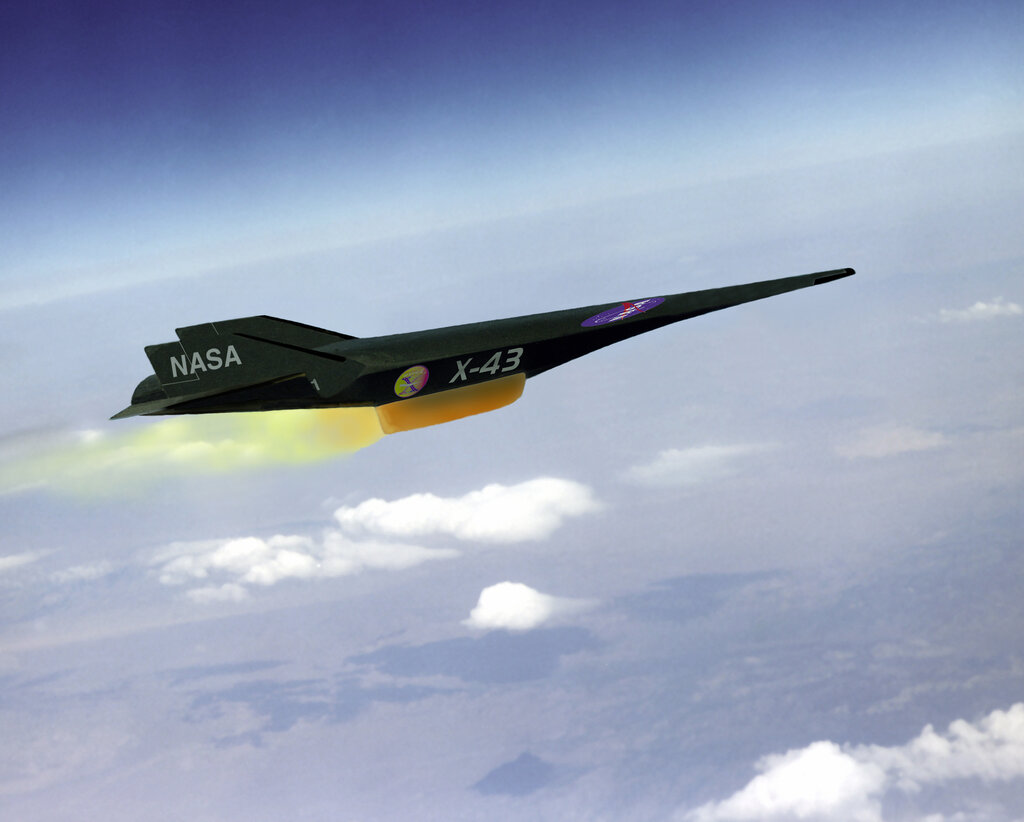
Engineering at the Edge
The unique physics of hypersonic flow presents a massive set of engineering challenges. How do you build a vehicle that can withstand such extreme temperatures without melting or breaking apart? Standard aerospace materials like aluminum are useless. Engineers must turn to exotic materials like carbon composites and special ceramics that can handle the heat or actively cool the vehicle's skin.
Control is another problem. The superheated plasma surrounding a hypersonic vehicle can block radio signals, causing a communications blackout. And the extreme forces mean that control surfaces (like wings and rudders) behave very differently than they do at lower speeds.
Furthermore, designing an engine that can operate in these conditions is incredibly difficult. A traditional jet engine can't work when the incoming air is already moving at hypersonic speeds. This has led to the development of new propulsion systems, like scramjets, which are specifically designed to operate in this extreme environment.
Mastering hypersonic flight requires solving challenges in materials science, aerodynamics, control systems, and propulsion all at once.
Ready to test your knowledge?
Around what Mach number is the boundary between supersonic and hypersonic flow generally considered to be?
What is a key physical phenomenon that distinguishes hypersonic flow from supersonic flow?
Understanding these principles is the first step toward appreciating the incredible engineering behind the next generation of aerospace vehicles.