Exploring Energy Work Techniques
Understanding Energy
What Is Energy?
In physics, energy is the ability to do work. It's the force that makes things happen, move, or change. Think about kicking a soccer ball. Your leg moves, the ball flies through the air, and the goalie has to stop it. All of that requires energy.
Energy
noun
The quantitative property that must be transferred to an object in order to perform work on, or to heat, the object.
Energy isn't a substance you can hold in your hand. It's a property of objects and systems. A car has energy when it's moving, a battery has energy stored inside it, and even a warm cup of coffee has energy. We measure energy in units called joules (J). A single joule is a tiny amount of energy, roughly what it takes to lift a small apple one meter off the ground.
Two Main Flavors of Energy
While energy comes in many forms, they all fall into two main categories: kinetic energy and potential energy. Understanding these two types is the key to understanding all the rest.
Kinetic energy is the energy of motion. Anything that is moving has kinetic energy, from a planet orbiting the sun to a tiny electron buzzing around an atom.
The amount of kinetic energy an object has depends on two things: its mass and its speed. A heavy truck moving at 50 miles per hour has much more kinetic energy than a small car moving at the same speed. And that same car has more kinetic energy at 50 mph than it does at 20 mph. The relationship is described by this formula:
The other main type is potential energy, which is stored energy. It's the energy an object has because of its position or state. A stretched rubber band has potential energy. A book sitting on a high shelf has gravitational potential energy because gravity can make it fall. The chemical bonds in a matchstick hold chemical potential energy, ready to be released.
Many other forms of energy are just specific types of kinetic or potential energy.
| Form | Type | Description |
|---|---|---|
| Thermal Energy | Kinetic | The total energy of moving atoms and molecules in a substance. We feel it as heat. |
| Chemical Energy | Potential | Energy stored in the bonds of chemical compounds, like in food or batteries. |
| Radiant Energy | Kinetic | Energy that travels in waves, such as light, microwaves, and radio waves. |
| Electrical Energy | Kinetic | The energy of moving electrons through a conductor, like a wire. |
| Nuclear Energy | Potential | Energy stored in the nucleus of an atom, released during fission or fusion. |
Energy Never Disappears
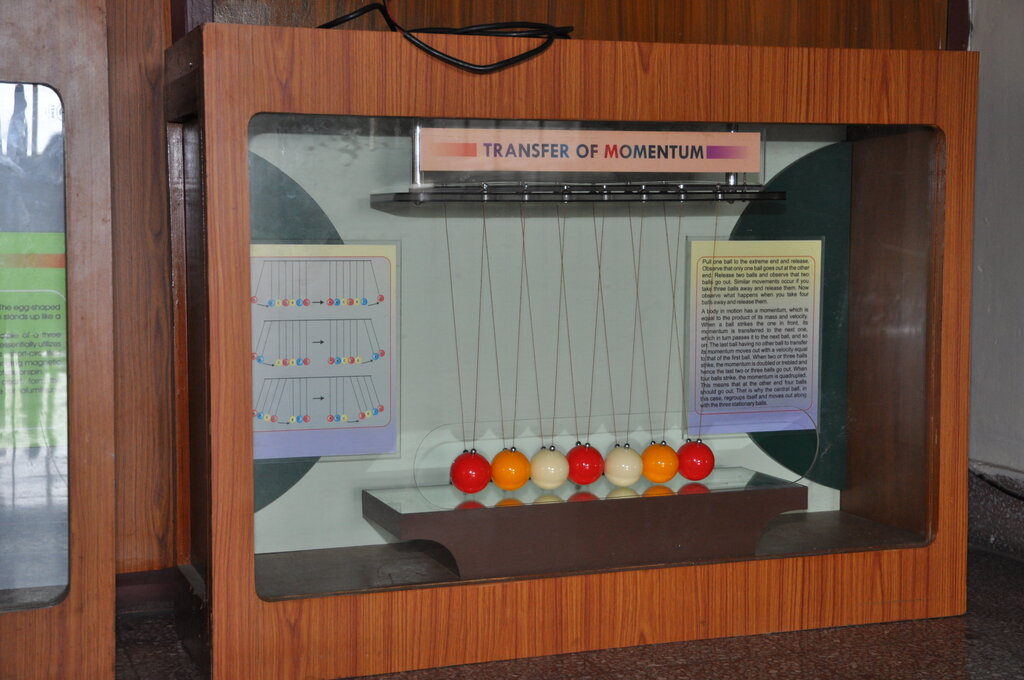
One of the most important rules in all of physics is the law of conservation of energy. It states that energy cannot be created or destroyed, only changed from one form to another.
The law of conservation of energy (which says that energy can change form but is never lost) ties together such topics as food calories, batteries, heat, light, and watch springs.
The total amount of energy in a closed system always stays the same. Think back to the roller coaster. At the top of the hill, it's loaded with potential energy. As it races down, that potential energy is converted into kinetic energy. When it goes up the next hill, kinetic energy is converted back into potential energy. Some energy is also transformed into thermal energy due to friction with the tracks and air, which is why the wheels get warm.
This process of changing from one form to another is called energy transformation or energy conversion.
Here's another example: a flashlight.
- Chemical energy is stored in the batteries.
- When you turn it on, this chemical energy is transformed into electrical energy as electrons flow through the circuit.
- The electrical energy flows to the bulb, where it is transformed into radiant energy (light) and thermal energy (heat).
In every step, energy changes form, but the total amount of energy remains constant.
Ready to check your understanding?
In physics, what is the fundamental definition of energy?
A roller coaster car is sitting motionless at the very top of its highest hill. At this point, it has the maximum amount of __________ energy.