Exploring Computer Network Types
Introduction to Computer Networks
What Is a Network?
A computer network is simply a group of devices connected together. Think of it like a conversation between friends. For a conversation to happen, you need people who can talk and listen, and a shared language they all understand. A network is similar, but with computers, phones, printers, and servers as the participants.
The main purpose of networking is to share things. This could be information, like a file or an email, or resources, like access to a single printer from multiple computers. By connecting devices, we can send data back and forth, collaborate on projects, and access the vast world of the internet. Your phone connecting to your home Wi-Fi is a perfect, everyday example of a network in action.
The core idea is simple: connect devices so they can communicate and share.
The Key Players
Every network, from the one in your home to the massive one at a global corporation, uses a few basic building blocks. Let's meet the essential components.
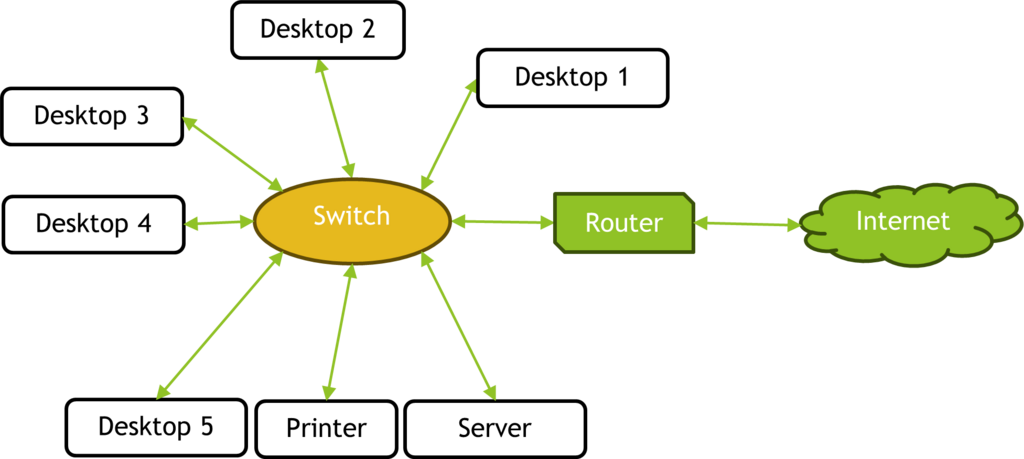
First, you have the devices themselves. These are the endpoints, like your laptop, smartphone, smart TV, or a company server. In network terms, they're often called hosts or clients.
Next are switches. A switch acts like a local traffic coordinator. It connects multiple devices within the same network, like all the computers in one office. When one computer sends a file to another, the switch ensures the data goes directly to the correct destination without bothering other devices. It's the digital equivalent of a mail sorter in an office building, making sure each letter gets to the right desk.
Then there are routers. While a switch connects devices on the same network, a router connects different networks together. The most common example is the router in your home. It connects all your personal devices (your local network) to the internet (a giant, global network). It's the gateway that lets your data travel out into the world and directs incoming data to the right device in your home.
| Component | Primary Role |
|---|---|
| Device (Host) | Sends or receives data (e.g., your laptop, phone) |
| Switch | Connects devices on the same local network |
| Router | Connects different networks together (e.g., your home to the internet) |
The Rules of Communication
For devices to communicate effectively, they need to follow a set of rules. You can't just send a jumble of digital bits and hope for the best. These rules are called communication protocols.
A protocol is like a shared language and a set of conversational etiquette for computers. It defines how data should be formatted, addressed, transmitted, and received. It ensures that a message sent from a computer in one country can be perfectly understood by a server in another, even if they are made by different manufacturers and run different software.
Protocols are the grammar of the digital world. Without them, the internet would be chaos.
You don't need to know the details of every protocol, but it's helpful to understand their purpose. They handle everything from establishing a connection and breaking data into small packets for transmission to making sure all the packets arrive and are reassembled in the correct order.
These networks and protocols are all around us. Your home Wi-Fi is a small network that lets your devices share an internet connection. The office where you work has a larger network for sharing files and printers. Even the system that lets you pay with a credit card at a coffee shop relies on a secure network to process the transaction. They are the invisible infrastructure of modern life.
What is the primary purpose of a computer network?
Which device is responsible for connecting different networks together, such as connecting your home network to the internet?