Exploring Chinese Dialects
Introduction to Chinese Dialects
One Language, Many Voices
When people talk about "speaking Chinese," they're usually referring to Mandarin. But the linguistic landscape of China is far more complex. What are often called "dialects" are, in many cases, distinct languages that fall under the umbrella of the Chinese language family.
Think of it like the Romance languages in Europe. Spanish, French, and Italian all descended from Latin, but a Spanish speaker can't have a casual conversation with a French speaker. The same is true for Chinese. Someone who speaks Cantonese from Guangzhou would find it nearly impossible to understand someone speaking Shanghainese, a Wu dialect.
These varieties share a common written script—Chinese characters—but their spoken forms are mutually unintelligible.
Dialect
noun
In China, "dialects" (方言, fāngyán) are often as different from each other as separate languages. Speakers of different dialects usually cannot understand one another.
Linguists group the hundreds of local varieties into seven major dialect groups. Let's take a look at where they are spoken and by how many people.
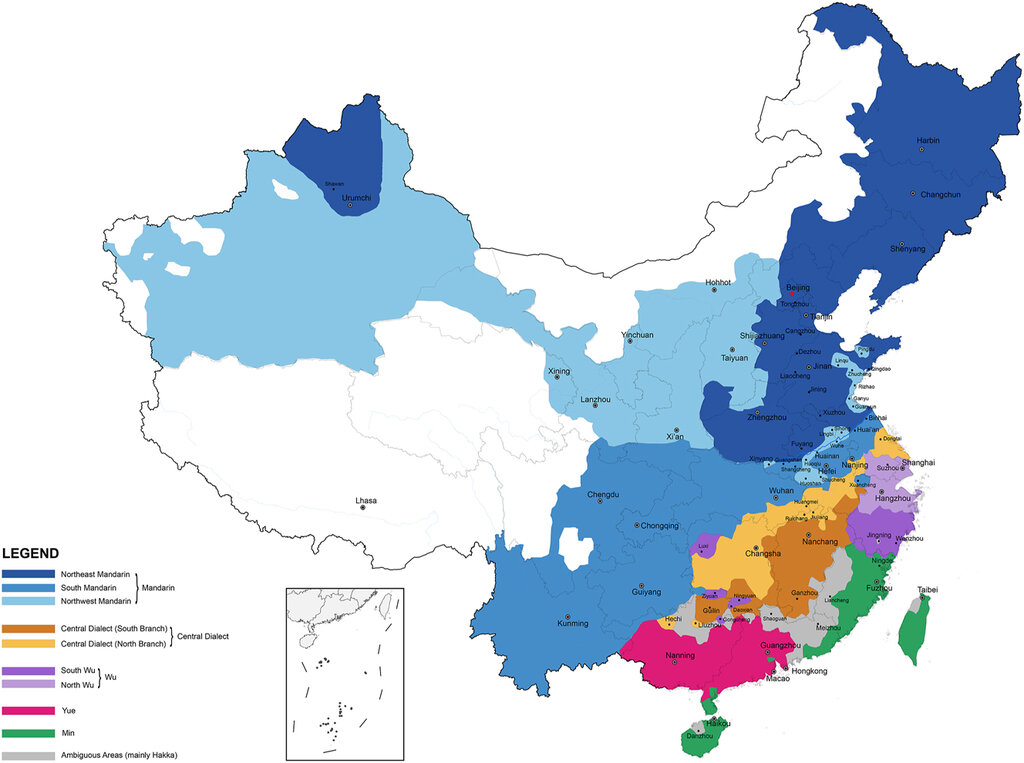
The Seven Major Groups
Each dialect group has its own unique sounds, vocabulary, and grammar. While they all belong to the same language family, their differences are vast. The table below gives a quick overview of the main groups.
| Group | Speakers (approx.) | Main Geographic Area |
|---|---|---|
| Mandarin (官话) | 920 million | Northern, Central, and Southwestern China |
| Wu (吴语) | 82 million | Shanghai, Zhejiang, southern Jiangsu |
| Yue (粤语) | 68 million | Guangdong, Guangxi, Hong Kong, Macau |
| Min (闽语) | 60 million | Fujian, eastern Guangdong, Hainan, Taiwan |
| Xiang (湘语) | 38 million | Hunan province |
| Hakka (客家话) | 48 million | Scattered across southeastern China |
| Gan (赣语) | 22 million | Jiangxi province |
A Closer Look
Mandarin (官话, Guānhuà) is the largest group by far. As the basis for Standard Chinese, it's the official language of China, Taiwan, and Singapore. Its massive number of speakers and official status make it the lingua franca across the country.
Wu (吴语, Wúyǔ) is famous for its soft, flowing sounds. Its most well-known representative is Shanghainese. It's spoken in the economically powerful Yangtze River Delta.
Yue (粤语, Yuèyǔ), commonly known as Cantonese, is spoken in southern China's Guangdong province, as well as in Hong Kong and Macau. It has a major global presence due to historical emigration from the region.
Min (闽语, Mǐnyǔ) is one of the most diverse groups. The dialects within Min are often not mutually intelligible with each other. It's spoken in Fujian province and has spread to Taiwan and across Southeast Asia, where it's known as Hokkien.
Xiang (湘语, Xiāngyǔ), also known as Hunanese, is spoken primarily in Hunan province. It's heavily influenced by the surrounding Mandarin-speaking regions.
Hakka (客家话, Kèjiāhuà) literally means "guest family language." Its speakers are found in scattered communities across southeastern China and throughout the global Chinese diaspora. They are thought to have migrated from northern China centuries ago.
Gan (赣语, Gànyǔ) is concentrated in Jiangxi province. It shares some features with Hakka and is geographically close to Mandarin, Wu, and Min-speaking areas.
Ready to test your knowledge of China's linguistic diversity?
The relationship between different Chinese languages like Cantonese and Shanghainese is best compared to the relationship between which of the following?
Which language group serves as the basis for Standard Chinese and is the official language of China?
Understanding these dialect groups is the first step to appreciating the incredible diversity within the Chinese-speaking world.