Exploring Car Engine Types
Engine Basics
Harnessing Explosions
Most cars on the road today are powered by an internal combustion engine, or ICE. The name sounds complex, but the idea is simple: it creates power by burning fuel inside the engine itself. Think of it as a series of tiny, controlled explosions pushing parts to create motion. This is how the chemical energy in gasoline is turned into the mechanical energy that spins your wheels.
Internal combustion engines convert chemical energy from fuel into mechanical energy through combustion process
At the heart of this process are two key components: the cylinder and the piston. A cylinder is a hollow, round chamber, and a piston is a solid plug that fits snugly inside it. The piston can slide up and down within the cylinder. An engine has several of these cylinder-piston pairs working together.
piston
noun
A cylindrical component that moves up and down inside the cylinder of an engine.
The entire process that generates power happens in a continuous, repeating sequence called the four-stroke cycle. Each up or down movement of the piston is called a stroke. Let's walk through what happens in a single cylinder.
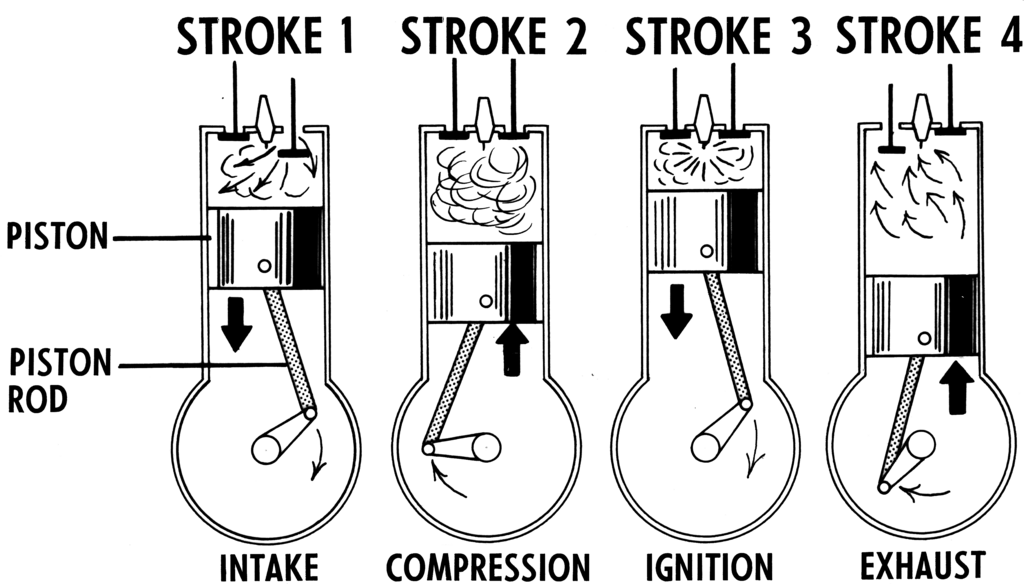
The Four-Stroke Cycle
This cycle is the engine's entire playbook, repeated thousands of times per minute.
| Stroke | Piston Movement | What Happens |
|---|---|---|
| 1. Intake | Moves Down | The piston lowers, creating a vacuum that sucks a mixture of air and fuel into the cylinder. |
| 2. Compression | Moves Up | The piston moves up, squeezing the air-fuel mixture into a much smaller space. This makes it highly combustible. |
| 3. Power | Forced Down | A spark plug ignites the compressed mixture. The resulting explosion forces the piston down with great power. This is the stroke that creates motion. |
| 4. Exhaust | Moves Up | The piston travels back up, pushing the burnt gases out of the cylinder to make way for the next cycle. |
In short: Suck, Squeeze, Bang, Blow. That's the four-stroke cycle in a nutshell.
Connecting the Pieces
So how does the piston's up-and-down movement make the wheels turn? Two other parts make this happen: the crankshaft and the camshaft.
The crankshaft is a rotating shaft connected to the bottom of all the pistons. As the pistons are forced down during the power stroke, they push on the crankshaft, causing it to spin. Think of it like your legs pushing pedals on a bicycle. This rotational motion is what ultimately powers the car.
The camshaft is another rotating shaft, but its job is to manage the flow of air, fuel, and exhaust. It has egg-shaped lobes called cams that open and close the valves at the top of the cylinder at precisely the right moments in the four-stroke cycle.
The camshaft is synchronized to turn at exactly half the speed of the crankshaft. This perfect timing ensures that for every two full rotations of the crankshaft (which completes one four-stroke cycle), the camshaft completes one rotation, opening and closing each valve once.
Let's check your understanding of these core concepts.
What is the primary function of an internal combustion engine?
Which component is responsible for converting the pistons' up-and-down movement into the rotational motion that powers the wheels?
These fundamental components and the four-stroke cycle are the basis for nearly all gasoline-powered cars. Understanding them is the first step to knowing what's happening under the hood.