Exploring Artificial Intelligence
Introduction to Artificial Intelligence
What Is Artificial Intelligence?
Artificial intelligence, or AI, is the science of making computers do things that normally require human intelligence. Think of it like teaching a machine to learn, reason, and solve problems. It's not about creating robots that look and act exactly like us, but about building systems that can analyze information and make smart decisions based on it.
This introduction to this special issue discusses artificial intelligence (AI), commonly defined as “a system’s ability to interpret external data correctly, to learn from such data, and to use those learnings to achieve specific goals and tasks through flexible adaptation.”
At its heart, AI relies on algorithms. An algorithm is just a set of rules or instructions a computer follows to complete a task. For AI, these algorithms are designed to process huge amounts of data, find patterns, and make predictions.
algorithm
noun
A process or set of rules to be followed in calculations or other problem-solving operations, especially by a computer.
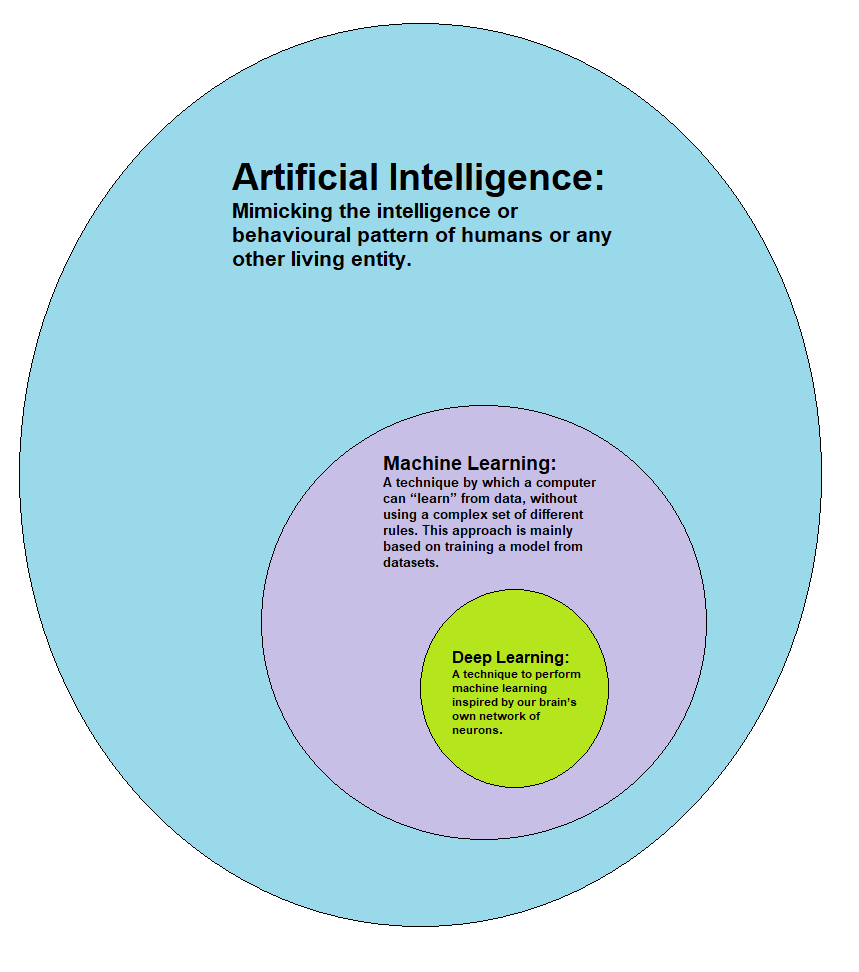
AI isn't a single technology. It's a broad field with many subfields. You've likely heard terms like machine learning and deep learning, which are specific ways of achieving artificial intelligence. Machine learning allows systems to learn from data without being explicitly programmed, while deep learning is a more advanced type of machine learning inspired by the structure of the human brain.
How AI Works
The basic principle of most modern AI is learning from examples. An AI system is trained on a massive dataset, allowing it to recognize patterns and relationships. For example, to teach an AI to identify pictures of cats, you'd show it millions of images, some with cats and some without. The system learns the features that define a cat—whiskers, pointy ears, fur patterns—and uses that knowledge to identify cats in new, unseen photos.
This process can be broken down into three simple steps: input, processing, and output.
This simple cycle applies to almost any AI system. Whether it's recommending a movie, translating a sentence, or navigating a car, the AI takes in data, processes it through its learned model, and produces a useful output.
AI All Around Us
Artificial intelligence isn't just a futuristic concept; it's already a part of our daily lives. When your favorite streaming service suggests a new show you might like, that's AI analyzing your viewing habits to make a recommendation. When you ask your phone for directions, AI is calculating the fastest route based on real-time traffic data.
In industry, AI is transforming how businesses operate. It powers everything from fraud detection systems at banks to automated assembly lines in factories. In healthcare, AI helps doctors diagnose diseases earlier and more accurately by analyzing medical images like X-rays and MRIs. Farmers use AI to monitor crop health and optimize yields, while retailers use it to manage inventory and predict what customers will want to buy.

Essentially, if a task involves finding patterns, making predictions, or automating complex decisions, there's a good chance AI can play a role. As a foundational technology, its applications are vast and continue to grow.