Exploring Artificial General Intelligence
Introduction to AI
What Is Artificial Intelligence?
At its core, Artificial Intelligence (AI) is about creating computer systems that can perform tasks that typically require human intelligence. This includes things like learning from experience, solving problems, understanding language, and recognizing patterns in images or sounds.
Artificial Intelligence
noun
A field of computer science dedicated to creating systems that can perform tasks that normally require human intelligence.
Think about how you recognize a friend's face in a crowd. Your brain processes visual information, compares it to memories, and makes a match almost instantly. AI researchers work to build systems that can do the same thing, just with data and algorithms instead of neurons.
But AI isn't a single technology. It's a broad field with many different approaches and applications, from the algorithm that recommends movies on a streaming service to the software that helps doctors diagnose diseases.
AI is a broad field that encompasses machine learning, deep learning, natural language processing, computer vision, and more.
A Brief History of AI
The dream of creating intelligent machines is ancient, but the scientific pursuit of AI began in the mid-20th century. The field was officially born at a 1956 workshop at Dartmouth College, where the term "Artificial Intelligence" was coined.
Early AI research was full of optimism. Pioneers believed that a machine with human-like intelligence was just a few decades away. They created programs that could solve algebra problems and play checkers. However, the initial excitement was followed by periods of reduced funding and interest, often called "AI winters," when the complexity of the problems proved much harder than anticipated.
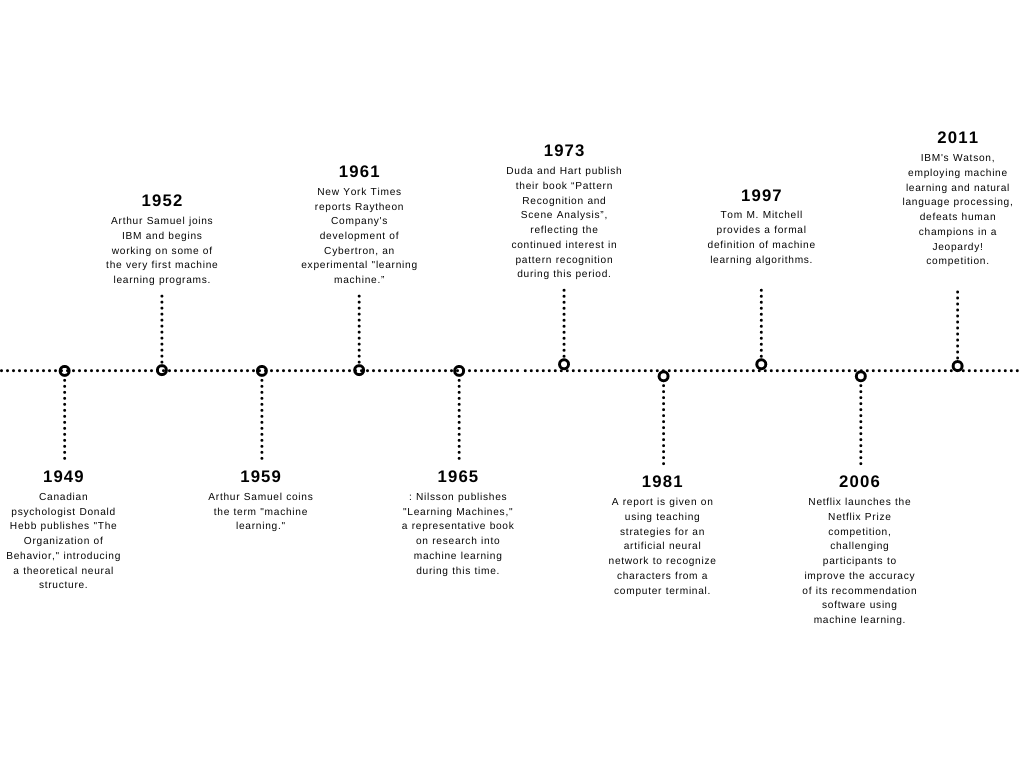
The field saw a resurgence with the rise of machine learning in the 1980s and 90s, and again in the 2010s with breakthroughs in deep learning. These advances were fueled by two key factors: the availability of massive amounts of data and the development of much more powerful computers.
Here are a few key moments in AI's evolution:
| Year | Milestone |
|---|---|
| 1950 | Alan Turing proposes the "Turing Test" to measure a machine's intelligence. |
| 1956 | The term "Artificial Intelligence" is coined at the Dartmouth Conference. |
| 1966 | ELIZA, an early natural language processing program, is created. |
| 1997 | IBM's Deep Blue defeats world chess champion Garry Kasparov. |
| 2011 | IBM's Watson wins the quiz show Jeopardy! against human champions. |
| 2010s | Deep learning techniques lead to major advances in image and speech recognition. |
Types of AI in Use Today
When people talk about AI today, they are almost always referring to what's known as Artificial Narrow Intelligence (ANI), or "weak AI." This is AI that is designed and trained for one specific task.
A chess-playing AI is a perfect example of narrow AI. It can beat any human on the planet at chess, but it can't do anything else. You couldn't ask it for driving directions or to recommend a good book.
Virtually every AI application you interact with is a form of narrow AI. This includes:
- Voice Assistants: Siri, Alexa, and Google Assistant are trained for natural language processing and executing specific commands.
- Image Recognition: Software that tags your friends in photos on social media.
- Recommendation Engines: The systems that suggest products on Amazon or shows on Netflix.
- Spam Filters: Algorithms in your email client that learn to identify and block unwanted messages.
These systems are incredibly powerful and useful, but their intelligence is confined to a limited, pre-defined range. They operate within a specific context and can't apply their knowledge to other domains.
The term "AI" also refers to the entire field of study. In this broader sense, AI encompasses all the efforts to build intelligent systems, including all the various forms of narrow AI as well as the ongoing research into more complex problem-solving and learning capabilities. It's the overarching discipline that contains all these specific applications.
Ready to check your understanding? Let's see what you've learned.
What is the primary goal of Artificial Intelligence?
The term "Artificial Intelligence" was officially coined at which event?
Understanding these basic concepts is the first step. You now have a solid foundation for what AI is, where it came from, and how it's used today.