Exploring Artificial General Intelligence
Introduction to AGI
The Dream of a General AI
For decades, artificial intelligence was more science fiction than reality. Today, AI is all around us, from the navigation apps on our phones to the algorithms that suggest movies. But most of these systems are specialists. They're designed to do one thing very well, like recognizing faces or translating languages. The long-held dream of AI research is something much broader: an intelligence that can think, learn, and adapt like a human.
Artificial General Intelligence is the ability of an AI agent to learn, perceive, understand, and function completely like a human being.
This is the core idea behind Artificial General Intelligence, or AGI. An AGI wouldn't need to be reprogrammed to tackle a new problem. It could draw on its existing knowledge and learn new skills to solve tasks it has never seen before. It represents a shift from AI that performs specific, programmed tasks to one that possesses a flexible, comprehensive understanding of the world.
Specialist vs. Generalist
The AI we interact with daily is often called Artificial Narrow Intelligence (ANI), or weak AI. Think of a grandmaster chess computer. It can analyze millions of moves and defeat any human player, but it can't tell you the rules of checkers or recommend a good book. Its intelligence is deep but extremely narrow.
ANI is a master of one trade. AGI would be a master of learning any trade.
An AGI, by contrast, would have generalized cognitive abilities. It could learn the rules of chess, understand the strategic principles behind the game, and then apply those reasoning skills to a completely different domain, like business strategy or urban planning. It wouldn't just follow instructions; it would understand context and transfer knowledge.
| Feature | Artificial Narrow Intelligence (ANI) | Artificial General Intelligence (AGI) |
|---|---|---|
| Scope | Performs a single, specific task | Can handle a wide range of tasks |
| Learning | Limited to its designated function | Learns and adapts across different domains |
| Flexibility | Inflexible; cannot perform outside its programming | Highly flexible and adaptable |
| Example | Spam filters, image recognition, chess bots | A hypothetical AI that can write, code, and invent |
The Road to AGI
The concept of a thinking machine is not new. The journey toward AGI is really the story of AI itself, marked by periods of excitement and quiet progress. It all started with an ambitious question: can machines think?
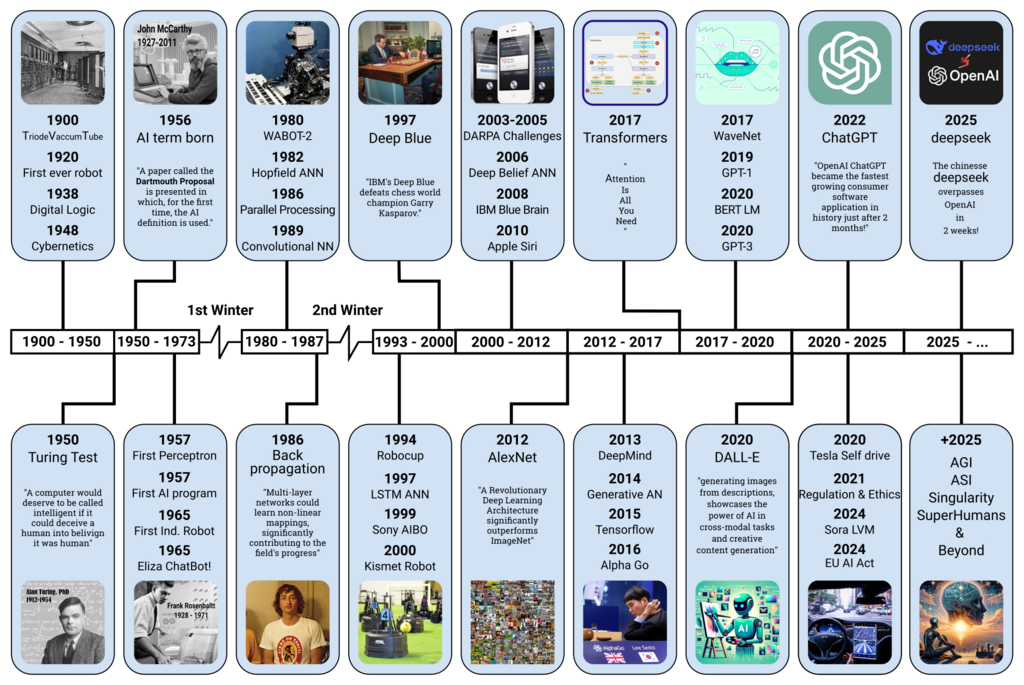
In the 1950s, pioneers like Alan Turing laid the theoretical groundwork. The term "artificial intelligence" was coined in 1956 at a workshop at Dartmouth College, where researchers gathered to explore how machines might simulate human learning and intelligence. Early AI programs could solve algebra problems and prove logical theorems, sparking enormous optimism.
The path wasn't always smooth. The complexity of creating true intelligence led to periods known as "AI winters," when funding and interest waned. But breakthroughs continued. The 1990s saw IBM's Deep Blue defeat chess champion Garry Kasprov, a landmark achievement for ANI. In the 2010s, the rise of deep learning and massive datasets fueled a new wave of progress, leading to the powerful language models and generative tools we see today. Each step, while focused on narrow tasks, has provided crucial building blocks for the pursuit of a more general intelligence.
This historical context is important. It shows that AGI is not a sudden invention but the culmination of decades of research. While true AGI remains a hypothetical goal, it is the driving force behind much of the innovation in the field, pushing researchers to build systems that are more flexible, capable, and ultimately, more intelligent.