Exploring Antigravity Concepts
Introduction to Gravity
The Pull of the Universe
Gravity is the invisible force that orchestrates the universe. It holds galaxies together, keeps planets in orbit, and pins our feet to the ground. For centuries, we've tried to understand its nature, leading to two of the most profound theories in physics.
Gravity is the force of attraction between any two objects that have mass.
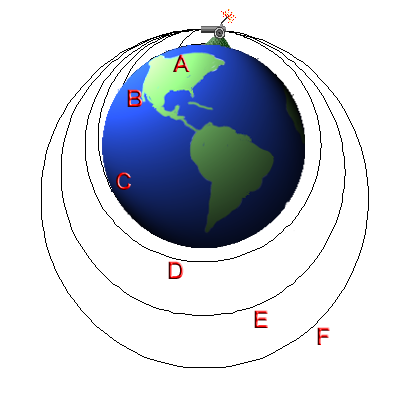
The first major breakthrough came from Isaac Newton. He realized that the same force causing an apple to fall from a tree is what keeps the Moon circling the Earth. This insight led to a universal law that described gravity's behavior with incredible accuracy.
Newton's Universal Law
Newton proposed that every object with mass pulls on every other object with mass. The strength of this pull depends on two things: how much mass the objects have and how far apart they are.
His Law of Universal Gravitation is captured in a simple, elegant equation:
Here’s what it means:
- is the gravitational force.
- and are the masses of the two objects. The more massive the objects, the stronger the force.
- is the distance between the centers of the objects. As the distance increases, the force gets weaker—and it does so dramatically. This is an "inverse-square law," meaning if you double the distance, the force drops to one-fourth of its original strength.
- is the gravitational constant, a very small number that scales the force. It’s what makes gravity noticeable for planets but practically undetectable for everyday objects like pencils and books.
According to Newton, a massive object like the Earth generates a gravitational field that fills the space around it. Any other object within this field feels a force pulling it toward the Earth's center. The field gets weaker the farther you are from the object.
Einstein's Warped Spacetime
Newton's law was revolutionary and is still used to calculate satellite orbits and planetary motion. But it had limits. It described how gravity worked, but not why. And it broke down in extremely strong gravitational fields. It took Albert Einstein to provide a new picture.
In his theory of general relativity, Einstein proposed that gravity isn't a force at all. Instead, it's a consequence of the curvature of spacetime.
Mass and energy tell spacetime how to curve, and the curvature of spacetime tells matter how to move.
Imagine a stretched-out rubber sheet. This sheet represents spacetime. Now, place a heavy bowling ball in the center. The sheet warps and creates a dip. If you roll a small marble nearby, it won't travel in a straight line; it will follow the curve in the sheet created by the bowling ball. That's gravity in a nutshell. Planets orbit the Sun not because the Sun is pulling them with a force, but because they are following the curved path in spacetime that the Sun's immense mass has created.
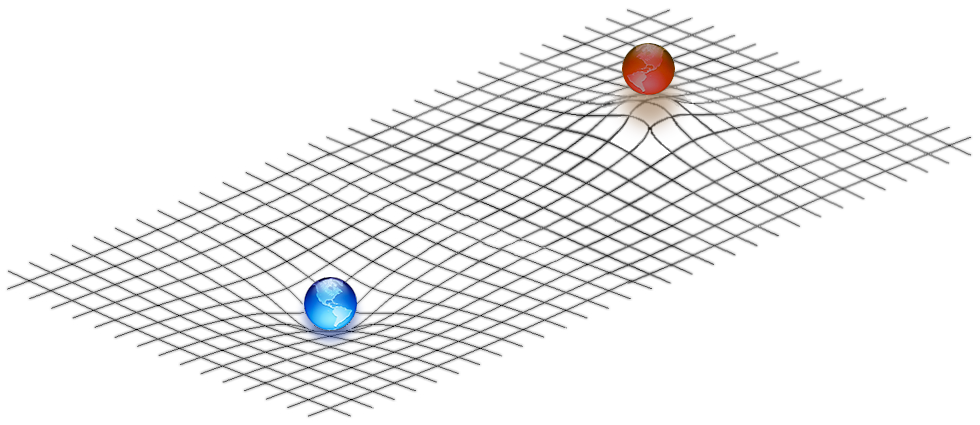
General relativity explained mysteries that Newton's law couldn't, like a tiny wobble in the orbit of Mercury. It also made a startling new prediction: that accelerating massive objects should create ripples in the fabric of spacetime itself.
Gravitational Waves
Einstein predicted that when massive objects like black holes or neutron stars collide, they send out waves of gravitational energy that travel at the speed of light. These are gravitational waves.
Think of it like dropping a rock into a still pond. The impact creates ripples that spread across the water's surface. Similarly, a cataclysmic cosmic event creates ripples that stretch and squeeze the fabric of spacetime as they pass.
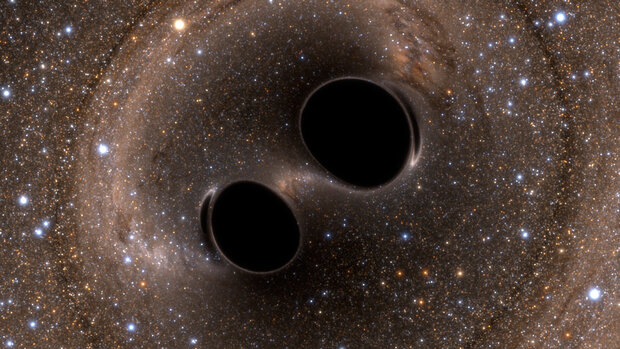
These distortions are incredibly tiny. By the time they reach Earth, they might stretch a kilometer-long object by less than the width of a proton. For a century, they were purely theoretical. But in 2015, the LIGO observatory made the first-ever direct detection of gravitational waves, confirming Einstein's prediction and opening a brand-new way to observe the universe.
According to Newton's Law of Universal Gravitation, if you double the distance between two objects, what happens to the gravitational force between them?
What is the primary way Albert Einstein's theory of general relativity describes gravity?
From Newton's universal pull to Einstein's curved reality, our understanding of gravity has shaped our view of the cosmos. These foundational ideas are the pillars upon which modern physics is built.