Exploring AI Language Model Capabilities
Introduction to Large Language Models
What Is a Large Language Model?
A Large Language Model, or LLM, is a type of artificial intelligence designed to understand and generate human language. Think of it as an extremely well-read student who has spent years in a library containing billions of books, articles, and websites. This student doesn't understand concepts in the human sense, but they've become an unmatched expert at recognizing and predicting patterns in text.
The fundamental task of an LLM is simple: predict the next word in a sequence. Given the phrase "the cat sat on the," the model calculates the most probable word to come next, which is likely "mat." By repeating this process over and over, LLMs can write sentences, paragraphs, and even entire articles.
A Large Language Model is a type of deep learning model trained on massive text corpora.
This ability to predict language patterns is what allows them to perform complex tasks. The
large
in their name refers to two things: the enormous amount of text they are trained on and the huge number of parameters they contain. A parameter is like a knob or a dial that the model can tune during training to improve its predictions. Modern LLMs can have hundreds of billions of these parameters, allowing them to capture incredibly subtle nuances of language.
The Architecture of LLMs
The breakthrough that paved the way for modern LLMs was an architecture called the Transformer, introduced in 2017. Before the Transformer, models like Recurrent Neural Networks (RNNs) processed text sequentially, one word at a time. This was like reading a sentence through a tiny peephole, making it difficult to remember context from the beginning of a long paragraph.
Transformers can process all the words in a sentence at once. This parallel processing is more efficient and, crucially, allows the model to weigh the importance of every word in relation to every other word, regardless of their distance. This core mechanism is called self-attention.
The Transformer model is the core architecture behind LLMs (Large Language Models).
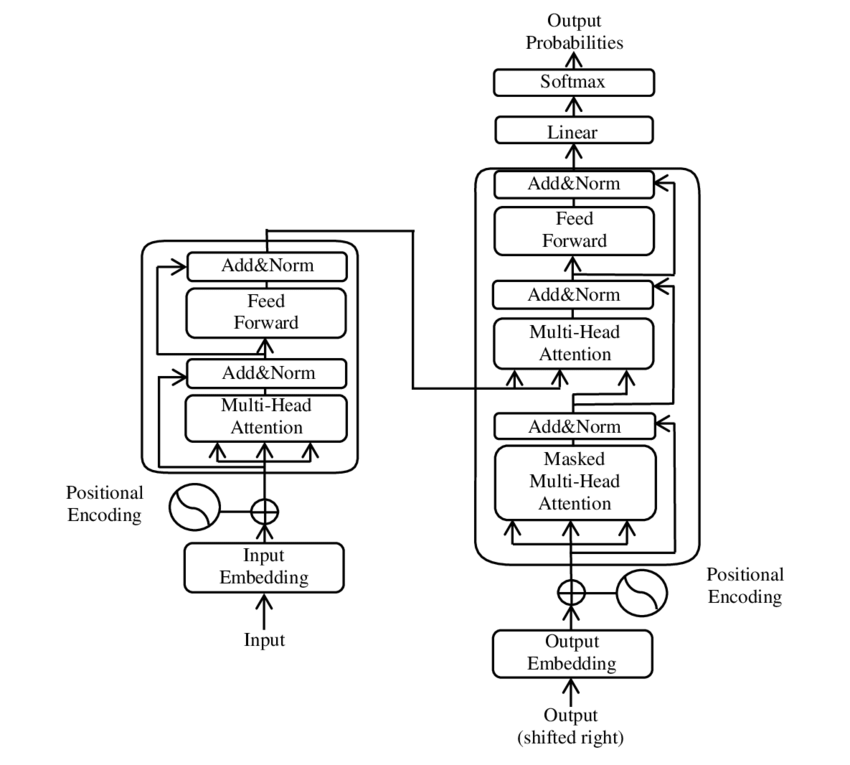
Self-attention allows the model to create richer, more context-aware representations of words. For example, in the sentence "The robot picked up the ball, but it was too heavy," self-attention helps the model understand that "it" refers to the "ball," not the "robot." It does this by creating an "attention score" between "it" and all other words in the sentence, giving a high score to "ball."
Training an LLM
Training an LLM happens in two main stages: pre-training and fine-tuning.
Pre-training is the long and computationally expensive initial phase. Here, the model is fed a massive, unlabeled dataset of text from the internet. Its goal is to learn the general patterns of language by predicting missing words or the next word in a sequence. This is where the model develops its broad understanding of grammar, facts, and reasoning abilities. This process is self-supervised because the training data (the text itself) provides the labels—no human annotation is needed.
After pre-training, we have a powerful but general-purpose model. It knows a lot about language but isn't specialized for any particular task.
Fine-tuning is the second stage, where the pre-trained model is adapted for a specific purpose. The model is trained on a much smaller, curated dataset that is labeled for a particular task, like answering questions or translating languages. This process adjusts the model's parameters to make it better at that specific job without losing the general knowledge it gained during pre-training.
This two-step process is highly efficient. Instead of training a massive model from scratch for every new task, developers can fine-tune an existing pre-trained model, saving significant time and resources.
Ready to test your knowledge? Let's see what you've learned about the fundamentals of Large Language Models.
What is the core, fundamental task that an LLM performs repeatedly to generate text?
The "Large" in Large Language Model primarily refers to the massive amount of training data and the huge number of what?
These foundational concepts—the Transformer architecture, self-attention, and the two-stage training process—are the building blocks that enable the powerful language capabilities of modern AI.