Exploring Acid Design
Introduction to ACID Properties
The ACID Test for Databases
In the world of databases, a transaction is any single, logical unit of work. This could be something simple like updating a user's email address or more complex, like transferring money from a savings to a checking account. For a database to be reliable, these transactions need to follow a strict set of rules. This set of rules is known by the acronym ACID.
ACID is a set of properties of database transactions intended to guarantee data validity despite errors, power failures, and other mishaps
ACID stands for Atomicity, Consistency, Isolation, and Durability. Think of these four properties as guarantees that a database management system makes. They ensure that your data remains accurate and predictable, even when multiple operations are happening at once or if the system unexpectedly crashes.
Breaking Down the Properties
Let's look at what each of these four guarantees means in practice.
Atomicity
noun
The 'all or nothing' property. A transaction is an indivisible unit that is either performed in its entirety or not at all. There is no partial completion.
Imagine you're transferring $100 from your savings account to your checking account. This transaction involves two steps: subtracting $100 from savings and adding $100 to checking. Atomicity guarantees that both of these steps happen. If the system crashes after the money is taken from savings but before it's added to checking, the entire transaction is rolled back. Your savings account goes back to its original balance, as if nothing ever happened.
Consistency
noun
Ensures that a transaction can only bring the database from one valid state to another, maintaining all predefined rules and constraints.
Consistency is about maintaining data integrity. Databases have rules, like "an account balance cannot be negative" or "every order must be linked to a valid customer ID." A transaction that would violate one of these rules is stopped and rolled back. This ensures the database's data is always in a usable, predictable state.
Isolation
noun
Ensures that concurrently executing transactions do not interfere with each other. The result is the same as if the transactions were executed one after another.
Databases are often used by many people or systems at the same time. What happens if two people try to book the last seat on a flight simultaneously? Isolation handles this. It makes sure that one transaction finishes before the next one can access the same data. From the perspective of each transaction, it's as if it's the only one running on the database, preventing confusion and errors.
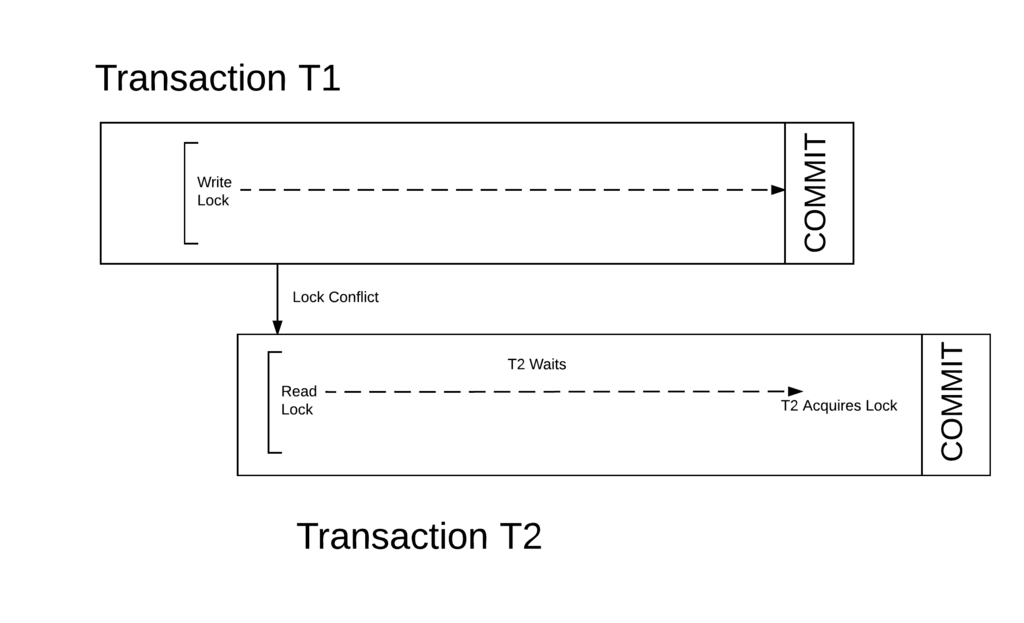
This prevents a scenario where both transactions see one seat available, both sell it, and the airline ends up with an overbooked flight.
Durability
noun
The guarantee that once a transaction has been committed, it will remain committed even in the event of a system failure, such as a power outage or crash.
Durability means that when the database tells you a transaction is complete, it means it. The changes are permanently recorded (usually to a disk or other non-volatile memory). If your banking app confirms your money transfer, you can be sure that money is transferred for good, even if the bank's server loses power a second later. The transaction won't be undone.
Ready to check your understanding?
Which ACID property ensures that a transaction is an 'all-or-nothing' operation, meaning either all of its operations are completed successfully or none of them are?
A banking application transfers $50 from a savings account to a checking account. The system crashes after deducting the money from savings but before adding it to checking. Thanks to the Atomicity property, what is the state of the accounts after the system reboots?
Together, these four properties ensure that database transactions are processed reliably, forming the foundation of modern database systems.