Exploring 3D Chaotic Maps
Introduction to Chaos Theory
The Order within Chaos
Some systems seem completely random, yet they follow strict, unchanging rules. This is the central puzzle of chaos theory. A chaotic system is not random; it's deterministic. If you know the exact starting point and the rules, you can, in principle, predict its entire future. The catch is the word 'exact'.
In the real world, we can never know the starting conditions with perfect precision. For most simple systems, a tiny bit of uncertainty doesn't matter much. If you're calculating the arc of a thrown baseball, being off by a millimeter in its starting position won't drastically change where it lands. But in a chaotic system, even an infinitesimally small difference in the starting point will lead to a wildly different outcome down the line.
Chaos is when the present determines the future, but the approximate present does not approximately determine the future.
The Butterfly Effect
This profound sensitivity to initial conditions is famously known as the butterfly effect. The idea is that the flap of a butterfly's wings in Brazil could, over time, set off a chain of events that culminates in a tornado in Texas. This doesn't mean the butterfly creates the tornado, but that its tiny disturbance alters the atmospheric system's long-term state in a way that is fundamentally unpredictable.
A double pendulum is a perfect physical example. It's just two pendulums attached end to end, but its motion is mesmerizingly complex. If you release it from what looks like the exact same spot twice, it will never follow the same path. The slightest, unmeasurable difference in its starting position is all it takes to create a completely unique dance each time.
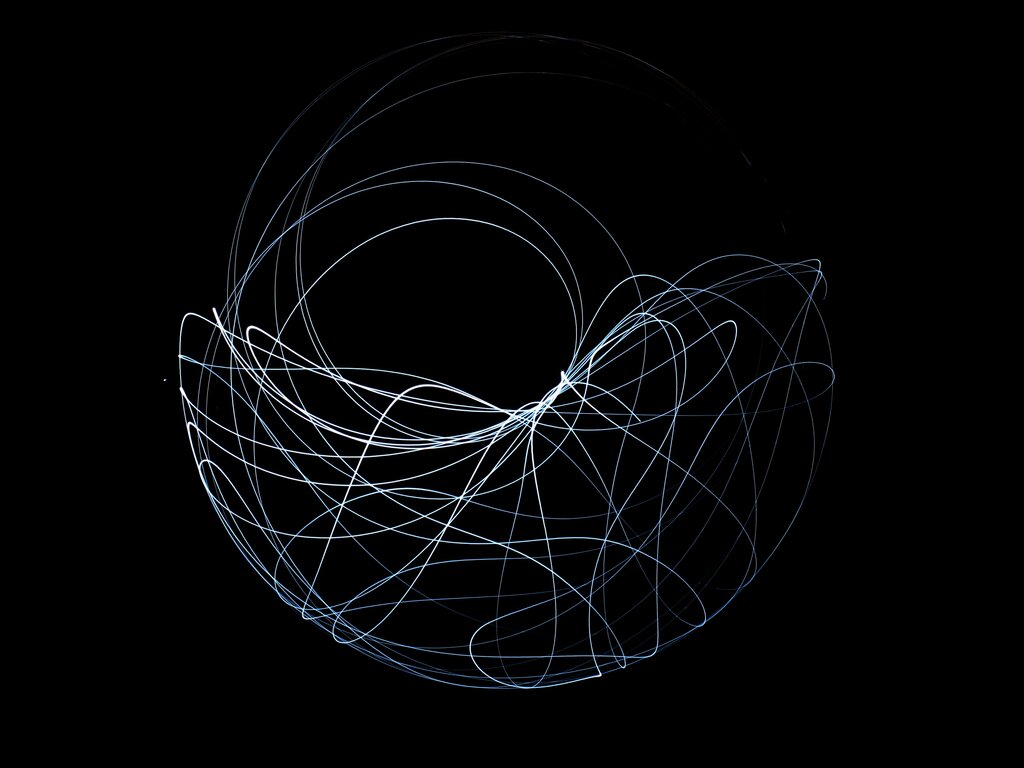
Beyond this sensitivity, chaotic systems have two other defining traits.
First, they exhibit topological mixing. Think of adding a drop of milk to coffee. As you stir, the milk (which starts in one small region) eventually gets stretched and folded throughout the entire cup. Any region of the system will eventually overlap with any other given region.
Second, they have dense periodic orbits. This is a bit counterintuitive. It means that within the chaotic behavior, there are an infinite number of points that are part of stable, repeating cycles. You can get arbitrarily close to a path that repeats itself forever. However, the slightest nudge will knock you off this stable path and back into chaotic behavior. These stable orbits are hidden within the chaos like needles in a haystack.
Measuring Chaos
How can we put a number on this level of unpredictability? Mathematicians use a tool called the Lyapunov exponent, often represented by the Greek letter lambda (). It measures the rate at which two initially close trajectories in a system diverge from each other.
Imagine starting two parallel paths in a system, incredibly close together. The distance between them, , will change over time. In many chaotic systems, this separation grows exponentially.
If the Lyapunov exponent () is positive, the paths are flying apart exponentially fast, which is a signature of chaos. A negative means the paths are converging, indicating a stable, predictable system. If is zero, the paths maintain their distance, like two planets in stable orbits.
A positive Lyapunov exponent is a hallmark of chaotic behavior, indicating sensitivity to initial conditions.
Simple Rules, Complex Behavior
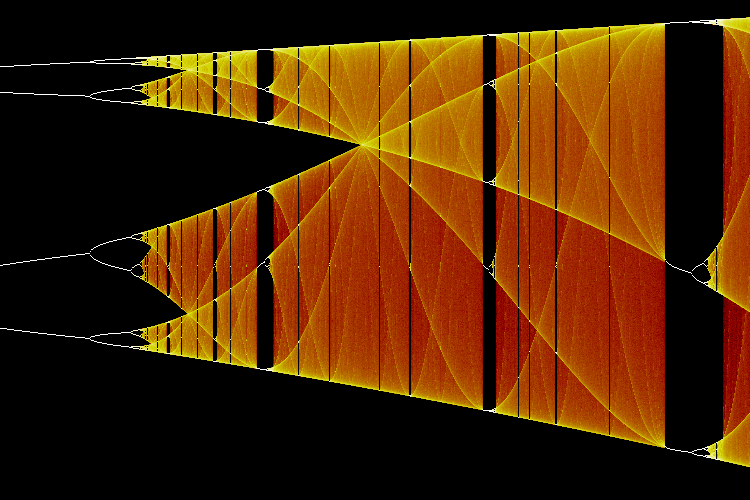
Chaotic behavior doesn't require a complicated setup. It can emerge from surprisingly simple equations. One of the most famous examples is the logistic map, a model used to describe population growth.
Here, is the population in a given year (as a fraction of the maximum possible population), and is the population in the next year. The parameter represents the growth rate. For small values of , the population settles to a stable number. But as you increase , the system's behavior changes dramatically. It starts oscillating between two values, then four, then eight, until at a certain point, it becomes completely chaotic. The population from one year to the next appears random, even though it's determined by this simple formula.
Another classic example is the Lorenz system, a set of three differential equations originally intended to model atmospheric convection. Meteorologist Edward Lorenz discovered that tiny rounding differences in his initial data—from 0.506127 down to 0.506—produced vastly different long-term weather forecasts. The visual representation of his system, the Lorenz attractor, has become an iconic symbol of chaos theory.
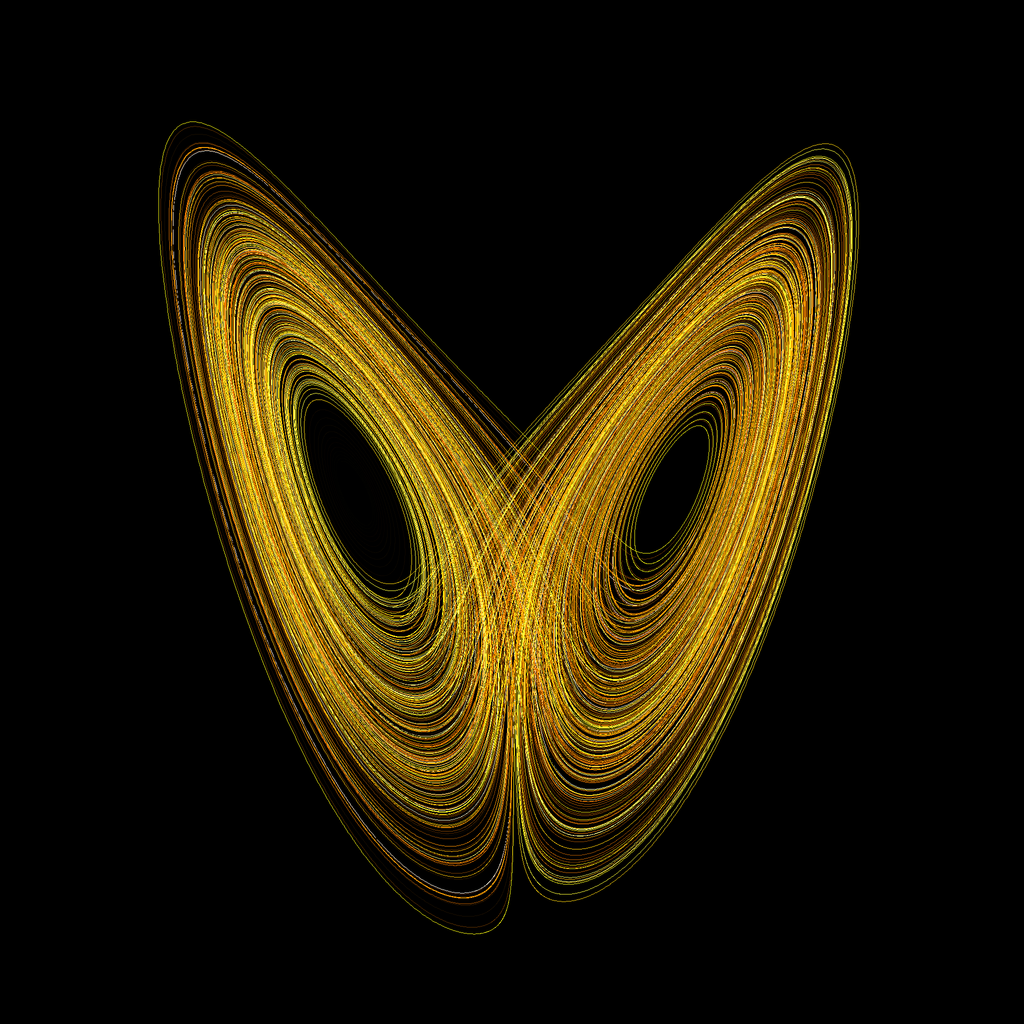
These examples show that you don't need complex rules to get complex outcomes. Simple, deterministic systems can generate behavior so intricate and unpredictable it looks like random noise. This insight has changed how we look at everything from fluid dynamics to the stock market.
Let's review the key ideas before moving on.
Ready to test your understanding?
Which statement best describes the core principle of a chaotic system?
The 'butterfly effect' is a popular term for which key concept in chaos theory?
Understanding these core principles—determinism, sensitivity, and the tools used to measure chaos—provides the foundation for exploring more complex phenomena in the world of dynamical systems.