Exoplanetary Discoveries
Introduction to Exoplanetary Science
Worlds Beyond Our Own
For most of human history, the eight planets orbiting our Sun were the only ones we knew. We wondered if other stars had planets of their own, but there was no way to be sure. These distant worlds, orbiting stars other than our Sun, are called exoplanets.
Exoplanet
noun
A planet that orbits a star outside our solar system.
The idea of exoplanets isn't new; philosophers and scientists have speculated about them for centuries. But finding them is incredibly difficult. Stars are blindingly bright, and their planets are comparatively tiny and dim, making them easy to miss. It's like trying to spot a firefly next to a searchlight from miles away.
The first confirmed discovery of an exoplanet orbiting a Sun-like star happened in 1995. Swiss astronomers Michel Mayor and Didier Queloz announced they had found a planet called 51 Pegasi b. It was a gas giant, about half the mass of Jupiter, but it orbited its star in just four days. This discovery opened the floodgates and kicked off the modern era of exoplanet science.
Why We Search
Studying exoplanets does more than just add to our celestial catalog. Each new discovery helps us answer fundamental questions about the universe. How common are planets? How do planetary systems form and evolve? And, of course, are we alone?
By studying the variety of exoplanets—from scorching hot gas giants to small, rocky worlds—we learn more about our own solar system's place in the cosmos. Finding planets within a star's "habitable zone," where conditions might be right for liquid water, is a key driver of this research. It's the first step in the long search for life beyond Earth.
How to Find a Hidden Planet
Since exoplanets are too far and dim to see directly with most telescopes, astronomers rely on clever indirect methods to find them. These techniques look for the effects a planet has on its parent star.
One of the most successful techniques is the transit method. When a planet passes directly in front of its star from our point of view, it blocks a tiny fraction of the star's light. This causes a brief, periodic dip in the star's brightness. By measuring these dips, astronomers can infer the presence of a planet and even estimate its size.
Another common technique is the radial velocity method, or the "wobble" method. A planet's gravity tugs on its star, causing the star to wobble slightly. This wobble changes the color of the star's light as it moves toward and away from us, a phenomenon known as the Doppler effect. Detecting this subtle shift in light reveals the planet's presence and gives clues about its mass.
These are just two of several methods astronomers use. Each has its strengths and helps build a more complete picture of the exoplanets we find.
A Galaxy Full of Worlds
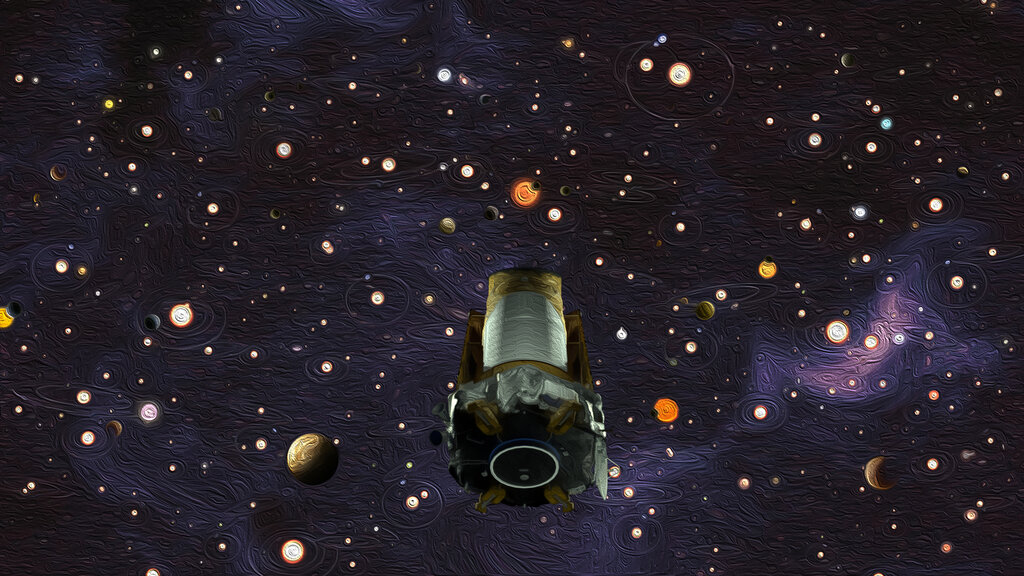
The field of exoplanetary science is exploding. Thanks to missions like NASA's Kepler Space Telescope and the Transiting Exoplanet Survey Satellite (TESS), the number of known exoplanets has grown from a handful to thousands.
As of today, astronomers have confirmed over 5,000 exoplanets in more than 3,800 planetary systems, with thousands more candidates awaiting confirmation.
These discoveries have revealed an astonishing diversity of worlds. We've found 'Hot Jupiters' orbiting perilously close to their stars, 'Super-Earths' that are larger than our planet but smaller than Neptune, and even planets orbiting two stars at once, like Tatooine from Star Wars.
Each new world gives us another data point in our quest to understand how planets form and where life might exist. The study of exoplanets has transformed our view of the galaxy from a collection of lonely stars to a vast landscape teeming with other solar systems.
What is an exoplanet?
The transit method of detecting exoplanets involves observing what effect?
This is just the beginning. With more powerful telescopes on the horizon, we're moving from simply detecting exoplanets to characterizing them, studying their atmospheres, and searching for the telltale signs of life.