Existentialism's Core Concepts
Introduction to Existentialism
The Weight of Freedom
Most philosophies try to answer the big questions by looking for universal truths about humanity. They might ask, "What is human nature?" or "What is our purpose?" Existentialism flips this script. It starts with you, the individual, and argues that there is no pre-made human nature or cosmic purpose.
Instead of discovering who you are, existentialism says you must decide who you are.
This philosophy places enormous emphasis on individual freedom, responsibility, and the subjective experience of life. It suggests that we are each born into a world without inherent meaning, and it is up to us to create it for ourselves. We are not defined by a soul, a god, or a biological blueprint. We are defined by our choices and actions.
Existence Precedes Essence
The central idea of existentialism is captured in the phrase "existence precedes essence." It sounds academic, but the concept is straightforward.
Think about a manufactured object, like a pair of scissors. Before it was made, someone had an idea for it—a concept, or essence. They knew it would be used for cutting, what it would look like, and what materials it would be made from. Its purpose and design existed before the actual pair of scissors did. For the scissors, its essence precedes its existence.
Existentialists argue that for humans, the opposite is true. We are born without a pre-defined purpose. We simply exist first—thrown into the world as conscious beings. It is only through living, making choices, and acting on our freedom that we create our essence—our self, our values, our purpose.
You weren't born a writer, a musician, a parent, or a kind person. You become these things by writing, playing music, raising a child, or acting with kindness.
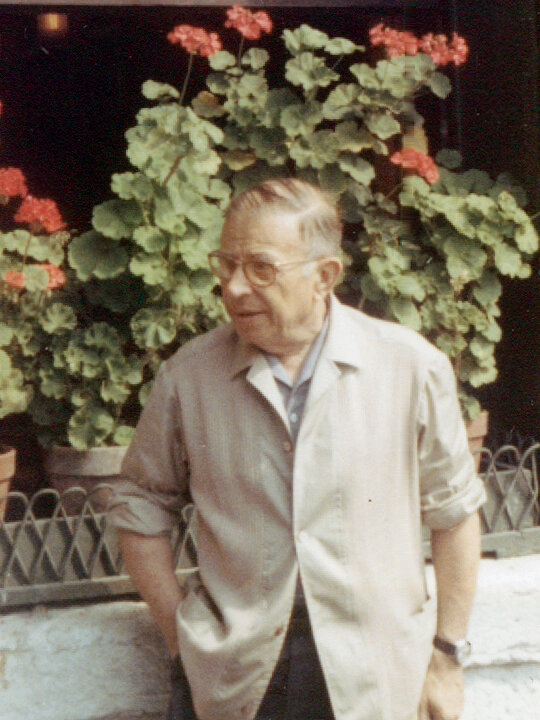
The core tenet of this philosophy is the idea that “existence precedes essence,” a concept most famously championed by Jean-Paul Sartre.
Key Figures
While existentialism became a popular movement in the mid-20th century, its roots go back to the 19th century.
Søren Kierkegaard, a Danish philosopher, is often considered the first existentialist. He explored themes of individual choice, faith, and anxiety, arguing that individuals must make a passionate, personal "leap of faith" to find meaning.
Friedrich Nietzsche, a German philosopher, famously declared that "God is dead," suggesting that traditional religious and moral frameworks had lost their power in the modern world. This left humanity free—and burdened—to create its own values.
In the 20th century, French philosophers like Jean-Paul Sartre, Simone de Beauvoir, and Albert Camus brought existentialism to a wider audience through their philosophy, novels, and plays. Sartre famously coined the phrase "existence precedes essence" and emphasized that we are "condemned to be free." De Beauvoir applied existentialist ideas to feminism in her groundbreaking work, arguing that one is not born a woman, but becomes one.
What is the central idea captured by the existentialist phrase "existence precedes essence"?
According to the existentialist perspective, how is a human being different from a manufactured object like a paper knife?
Ultimately, existentialism is a call to live authentically and deliberately. It challenges us to face the lack of inherent meaning not with despair, but with the resolve to create our own.