Excel in Strategy and Operations
Foundations of Business Strategy
What Is Business Strategy?
At its heart, a business strategy is a clear plan for achieving a company's goals. It's the map that guides decisions, from big-picture choices about what markets to enter to daily operational tasks. Without a strategy, a business is just reacting to events. With one, it can proactively shape its future.
The core purpose of any strategy is to create and sustain a competitive advantage. This is what sets a business apart from its rivals and makes customers choose it over others.
Competitive Advantage
noun
A condition or circumstance that puts a company in a favorable or superior business position.
A competitive advantage can come from many places. A company might offer the lowest prices, like a discount supermarket. It could have a superior product, like a smartphone with a groundbreaking camera. Or it might build a powerful brand that people trust and want to be associated with.
The key isn't just to gain an advantage, but to make it sustainable. A great strategy ensures the business can keep its edge over the long term.
The Strategic Management Process
Developing a winning strategy isn't a one-time event; it's a continuous cycle known as the strategic management process. This process helps organizations analyze their situation, create a plan, and put it into action. It's generally broken down into two main phases: formulation and implementation.
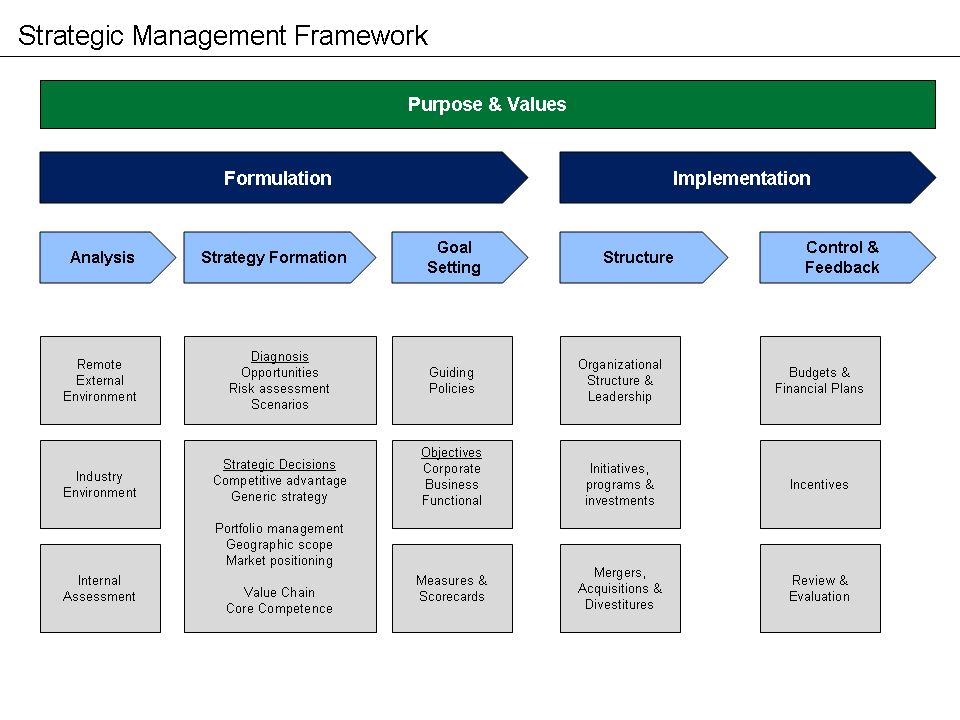
Strategy Formulation is the planning phase. It's where leaders ask the big questions: What is our mission? What are our goals? To answer these, they analyze the company's internal strengths and weaknesses as well as the external opportunities and threats in the market. This deep thinking leads to the formation of a specific, actionable strategy.
Strategy Implementation is the action phase. A brilliant plan is useless if it stays on paper. Implementation is about translating the strategy into reality. This involves organizing the company's structure, allocating resources like money and personnel, and developing policies to guide day-to-day decisions. It’s about making sure everyone in the organization is working towards the same strategic goals.
Frameworks for Strategic Thinking
To guide the formulation process, leaders often use strategic planning frameworks. These are tools that provide a structure for analyzing a business and its environment. They help organize complex information and ensure that all key factors are considered.
Utilize frameworks like SWOT analysis (Strengths, Weaknesses, Opportunities, Threats) and Porter’s Five Forces model to comprehend market dynamics and competitive positioning.
One of the most fundamental and widely used frameworks is the SWOT analysis. It's a simple but powerful tool for sizing up a company's position.
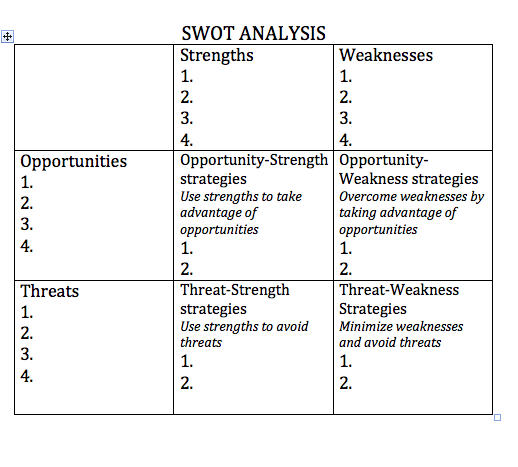
SWOT stands for:
- Strengths: Internal attributes that give the company an advantage. Examples: a strong brand reputation, proprietary technology, a talented team.
- Weaknesses: Internal attributes that place the company at a disadvantage. Examples: outdated equipment, a lack of capital, a poor location.
- Opportunities: External factors that the company could use to its advantage. Examples: a growing market, a competitor's misstep, new technology.
- Threats: External factors that could harm the business. Examples: a new competitor, changing customer tastes, new regulations.
By laying out these four areas, a business can develop strategies that leverage its strengths, address its weaknesses, capitalize on opportunities, and defend against threats.
A good strategy isn't just about having a great idea. It's about a disciplined process of analysis, planning, and execution. By understanding these foundations, you can start to see why some businesses thrive while others falter.
Ready to check your understanding? Let's review what you've learned about the foundations of business strategy.
What is the primary purpose of a business strategy?
In a SWOT analysis, a new piece of legislation that could negatively impact your business would be classified as a(n) ________.
Understanding these core concepts is the first step toward thinking like a strategist.