Evolution of the Indian Subcontinent
State Formation Dynamics
The Age of Great Kingdoms
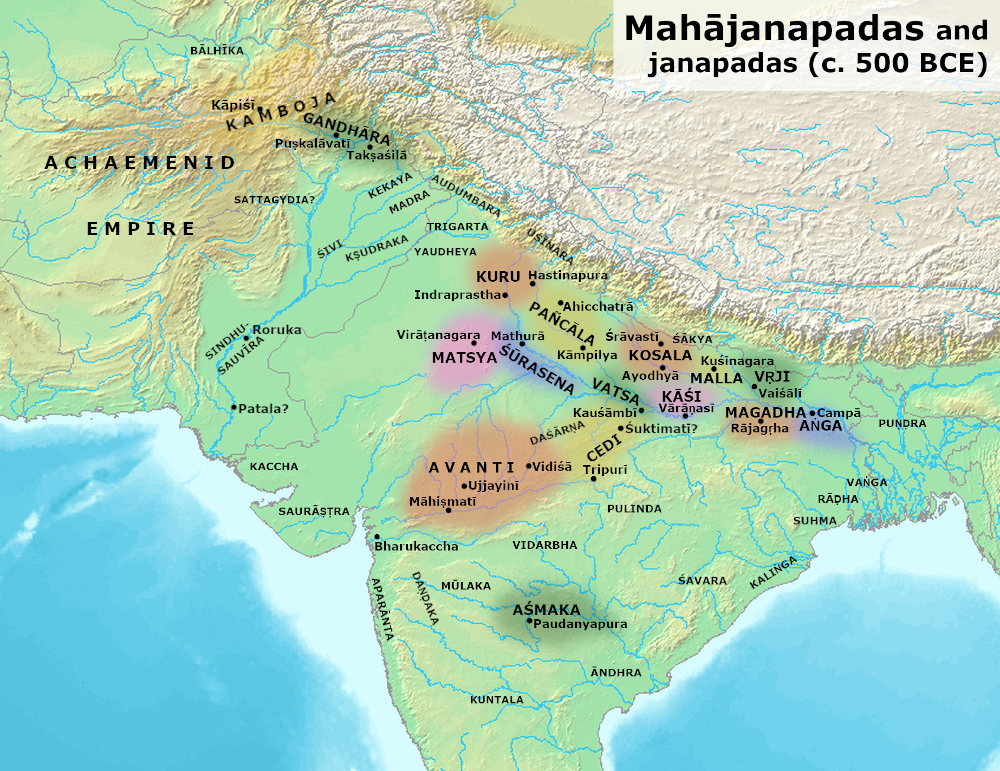
Around the 6th century BCE, the political landscape of northern India began to shift dramatically. The smaller, semi-nomadic tribal units of the Vedic period, known as janas, had settled into defined territories called janapadas. But a new, more powerful entity was emerging: the mahajanapada, or 'great realm'.
This was not merely a change in name. It represented a fundamental transformation from kin-based chiefdoms to organized territorial states with complex administrative systems, standing armies, and fortified capital cities. Sixteen of these powerful states came to dominate the subcontinent, setting the stage for India's first great empires.
The Catalysts of Change
Two key developments fuelled this political evolution: iron technology and urbanization. The widespread use of iron tools, particularly axes and ploughshares, revolutionized agriculture in the fertile Gangetic plains. Iron axes could clear dense forests more efficiently, opening up vast new lands for cultivation. The heavy iron ploughshare could till the hard alluvial soil much more effectively than its wooden predecessor.
This agricultural boom created substantial food surpluses for the first time. A society that isn't entirely focused on producing food can support a diverse population, including kings, priests, soldiers, artisans, and merchants. This surplus became the economic engine driving state formation, funding armies, and enabling the growth of cities during the .
These new urban centres became hubs of craft production and trade. Coins, specifically punch-marked coins, began to circulate, facilitating commerce and making it easier for rulers to collect taxes. A monetized economy replaced the older barter system, further strengthening the central authority of the state.
Magadha's Ascent
While several Mahajanapadas vied for supremacy, one kingdom, Magadha, steadily rose to become the most powerful. Its success wasn't accidental. Geographically, Magadha was perfectly positioned in the lower Gangetic plain, a region of immense agricultural productivity. It also controlled rich deposits of iron ore in modern-day Jharkhand, giving it a significant military advantage in producing superior weapons and tools.
Under ambitious and often ruthless rulers like Bimbisara and his son Ajatashatru, Magadha pursued a relentless policy of expansion. They used a combination of strategic marriages and military conquest to absorb their neighbours. Their military was formidable, notable for being among the first in India to use large numbers of war elephants, which acted like ancient tanks, terrifying enemy infantry and cavalry alike.
Magadha's strategic location, natural resources, and aggressive leadership provided the perfect blueprint for building the subcontinent's first major empire.
New Ideas for a New Era
The immense social and political changes of this era also sparked profound intellectual and spiritual questioning. The rigid, hereditary social structure of the Brahmanical tradition, based on the Vedas, was challenged by new schools of thought. This period saw the rise of , most notably Buddhism and Jainism.
These new philosophies rejected the authority of the Vedas and the dominance of the priestly Brahmin class. They questioned the efficacy of complex rituals and animal sacrifices, advocating instead for ethical conduct, non-violence (ahimsa), and personal spiritual effort. These ideas appealed strongly to the rising merchant class (vaishyas) and others who felt constrained by the established social hierarchy.
This period was also marked by a fascinating political experiment: a competition between two distinct forms of governance. While kingdoms like Magadha were monarchies, other states, such as the Vajjian confederacy, were run as republics or oligarchies, known as gana-sanghas.
| Feature | Monarchy (e.g., Magadha) | Gana-sangha (e.g., Vajji) |
|---|---|---|
| Ruler | A single hereditary king | An assembly of ruling chiefs (rajas) |
| Decision Making | King holds ultimate authority | Decisions made by the assembly through debate |
| Administration | Centralized bureaucracy appointed by the king | Chiefs governed their own clans; assembly handled foreign policy |
| Military | Large, centrally controlled standing army | Armies raised from individual clans under their chiefs |
The gana-sanghas were eventually absorbed by the powerful monarchies. However, their legacy of debate, assembly-based governance, and collective decision-making represents one of the world's earliest experiments with republican ideals. The rise of large, centralized states and the new philosophical currents they fostered fundamentally reshaped Indian civilization, laying the groundwork for the classical age that would follow.
What was the primary technological innovation that enabled the agricultural boom leading to the rise of the Mahajanapadas?
The emergence of new philosophies like Buddhism and Jainism was a response to: