Evolution of the English Literary Canon
Anglo-Saxon Transition
From Mead Hall to Manuscript
Before English was written down, it was sung. In the noisy mead halls of Anglo-Saxon England, professional poets called scops would entertain lords and warriors with epic tales of heroes, monsters and fate. These weren't memorised word-for-word. Instead, the poets used a vast mental toolbox of stock phrases and poetic structures, known as the oral-formulaic tradition, to weave stories on the spot. Each performance was unique, shaped by the audience and the moment.
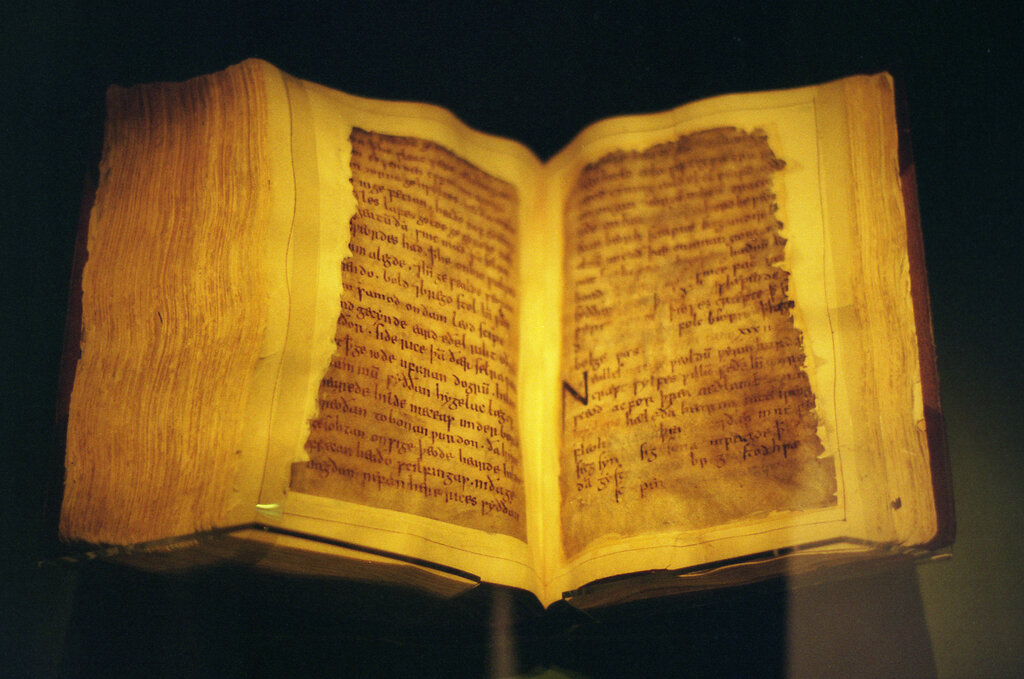
This was the world that produced Beowulf. The epic poem follows a Geatish warrior who sails to Denmark to defeat Grendel, a monstrous creature terrorising the king's hall. Beowulf is the ultimate expression of the heroic code, an unwritten set of rules that governed Anglo-Saxon warrior society. Loyalty to one's lord, courage in battle, and the pursuit of fame were the highest virtues. A warrior’s reputation, or dōm, was everything, as it was the only form of immortality they knew.
The heroic code prized strength and honour. A warrior's primary duties were to avenge their lord and to be generous with the spoils of war.
Clash of Beliefs
But Beowulf is more than just a pagan warrior tale. The story was written down by Christian monks centuries after its oral composition. As a result, it’s a fascinating blend of two worldviews. The poem's characters live by the old Germanic code, believing in a grim, unavoidable fate (wyrd). Yet, the narrator often speaks from a Christian perspective, attributing events to the will of a single, all-powerful God.
This tension reflects a major shift in Anglo-Saxon England. Before the 7th century, the land was divided into several warring kingdoms, often called the Heptarchy. Missionaries from Rome and Ireland gradually converted these pagan kingdoms to Christianity. This new religion brought with it the Latin alphabet and the culture of writing, which took place in monasteries.
The rise of literacy created a new way to preserve history. King Alfred the Great of Wessex, fighting against Viking invaders in the 9th century, commissioned the translation of many Latin texts into Old English. He also initiated the , a year-by-year record of English history. This was a monumental project, with copies distributed to monasteries across the kingdom. It wasn't just history; it was a form of propaganda, promoting a unified English identity under the leadership of Wessex.
A Language in Flux
The Viking invasions did more than just threaten kingdoms; they changed the language. As Norsemen settled in northern and eastern England—an area known as the Danelaw—their Old Norse language mingled with Old English. This contact simplified English grammar and added thousands of new words, including everyday terms like sky, egg, skin, and window.
| Old English | Old Norse | Modern English |
|---|---|---|
| scyrte | skyrta | shirt |
| cēapian | kaupa | buy (cheap) |
| drēam | draumr | dream |
| earg | argr | angry (archaic) |
| gifan | gefa | give |
This linguistic mixing created distinct regional dialects. However, as Wessex became the dominant political power, its dialect, West Saxon, became the standard written form of Old English. Scribes in the royal scriptorium at Winchester produced most of the surviving Old English manuscripts, establishing a literary foundation that would shape the language for centuries to come.
Starting with epic works like Beowulf, literature reflected the language and cultural shifts of England.
This period of Old English literature, from heroic poetry to historical prose, captures a society in transition. It balanced a pagan past with a Christian future and forged a new language from the collision of cultures. Let's review some key terms.
Now, let's test your understanding of this foundational period.
In Anglo-Saxon mead halls, what were the professional poets who performed epic tales called?
The epic poem Beowulf is a fascinating blend of which two belief systems?
This rich literary and linguistic world, forged by poets, monks, and kings, was the bedrock of English culture right up to the next great upheaval: the Norman Conquest of 1066.