Evolution of the Computing Age
Mechanical and Analog Precursors
The First Calculating Machines
Before computers could process words and images, they had to master numbers. The earliest steps toward automatic computation were taken with gears and levers, not silicon and electricity. These mechanical calculators aimed to solve a very human problem: error. People get tired and make mistakes, especially when doing repetitive calculations.
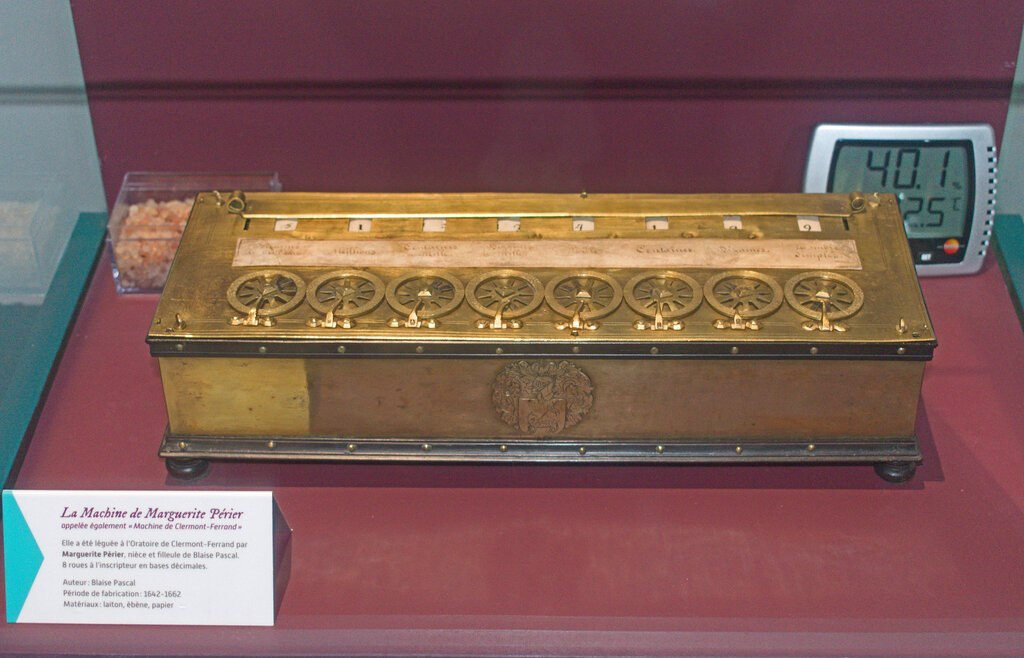
In 1642, Blaise Pascal invented the Pascaline to help his father, a tax supervisor. It was a brass box filled with interconnected gears and wheels. By turning dials, a user could perform addition and subtraction. Each wheel represented a digit (ones, tens, hundreds), and when one wheel made a full rotation from 9 to 0, it nudged the next wheel forward by one position — a mechanical version of carrying the one.
A few decades later, Gottfried Wilhelm Leibniz improved upon this design. His "Stepped Reckoner" could also perform multiplication and division. It used a special component called a Leibniz wheel, a drum with teeth of varying lengths, to manage the more complex operations. While clever, these devices were delicate, expensive, and not widely adopted. They could perform a single calculation, but they couldn't follow a series of instructions.
Babbage's Engines
The next major leap came from Charles Babbage, an English mathematician who was frustrated by the error-filled mathematical tables used in navigation and engineering. In the 19th century, these tables were calculated by hand, and mistakes were common and costly.
By 1822 the English mathematician Charles Babbage was proposing a steam driven calculating machine the size of a room, which he called the Difference Engine.
Babbage's first design was the Difference Engine, a massive, special-purpose calculator designed to tabulate polynomial functions. It was a machine built for one job, but it would do it perfectly every time, churning out tables of numbers with unerring precision. It worked by solving a series of additions, using the method of finite differences. Although he secured government funding, Babbage never completed the full machine due to manufacturing challenges and political disputes.
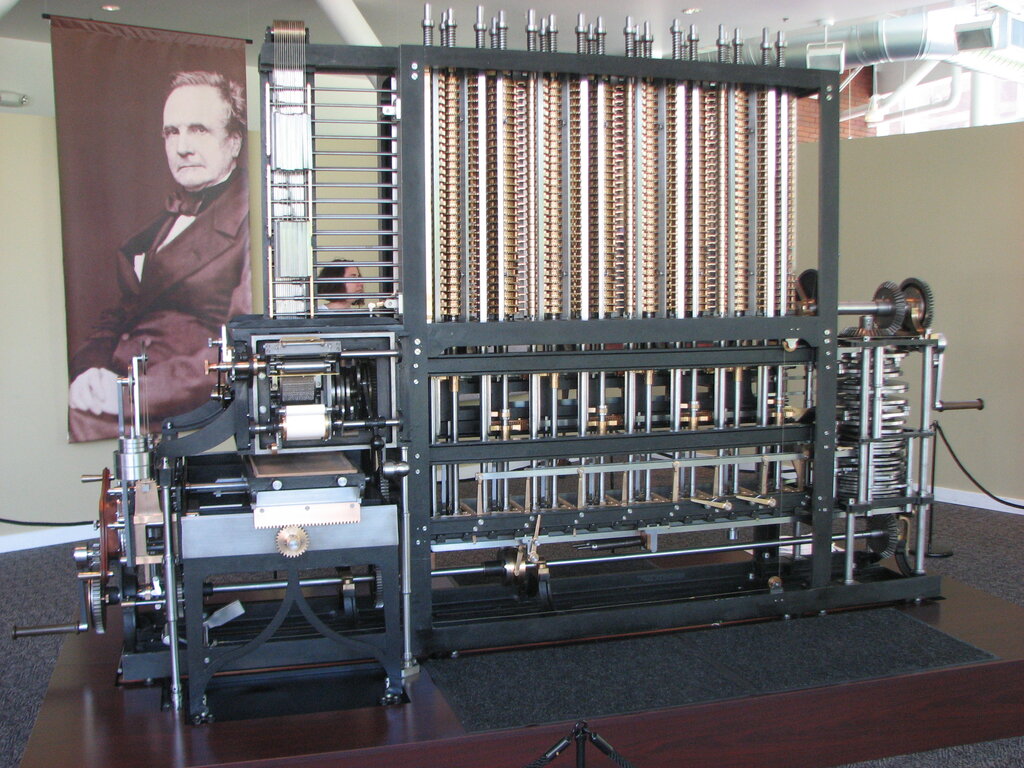
His ambitions, however, grew far beyond this. Babbage conceived of a much more powerful and flexible machine: the Analytical Engine. This was not a calculator, but a general-purpose, programmable computer. It was a revolutionary design that laid out the fundamental architecture for computing for the next hundred years.
The engine had four key components:
- The Mill: This was the calculating unit, analogous to a modern Central Processing Unit (CPU). It performed the arithmetic operations.
- The Store: This was the memory, where data and intermediate results could be held. Babbage envisioned it holding 1,000 numbers of 40 decimal digits each.
- The Input: A device to feed instructions and data into the machine.
- The Output: A mechanism to print the results.
Instructions and Algorithms
To tell the Analytical Engine what to do, Babbage borrowed an ingenious idea from a completely different industry: textiles.
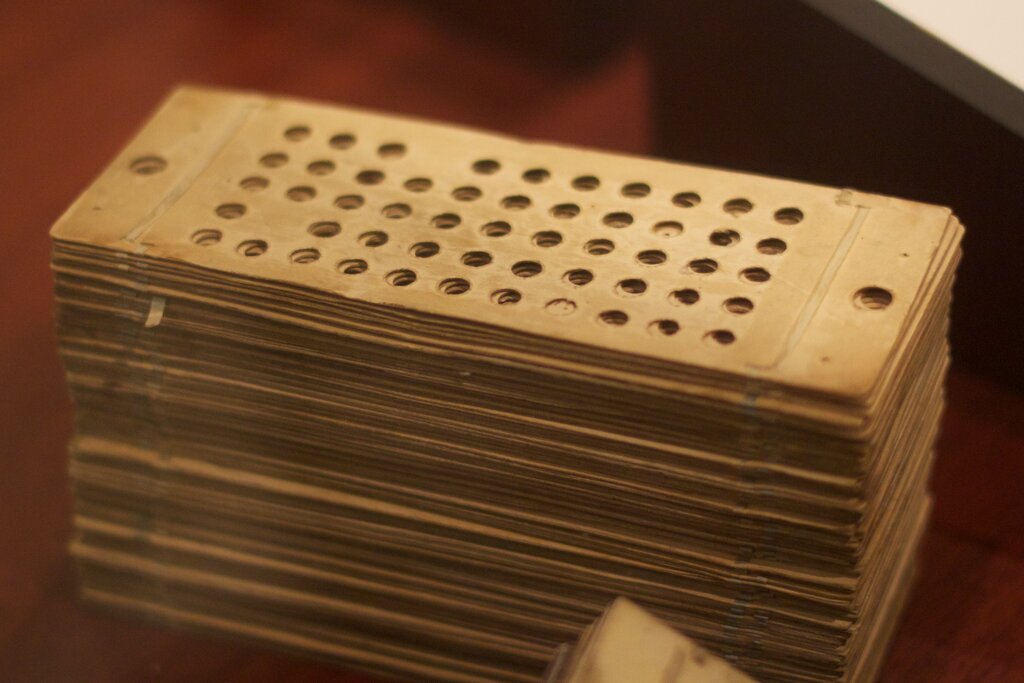
Babbage realized he could use punched cards to control his engine. One set of cards would contain the instructions (the program), while another set would provide the data. This separation of program and data was a crucial insight. It meant the Analytical Engine wasn't built to solve just one type of problem; it could be reprogrammed to solve any problem that could be expressed as a series of steps.
Working alongside Babbage was Ada Lovelace, a gifted mathematician. She saw the true potential of the Analytical Engine beyond mere number crunching. She recognized that if numbers could represent other things, like musical notes or letters, the machine could manipulate symbols and create art or music. She famously wrote what is considered the world's first computer program: an algorithm for the Analytical Engine to compute Bernoulli numbers.
Lovelace's work established the concept of a multi-purpose machine that could follow a set of instructions—the core idea of modern software.
Analog Computing
While Babbage was designing his digital machines, another form of computation existed: analog. Unlike digital devices that count discrete numbers (0, 1, 2...), analog computers use continuous physical phenomena like distance, voltage, or pressure to model a problem.
The most common example is the slide rule. By sliding marked rulers against each other, a user could perform multiplication and division quickly. The lengths on the scales were logarithmic, so adding two lengths was equivalent to multiplying their corresponding numbers. Slide rules were indispensable tools for engineers and scientists for centuries, but they had limits. Their precision was limited by how accurately you could mark and read the scales, and they weren't programmable for complex, multi-step problems.
Let's check your understanding of these early computing concepts.
What was the primary problem that early mechanical calculators like the Pascaline aimed to solve?
Which component of Charles Babbage's Analytical Engine is analogous to a modern computer's Central Processing Unit (CPU)?
These mechanical and analog devices, from the Pascaline to the Analytical Engine, established the core concepts of calculation, memory, and programmability that would later be electrified and miniaturized to create the computers we use today.