Evolution of Martial Arts Systems
Striking Biomechanics
The Body as a Whip
A powerful strike isn't born in the fist or the foot. It's the final link in a chain reaction that starts from the ground up. This sequence of energy transfer is called the kinetic chain. Think of it like cracking a whip. The motion starts with a large, slow movement at the handle, and the energy accelerates down the length, culminating in a final, explosive crack at the tip.
In striking, your body is the whip. Power is generated by the large, strong muscles of your legs and hips, and it flows through your torso and out through the striking limb. Each segment of your body adds to and multiplies the force. A punch that only uses the arm is weak. A punch that engages the entire kinetic chain, from the floor to the fist, can be devastating.
Power is not created in the limb; it is merely delivered by it. The real engine is the coordinated rotation of your entire body.
This process starts with your connection to the ground. By pushing off the floor, you initiate the entire sequence. This is known as ground reaction force, and it's the fundamental first step in generating power. Without a solid base and proper engagement with the ground, the chain is broken before it even starts.
Roundhouse vs. Cross
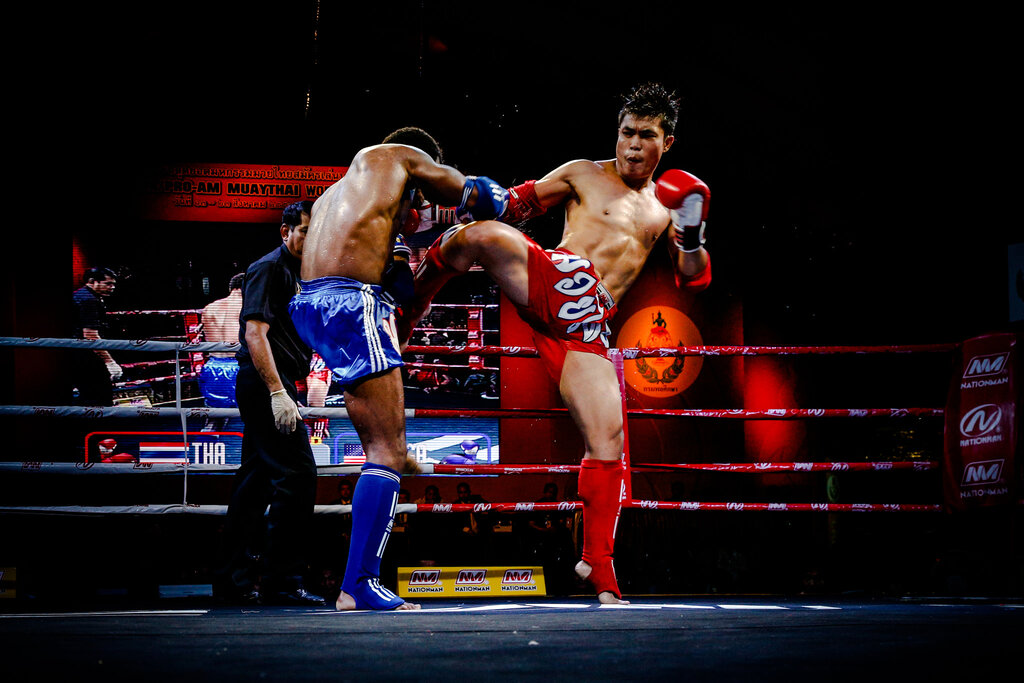
Let's compare the biomechanics of two classic strikes: the Muay Thai roundhouse kick and the Western boxing cross. Both are rotational power strikes, but they solve the problem of generating force in different ways.
The Muay Thai roundhouse is a study in momentum transfer. A practitioner doesn't kick at a target; they kick through it. The entire body rotates on the ball of the supporting foot, with the hip turning over completely. This rotation whips the kicking leg into the target. The striking surface is the shin, a hard, dense bone conditioned for impact. This creates a devastating strike that functions like a baseball bat swinging into its target. The goal is to transfer the momentum of the entire body's rotation into the opponent.
The boxer's cross, on the other hand, is about generating rotational torque for a linear strike. The power starts with a pivot of the back foot, driving the rear hip forward. This rotation travels up through the core and into the shoulder, propelling the fist forward in a straight line. Unlike the roundhouse, where the entire body follows a wide arc, the boxer's energy is funneled into a direct, piercing impact.
Proper structural alignment is critical here. The wrist must be straight, and the elbow and shoulder aligned behind the punch. This creates a solid frame to transfer the force without the joints collapsing, which would dissipate energy and risk injury. Boxing's constant need for head defense also influences this mechanic, promoting a more coiled and guarded posture compared to the more open stance of a kicker.
Heavy Bag Physics
Training on a heavy bag is not just about conditioning; it's a physics lesson. The bag provides resistance, allowing a fighter to practice transferring maximum force into a target. A good strike doesn't just push the bag—it makes it shudder. This comes from the principle of impulse, defined as force multiplied by the time over which it's applied ().
A sharp, fast strike with good structural integrity delivers a massive amount of force over a very short time. This creates a high impulse that's absorbed by the bag, causing it to ripple and compact rather than just swing away. It's the difference between pushing someone over and delivering a knockout blow. The goal is to accelerate the hand or shin through the bag's surface, ensuring all the energy from the kinetic chain is delivered deep into the target.
So, whether it's a shin colliding with a heavy bag or a glove meeting a focus mitt, the underlying principles are the same. A powerful strike is a full-body athletic movement, a perfectly timed sequence of rotation and energy transfer that turns the human body into an efficient weapon. Mastering this is less about brute strength and more about understanding the elegant physics of motion.
Time to test your understanding of striking mechanics.
According to the principle of the kinetic chain, where does the power for a strong strike primarily originate?
What is the key biomechanical difference between a Muay Thai roundhouse and a boxer's cross?
Understanding these principles moves you from simply performing a technique to truly embodying it, making your movements both more powerful and more efficient.