Evolution of ICT Through the Decades
Electronic Switches and Tubes
From Clicks to Currents
Early computing machines relied on electromechanical relays. Think of a tiny, fast light switch, clicking open and closed to represent ones and zeros. While clever, these relays had a major flaw: moving parts. They were physically slow, noisy, and would eventually wear out from the constant motion, leading to frequent breakdowns.
To build faster, more reliable computers, engineers needed a switch with no moving parts at all. The solution was found in a glass bulb: the vacuum tube.
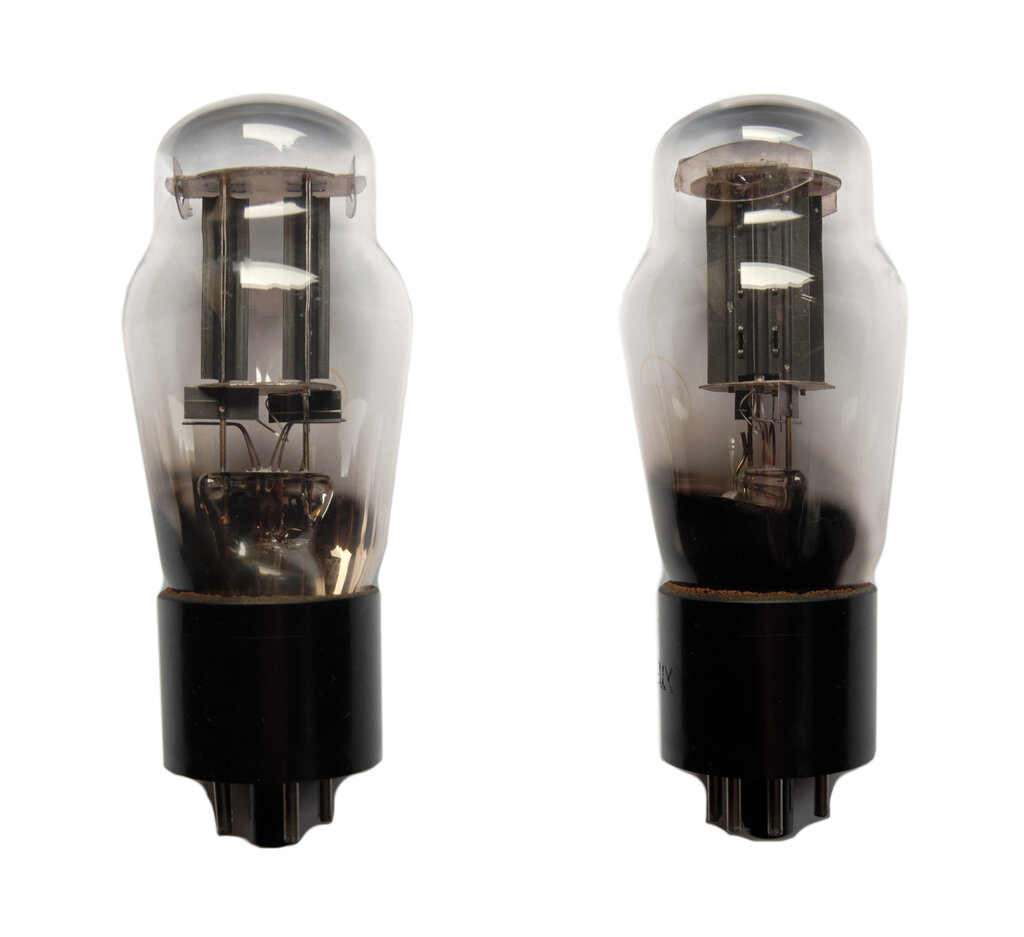
The vacuum tube operates on a principle called thermionic emission. It's a simple but powerful idea: when you heat a metal in a vacuum, it emits electrons. This flow of electrons can be controlled to act as a switch or an amplifier.
Thermionic Emission
noun
The release of electrons from a heated material, typically a metal filament, inside a vacuum.
The Triode as a Switch
The most important type of vacuum tube for early computing was the triode. It has three main components: a cathode that emits electrons when heated, an anode that collects them, and a control grid in between. The grid is the key.
By applying a small negative voltage to the grid, you can repel the negatively charged electrons and stop them from reaching the anode. This effectively turns the switch 'off'. If you remove the negative voltage from the grid, electrons flow freely to the anode, turning the switch 'on'.
This simple on-off capability, achieved with no moving parts, was thousands of times faster than any mechanical relay. It allowed for the creation of truly electronic digital computers.
The Age of ENIAC
The potential of the vacuum tube was fully realized in machines like the ENIAC (Electronic Numerical Integrator and Computer), completed in 1945. Considered the first general-purpose electronic computer, ENIAC was a monster. It weighed 30 tons, filled a large room, and used about 18,000 vacuum tubes as switches.
This massive collection of tubes allowed ENIAC to perform calculations at unprecedented speeds. It could execute about 5,000 additions per second, a task that would have taken a human with a mechanical calculator many hours. This marked the dawn of the 'First Generation' of computing, defined by its reliance on vacuum tube technology.
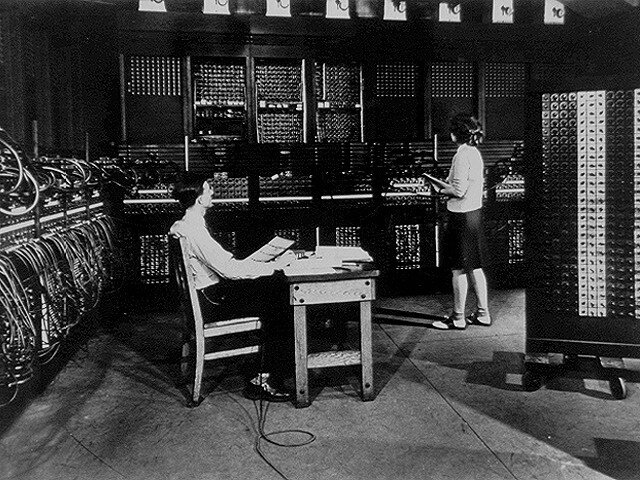
The Electronic Numerical Integrator and Computer, also known as the ENIAC, was the first computer that would use the vacuum tube.
But this new speed came with significant trade-offs. The 18,000 tubes in ENIAC consumed enormous amounts of electricity, about 150 kilowatts—enough to power a small town. This power generated immense heat, requiring a dedicated air conditioning system to prevent the machine from melting down.
Reliability was also a constant struggle. Each of the thousands of tubes had a limited lifespan and could fail at any moment. On average, a tube failed every couple of days, shutting the entire machine down until technicians could find and replace the faulty component. These challenges drove the search for a smaller, more efficient, and more reliable alternative, paving the way for the next great leap in electronics.
What was the primary disadvantage of using electromechanical relays in early computers?
The ENIAC computer, a hallmark of the 'First Generation' of computing, was primarily defined by its use of which technology?
This transition from mechanical relays to vacuum tubes was the first major step in creating the powerful digital world we know today.