Evolution of English Literature
Early English Foundations
From Spoken Word to Written Epic
Before English was written, it was sung. Travelling poets, known as scops, performed long epic poems from memory in mead-halls, recounting the deeds of heroes. The most famous surviving example is Beowulf, an epic that captures the worldview of early Anglo-Saxon culture. At its core is the Germanic heroic code, a set of values that dictated a warrior's life: absolute loyalty to one's lord, the pursuit of fame through brave deeds, and the obligation to avenge a fallen comrade.
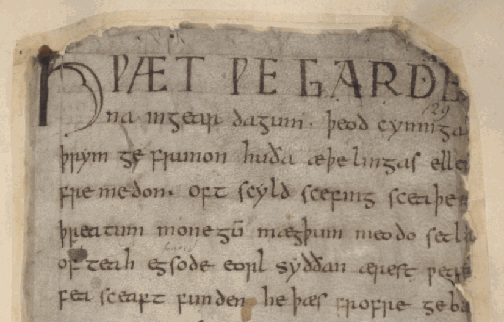
But Beowulf is more than a simple warrior's tale. It was written down by Christian monks centuries after its events, and their influence is clear. The poem is a fascinating blend of pagan heroism and Christian morality. Beowulf fights monsters, but he often thanks God for his victories. This tension between fate (wyrd) and divine providence runs through the entire epic.
This same sense of mortality and the fleeting nature of life creates the elegiac tone found in much Old English poetry. Poems like The Wanderer and The Seafarer are filled with a deep sense of melancholy, exploring themes of exile, loss, and the decay of all worldly things. The speakers are often isolated figures, lamenting the loss of their lord, their community, and the glories of the past.
The language of these poems, Old English, was highly synthetic. This means word order was less important than word endings, or inflections, which signalled a word's function in a sentence. Changing an ending changed the meaning, allowing for a flexible and compact poetic structure.
Conquest and a New English
In 1066, everything changed. The Norman Conquest brought a French-speaking aristocracy to England. For centuries, French became the language of power, law, and culture, while English was spoken mainly by the common people. This linguistic pressure cooker fundamentally reshaped the language.
One of the most obvious effects of the conquest was the introduction of Anglo-Norman, a northern dialect of Old French with limited Nordic influences, as the language of the ruling classes in England, displacing Old English.
Old English shed its complex inflections and became more analytic, relying on word order and prepositions (like of, to, and for) to create meaning, much like Modern English does. Thousands of French words flooded the vocabulary, especially in areas like government (parliament, sovereign), law (judge, jury), and cuisine (beef, pork). The language that emerged from this fusion was Middle English.
Chaucer’s England
By the late 14th century, English had re-emerged as the primary language of all social classes. Its greatest champion was Geoffrey Chaucer, a poet and civil servant who chose to write in the English vernacular of London instead of Latin or French. His masterpiece, The Canterbury Tales, shows just how sophisticated and expressive the new language had become.
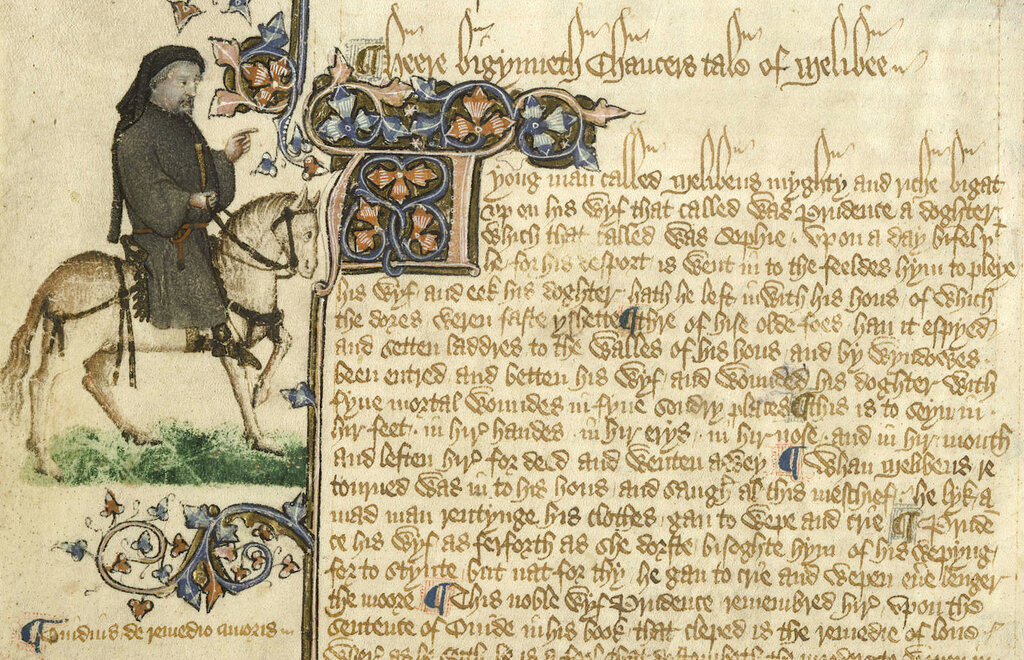
The poem is a collection of stories told by a diverse group of pilgrims on their way to Canterbury. Chaucer uses this framework to create a brilliant social satire, painting a vivid picture of medieval society. From the noble Knight to the corrupt Pardoner, each character's tale reveals their personality and social standing. Chaucer’s work established the London dialect as the standard for written English and proved that the vernacular could produce literature as powerful as any in Latin or French.
Now let's test your understanding of these foundational periods.
Which of the following best describes the core principles of the Germanic heroic code as presented in early Anglo-Saxon culture?
The poem Beowulf is a cultural artefact that shows a blend of two major belief systems. What are they?
The journey from Beowulf's mead-hall to Chaucer's Canterbury pilgrimage marks a profound transformation. It reflects not just the evolution of a language, but the birth of a distinctly English literary identity.