Evolution of Computing Systems
Vacuum Tube Era
The Age of Vacuum Tubes
Before the first generation of electronic computers, calculation was a mechanical affair. Machines used gears, levers, and electromechanical relays that physically moved to represent numbers and perform operations. They were clever, but slow and prone to wear. The leap to electronic computing required a new kind of switch, one with no moving parts.
The answer was the vacuum tube. A vacuum tube is a sealed glass tube containing a near-vacuum, which allows electrons to move freely. Inside, a component called a cathode is heated, causing it to release electrons. This process is called thermionic emission. A plate, or anode, with a positive charge attracts these electrons, creating a current. By placing a grid between the cathode and anode, we can control this flow. A small negative voltage on the grid repels the electrons, stopping the current. This ability to switch the flow of electrons on and off made the vacuum tube the first electronic switch, capable of representing the 0s and 1s of binary logic at speeds mechanical relays could never achieve.
This innovation paved the way for machines like ENIAC (Electronic Numerical Integrator and Computer) and UNIVAC (Universal Automatic Computer). These weren't just faster; they were the first general-purpose electronic computers, representing a fundamental shift in what was possible.
Architecture of Giants
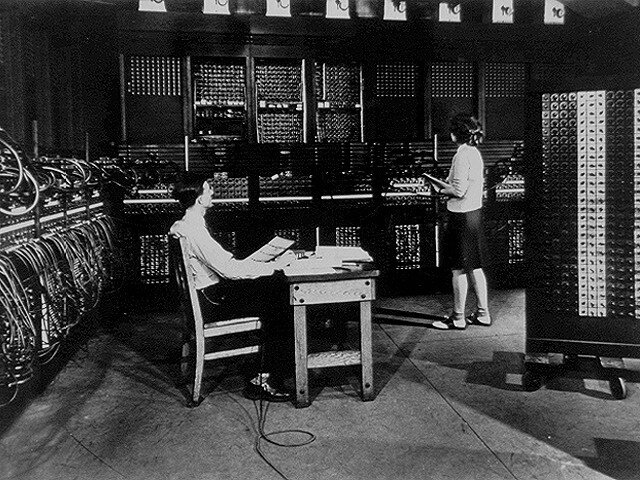
First-generation computers were defined by their immense physical scale. ENIAC, completed in 1946, contained nearly 18,000 vacuum tubes, weighed 30 tons, and occupied a room the size of a small house. This size wasn't for show; it was a direct consequence of its components.
Each vacuum tube, while faster than a relay, consumed a significant amount of power and generated immense heat. Keeping ENIAC cool required its own dedicated power and ventilation systems. The sheer number of tubes also created a reliability nightmare. A single tube failure could bring the entire machine down, and with an average lifespan of a few thousand hours per tube, failures were constant. Technicians spent a significant part of their days hunting down and replacing burned-out tubes.
Programming these early machines was a brutally physical process. There was no keyboard or operating system. To give ENIAC new instructions, engineers had to manually rewire it, unplugging cables from one socket and plugging them into another on massive plugboards. A complex program could take days or even weeks to set up.
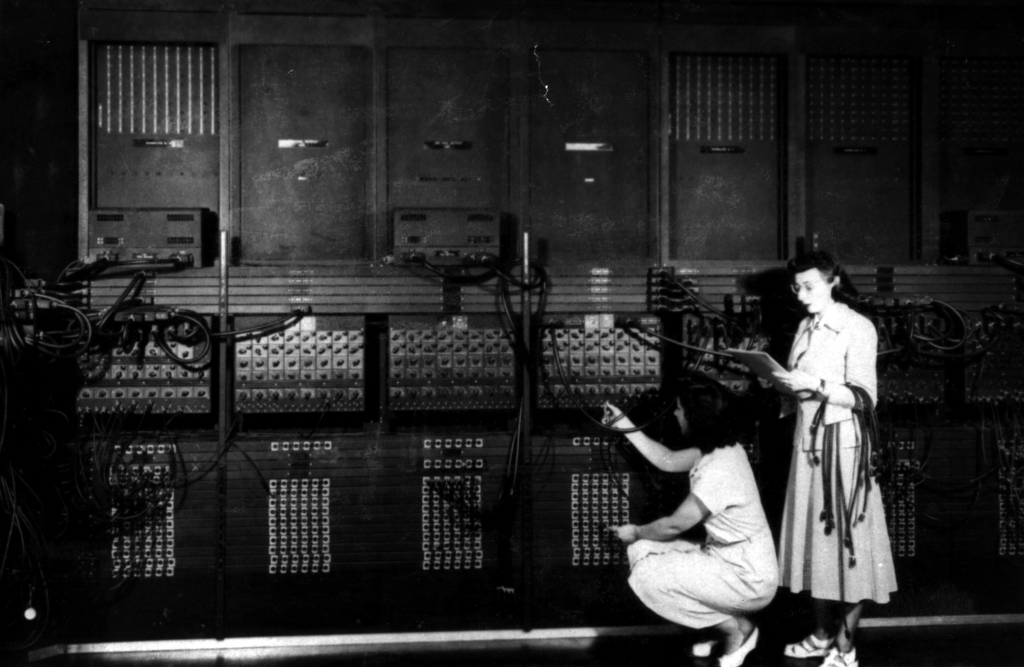
This point-to-point wiring was a major bottleneck. The computer's hardware and software were effectively the same thing. This inflexibility led mathematician John von Neumann to propose a revolutionary idea while consulting on ENIAC's successor, EDVAC.
The Stored-Program Concept
Von Neumann envisioned a computer that could store its instructions in memory right alongside the data it was processing. This is the core of the stored-program concept. Instead of being physically wired, the computer's tasks would be determined by a program held in its electronic memory. Changing the task was as simple as loading a new program.
Once ENIAC was finished and proved worthy of the cost of its development, Eckert and Mauchly’s next teamed up with the mathematician John von Neumann to design EDVAC, which pioneered the stored program.
This idea, which seems obvious today, was transformative. It separated the machine's physical hardware from the software it ran, creating the flexible, general-purpose computers we know. The architecture he proposed, now known as the von Neumann architecture, is the basis for nearly every computer built since.
The immense cost, size, and power requirements of vacuum tube computers limited their use to high-stakes government and military projects. The U.S. Army used ENIAC for ballistics calculations, and UNIVAC, one of the first commercially produced computers, was famously used by the Census Bureau. The cost-per-calculation was astronomical, but for these specific, massive tasks, it was worth it.
Let's check your understanding of these foundational concepts.
What electronic component was the fundamental building block of first-generation computers like ENIAC?
In a vacuum tube, how is the flow of electrons controlled to represent binary 0s and 1s?
The vacuum tube era was a short but crucial period. It established the power of electronic computation and laid the architectural groundwork for everything to come. However, the limitations of the vacuum tube itself, its heat, power consumption, and unreliability, made it clear that a new, smaller, and more efficient component was needed for computing to truly advance.