Evolution of Combat Arts
Striking Power Generation
The Engine of Impact
A powerful strike isn't just about muscle. It's about physics. Whether it's the devastating arc of a Muay Thai roundhouse or the sharp crack of a Karate kick, the force originates from the ground and travels through the body in a sequence called the kinetic chain. This chain is a series of linked body segments, and how you coordinate them determines the nature of your impact. Different martial arts have refined different ways of manipulating this chain to achieve their desired outcome, turning the human body into a highly efficient weapon.
The Muay Thai Roundhouse
Think of the Muay Thai roundhouse kick not as a kick, but as a full-body swing with the leg. The goal is maximum impact, treating the shin like a baseball bat. Power isn't generated by snapping the leg, but by pivoting on the supporting foot and rotating the hips and torso as a single, unified unit. This creates immense rotational torque, channeling the body's entire mass into the target.
The process starts with the ground. The fighter pushes off the ball of their standing foot, initiating a wave of energy that travels up the leg, through the core, and is finally unleashed through the hip rotation. The striking leg remains relatively straight, swinging in a wide, powerful arc. This technique sacrifices speed and quick retraction for raw, bone-crushing power.
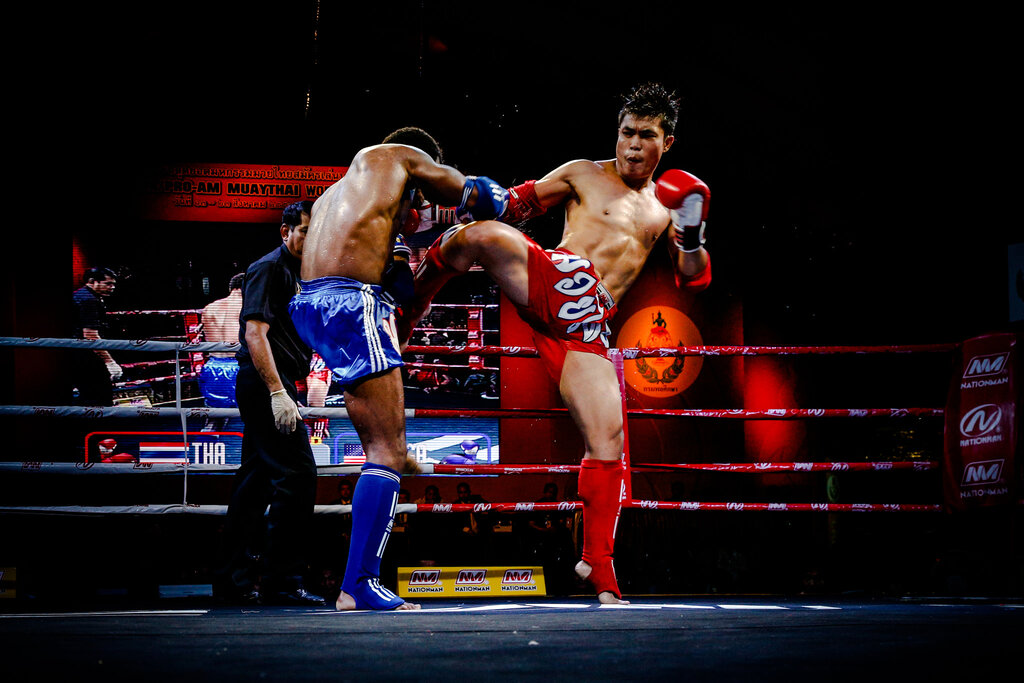
The connection to the floor is critical. This is where ground reaction force comes into play. For every action, there is an equal and opposite reaction. By pushing forcefully into the ground, the fighter receives an equal force back, which provides the anchor and initial momentum for the rotation. It’s this fundamental principle of physics that allows a fighter to generate force far exceeding what their leg muscles alone could produce.
The Karate Kick
Karate, particularly styles like Shotokan, approaches kicking with a different philosophy: speed, precision, and quick recovery. The power comes from a whip-like "snap" rather than a heavy swing. This begins with chambering the kicking leg—bringing the knee up high and tight to the chest. This position acts like a compressed spring, storing potential energy.
From the chamber, the lower leg extends explosively toward the target, striking with the ball of the foot or the instep. Almost immediately after impact, the leg is retracted back to the chambered position. This rapid extension and retraction is the essence of the snap. A key component to maximizing this snapping force is Hikite—the pulling hand. As the kick extends, the opposite hand is pulled back sharply to the hip. This counter-movement helps rotate the hips faster and stabilizes the upper body, adding extra velocity to the kick.
For example, our data indicates that the typical Karate and Taekwondo snap-like kick is based heavily on rapid knee extension, while Muay Thai uses a technique that places greater emphasise on COM movements to develop high impact forces.
This method prioritizes hitting a target quickly and returning to a stable defensive stance, minimizing the window for a counter-attack. The trade-off is a reduction in raw impact compared to the Muay Thai roundhouse, but the gain in speed and safety is significant.
Stance and Stability
A fighter's stance is the foundation for all power generation. It directly influences their center of gravity and ability to use the ground effectively. Karate often employs wider, deeper stances. This lowers the center of gravity, creating a highly stable base. From this stable platform, a practitioner can push off the ground with maximum force to initiate a linear or snapping technique. However, this stability comes at the cost of mobility.
Muay Thai fighters, by contrast, typically use a narrower, more upright stance with their weight slightly forward. This higher center of gravity makes them less rooted but far more mobile. It allows for the rapid hip rotation needed for powerful roundhouse kicks and facilitates quick defensive footwork and the ability to check incoming leg kicks. The choice of stance is a constant negotiation between the need for a stable power base and the need for fluid movement.
| Feature | Muay Thai Roundhouse | Karate Snap Kick |
|---|---|---|
| Primary Goal | Maximum impact and damage | Speed, precision, and quick retraction |
| Striking Tool | Shin | Instep or ball of the foot |
| Power Source | Full body and hip rotation | Rapid knee extension (snap) |
| Kinetic Chain | Rotational swing, like a bat | Linear snap, like a whip |
| Retraction Speed | Slow | Fast |
| Typical Stance | Narrow, mobile, upright | Wide, stable, low center of gravity |
Ready to test your understanding of how these powerful techniques work?
According to the principles of the kinetic chain, where does the power for a powerful martial arts strike originate?
What is the primary mechanism that generates power in a Muay Thai roundhouse kick?
Understanding these biomechanical differences shows there's more than one way to generate force. Both arts have optimized the kinetic chain for their specific strategic goals—one for overwhelming power, the other for lightning-fast precision.